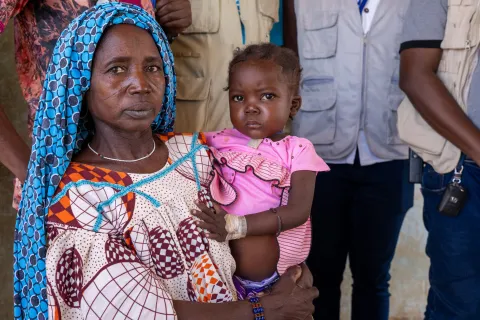
“I would love to have a beautiful and healthy baby.”
Taken daily during pregnancy, MMS is 13% more effective in reducing low birth weight than iron and folic acid supplements alone.

- Français
- English
Odile Konkobo, 25, is a considerate and responsible pregnant woman. Since the start of her pregnancy, she has regularly gone to the Ziniaré health center, in the Plateau-Central region of Burkina Faso, for her prenatal consultations. She follows the wise advice of the midwife.
“I regularly go to the health center to listen to the midwife’s advice. She gives me medicine that has vitamins to protect me from anemia and gives me blood. I practice hygiene at home to be clean, and I put away some clean clothes while waiting for the day of my delivery,” she confides.
The tablets Odile is referring to are multiple micronutrient supplements (MMS). They contain 15 essential vitamins and minerals are a safe and effective way to improve the diets and nutritional status of pregnant women. Taken daily during pregnancy, MMS can improve women's anemia, and is 13% more effective in reducing low birth weight than iron and folic acid supplements alone. For women who are underweight and anemic, the benefits of MMS are even more visible, with a 19% reduction in low birth weight.
In the Ziniaré health district, a dedicated midwife guides pregnant women. “What makes me proud in my work is first of all helping a woman to get pregnant, following her until she gives birth, so that she has a healthy child, and that she too is, in good health,” underlines Colette Compaoré, health worker at the Ziniaré health district.

In Burkina Faso, the prevalence of anemia is high among women of childbearing age, including pregnant women. According to the Demographic and Health Survey (EDS 2021), 56% of women aged 15 to 49 suffer from anemia.
“Since MMS are available, there are no longer low birth weights. Before, there was too much anemia. But with these tablets, cases of anemia among pregnant women have significantly decreased,” explained Ms. Compaoré.
Community-based health workers strengthen women’s adherence to MMS

Community-based health workers known as ASBC in Burkina Faso conduct close monitoring and help ensure strict adherence to MMS, for the health of the mother-to-be and her unborn baby. “We follow up to see if the women are actually taking the products that the health workers give them,” says Adeline Ouédraogo, ASBC in Ziniaré. Advice given is not limited to preparations for pregnancy, but also extends to the importance of using the micronutrients: “We show pregnant women that it is important to take MMS correctly, 1 tablet per day until delivery and 1 tablet per day for a period of 45 days after delivery. We also show those who have just given birth how to take care of the newborn,” underlines Ouedraogo who ensures babies and mothers have good health for a prosperous community.

With the support of the Bill and Melinda Gates Foundation (BMGF), UNICEF supports the Ministry of Health in multiple micronutrient supplementation for pregnant women. From August 2021 to December 2023, 140,940 pregnant women received MMS tablets during antenatal care in two health districts of Yako and Ziniaré, in the North and Central Plateau regions.
MMS play a fundamental role in fetal development and help prevent malformations. They include 15 micronutrients including iron and folic acid which help cover the iron needs of pregnant women to prevent anemia. MMS strengthens the immune system of women, protecting them against potential infections during pregnancy. After delivery, multiple micronutrient supplementation continues helping to provide essential nutrients to the baby through breast milk for growth and development.
Supported and encouraged by her husband, Odile continues to take MMS daily since the start of her pregnancy. She is hopeful that her child will be born healthy.
“I would like to have a beautiful baby with a normal birth weight. I want him to become a big personality later, to take good care of us,” concludes Odile.