Second Chance Schools Rebuild the Future of Displaced Children in Djibo
Children enrolled in the SSAP programme quickly excel and achieve strong results once integrated into the regular school system.

- Français
- English
“We’re happy to be here because we’ve resumed classes.”
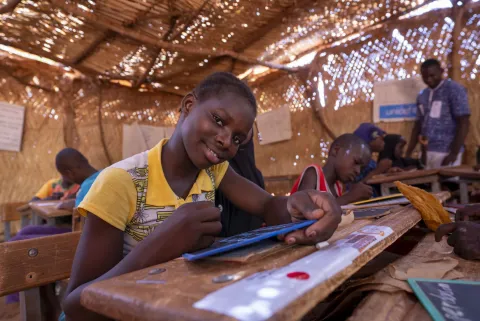
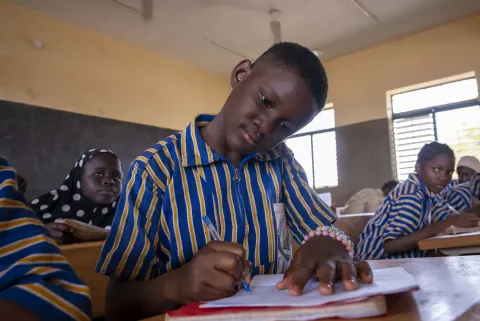
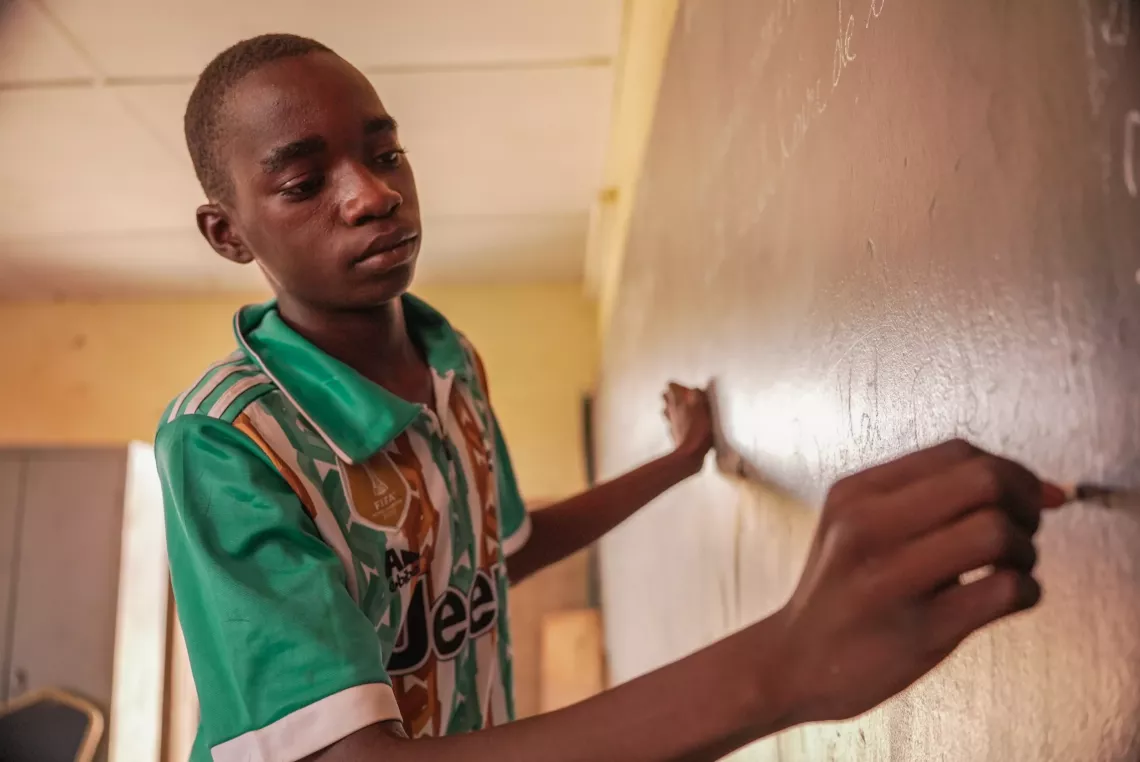
Tamboura Mahamadou, a 12-year-old displaced boy, is now in a regular CM2 class. Originally from Firgindi village in the Sahel region, he had never attended school before his family was forced to flee. He was enrolled for the first time in a class in Djibo through the Accelerated Learning Strategy – Passerelle (SSAP). “We were first taught Fulfulde, then French. We had lessons in math, literacy, history, geography, and science,” he proudly recounts.
Today in Djibo, Mahamadou continues his education in a formal school after having crossed the bridge that allows for out-of-school or dropout children to be re-enrolled.
A Tailored Response in an Emergency Context
With a security crisis that led to the closure of many schools in the Sahel region, SSAP offers a vital solution. “The region already had a high number of out-of-school children even before the crisis. The crisis worsened the situation,” explains Hamadou Diallo, UNICEF education specialist.
“Thanks to SSAP, children are enrolled in second chance schools and can transition to formal schools after one year of learning,” he adds.
The education and child protection programme implemented by UNICEF and its partner NGO SERACOM, with support from the European Union, is built upon close collaboration with state services and child protection actors. “Children need a minimum level of protection. That’s why we work with SERACOM to quickly redirect them to schools,” continues Diallo.

A Second Chance to Dream Again
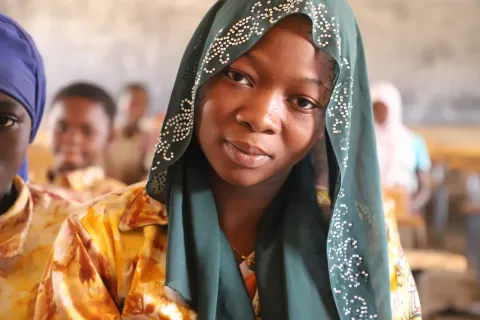
“When I grow up, I want to become a teacher,” says Safiatou Tamboura, 12, who is also displaced like Mahamadou. “The bad guys told us to leave, or they would kill us,” she says. After fleeing, she found stability through education. Today, she is learning to read, write, and express herself in Fulfulde and French in her first year of SSAP.

For parents, changes are visible.
“When we arrived, our children couldn’t read or write, let alone use a phone,” says Tamboura Hamadoum, a parent in Djibo. “Now, thanks to SSAP, they can read and they help me use my phone.”
The results of UNICEF’s education and child protection programme are blatant. During a visit in April 2025 to Djibo—a city marked by insecurity and mass displacement—UNICEF education officers and a European Union team visited second chance schools that are restoring hope to thousands of children.
Funded by the European Union with €1.1 million, the initiative aims to provide learning alternatives and protective support to 9,885 children aged 5 to 18 in highly insecure areas.
Visible Impact in Schools
At Djibo’s Sector 3 school, Director Barry Aboubacar confirms the programme’s impact.
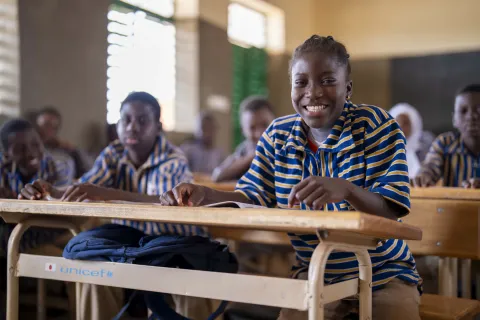
“We received 57 transferred learners. In CM1, the top student is one of these transferred children,” he says. Despite some challenges—insufficient documentation, training yet to be completed for some teachers—progress is evident: “Some children are even outperforming our long-time students.”

Konfé Boureima, head of the basic education district, also praises the approach. “It helps recover children, put them back on the path of the school system to help them build their future. SSAP must be funded because it gives a second chance to those wandering the streets,” he says.
Developing Social Skills and Restoring Confidence
Beyond schooling, the programme takes into account the child’s overall environment. At child-friendly space VIP in Djibo, lead facilitator Fadima Yasmine Aboubacar supervises children by age groups. “From 0 to 5 years, we enroll children in the Bissongo system for early childhood development. From 6 to 12, we raise awareness on child rights, protection, and mine-related risks. From 13 to 17, we discuss menstruation and after two years, we guide them to vocational-training centres,” she explains.
Even children with no educational background develop social skills and regain confidence. Some adolescents and young people aspire to careers in sewing or hairdressing.
“With awareness-raising sessions, introverted children begin to open up. We offer them initial guidance despite limited resources,” she says.

The 24-month education and child protection programme was launched in September 2024 and covers eight communes of Pama, Kompienga, Matiacoali in the East, Pensa and Barsalogho in the Centre-North and Djibo, Arbinda, Sebba in the Sahel, where basic services are extremely limited. —areas with extremely limited basic services. In addition to educational activities, the programme provides psychosocial support, learning materials, birth registration assistance, as well as exploitation or abuse case management. Community members and humanitarian actors also receive training on security risks and child protection.
“Education saves lives. We thank the European Union for its support and call on all partners to help displaced children like Mahamadou and Safiatou continue learning, dreaming, and building their future,” concludes Hamadou Diallo.