IT Girls in Cazin: “Despite prejudice – keep on!”
Lea, Erna and Meldina transferred their IT Girls experience from primary school to their secondary school and helped with the formation of the IT Girls Club.

- Bosanski/Hrvatski/Srpski
- English
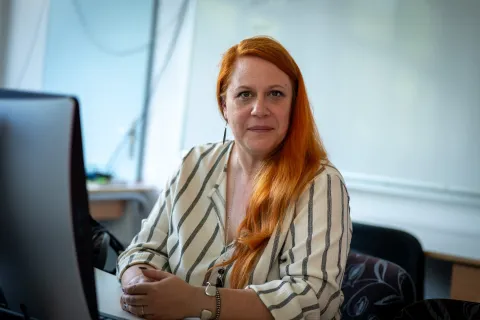
When mathematics and computer science teacher, Jasmina Durić, launched the IT Girls Club last year at the Cazin Gymnasium high school and asked if anyone had experience in programming, first year students Erna and Melina, and a second year student Lea, with years of experience acquired in the IT Girls Club at their Cazin II Elementary School, stood up.
“In October of 2023, I completed a training course within the project “IT Girls are coming to your schools” and started forming the IT Girls Club in our school. Several girls showed interest, but what made things easier for me was that three of them were already part of it in their primary school”. Honestly, they had more experience with Arduino than me”, professor Jasmina said, recalling the beginning of the IT Girls Club, which today gathers approximately 15 girls and one boy.
“I was learning while I was working with my students and I am glad that I had this kind of approach, where the professor is not the only one teaching. I think that if we keep spending time together, we will have even more opportunities to learn from each other. The girls have a lot of experience, they participated in last years IT Girls Clubs fair, where they saw many other projects and met a lot of people from other schools, so I am very happy to have them with me. The other girls, members of the IT Girls Club are constantly coming up with some new ideas on how to use Arduino in everyday life and they pleasantly surprise me each time”, the professor added.
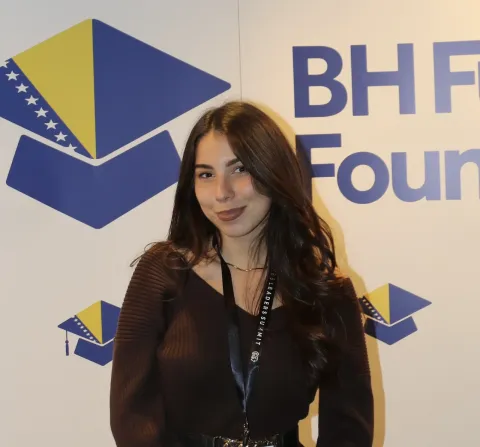
Lea, a second year student at the Gymnasium, says that she has always been interested in programming and robotics and that she enrolled as soon as she heard that IT Girls Club would be founded in the elementary school. During her first year in high school, the IT Girls Club didn’t exist, but when she heard that it would be formed there as well, she was thrilled:
“We have better equipment in Gymnasium than we used to in the elementary school, and we have agreed on the projects that we would like to implement, on what kind of materials we need, and we are working”.
Erna was programming even before she joined the IT Girls Club in elementary school. She was taking private lessons and when she heard about the IT Girls Club when she was in the ninth grade, she said it was logical for her to apply.
“I have always been curious about how things work, how a computer and other things work. Often, the only way for realizing some of my ideas is through programming”.
Meldina learned about the IT Girls Club in the ninth grade when she transferred from another school to the Cazin II Elementary School.
“There was no IT Girls Club in my school and when I changed school in the ninth grade, I joined the Club as soon as I learned about it. I have been interested in programming for quite some time but in my previous school we didn’t have a computer science section or an IT Club, so I was never given the opportunity. I immediately liked the idea of presenting the IT industry to young girls and giving them an opportunity, so I decided to join the Club,” Meldina said.
Currently, they are working on their first joint project in their IT Girls Club in the Gymnasium, called “Smart Garden”.
“With the school headmaster, we came up with the idea of creating a smart garden, which can help plants. If, for example, the soil is lacking moisture, the Smart Garden should activate the pump designed to automatically release water until the desired level of moisture is reached. We will try to apply this in a real situation and install it in a garden or a greenhouse to see how it works” Lea, Erna, and Meldina are announcing further plans:
“Our ultimate idea is to build a small greenhouse within our school but until that happens, we will use the greenhouse of one of our classmates and will probably test our design there. We can upgrade the design with more plates and do advanced metering of temperature, humidity, and air pollution as well, or have the light-activated when someone passes by, to detect if an animal enters the greenhouse…” the girls explained while showing how the system works via sensors and Arduino plates.


They are planning to present their work at the IT Girls fair on April 25th in Tuzla. They recalled the 2023 fair in Sarajevo, where they presented a digital watch and a video game, spent time with other girls from clubs from all over Bosnia and Hercegovina, and exchanged ideas:
“When you realize that you are not the only one interested in these topics, that you have something in common with other cities in the country, or that so many young girls have the same interests as you, everything becomes easier. We made a lot of new friendships, and a year later, we are still in contact with some girls that we met back then.
Emir Omerović is the teacher who leads the IT Girls Club at the Cazin II Elementary School and when he visited the Cazin Grammar School as a master educator for Una-Sana Canton, he was happy to see that girls from the Club were still actively working.
“I spoke with their professor, at the beginning she didn’t know how much they knew but she soon realized that she had an advanced group of girls with solid programming knowledge”, the teacher said and added that the IT Girls Club that he leads at the elementary school is still active:
“Through the IT Girls Clubs, girls can learn a lot and at the fairs, they can see how other girls are working, which can motivate them further. They can also show what they know when starting high school, just as Lea, Erna, and Meldina did, and this can certainly be useful for their enrolment in the university as well”.
Enes Škrgić, the headmaster of the Cazin Grammar School says that he used to teach computer science and is amazed with the idea and the work of the IT Girls Club, adding that the school is considering expansion of the activity so girls can work better with improved quality:
“Our challenge now is to prepare the space where they can work and we will do our best to have our laboratory available to them, with the necessary equipment – from soldering iron to various instruments – so they can complete whole projects. It would be also good to get a 3D printer in the foreseeable future, which the girls could use to complete some of their projects. They have very interesting ideas; they attended fairs and saw other schools’ projects. Their proposals and things they would like to do are really fascinating”, the headmaster said and added that the computer science curriculum should now incorporate all this.
He emphasizes that while he was teaching, he had one generation that worked with Arduino, an enthusiastic group of students, but they were mostly boys:
“I am fascinated by the fact girls are now joining the club and I must say that this is a commendable project because it serves to break the stereotypes and show that girls can equally share IT space. I am glad that girls from elementary school with good basic programming skills joined us.
Lea says that she was motivated to join the world of programming by the fact that there are not many women in the world of programming, so she wished to be a part of a team that would attract as many women to the IT sector as possible. Erna says that although she was told that programming was not for girls, she never thought of quitting:
“If I had quit when people told me to stop, I probably wouldn’t be where I am now”.
Medina concludes that women in the IT sector have to be more present and more heard:
“In general, I have very strong opinions on feminism, and considering the number of problems that women in the IT sector and generally in all fields encounter, I think that we need to raise our voices, fight for our rights and that we all need to work on this. Women belong to the IT industry, everyone does, and we definitely work better when we are together. Despite prejudice – keep on,” says Meldina, who hopes to continue programming in the future and will probably enroll at the Faculty of Electrical Engineering
Erna has already visited the Faculty of Electrical Engineering when her bother was enrolling, but she says that she has four more years to decide what to do next, whereas Lea is planning to study medicine.
“I think I will continue programming even if I enroll in medicine. I would like to do training courses for young people, especially girls, and encourage them. I am interested in the potential application of IT in medicine”.
Professor Jasmina Durić thinks that is extremely important for girls to have such a club:
“The aim of this initiative is to make girls more confident when it comes to the IT sector. Because there were so many prejudices, the IT sector was always more associated with men, despite the fact that the first programmer ever was a girl, but many are unfamiliar with this part of history”, Professor said, adding that she would have been happy if something like IT Girls Club had existed when she went to school:
“If I had the club and the opportunity to work with such kind of equipment, I think I would have been more into this field instead of mathematics, although I love both those fields. Computer science, or programming, presented in this way is much more attractive than the classical programming we teach in the second grade as per the curriculum. It would be good to incorporate this model into formal school curriculum because the computer science curricular reform demands it”.
The IT Girls is a joint initiative of UN agencies (UNICEF, UNDP, and UN Women) aimed to help overcome obstacles that women and girls encounter and to promote their engagement within the Information and Communications Technology (ICT) sector in Bosnia and Herzegovina. At this moment, over 700 girls and 200 boys in more than 100 elementary and high schools are actively involved in IT Girls Clubs as an extracurricular activity.