International Day of the Girl Child Marked in Sarajevo

- Bosanski/Hrvatski/Srpski
- English
Sarajevo, 14.10.2025; Under the slogan "The Girl I Am – The Change I Lead," the International Day of the Girl Child was marked today in Sarajevo, organized by UNICEF Bosnia and Herzegovina. The event brought together girls, teachers, the academic community, civil society, institutions, and the private sector with the aim of jointly reviewing the progress and challenges girls face in realizing their rights.
The UN Resident Coordinator in Bosnia and Herzegovina, Arnhild Spence, emphasized that girls in Bosnia and Herzegovina and around the world demonstrate exceptional resilience, courage, and leadership abilities every day:
"It is important that we are here today – because we are bringing together evidence and voices. I know that with us are researchers, policymakers, representatives of the business community, civil society, and young people themselves – to jointly determine what works and how we can improve and scale it up. We want girls' participation in decision-making to become permanent and for education to lead to real opportunities, while simultaneously demanding inclusion. Inclusion is not a privilege – it is a right. As we listen today to the research results, discussions, and voices of girls, let us commit to incorporating what we learn into strategies, budgets, and everyday practice. Because when we invest in girls – we invest in stronger communities, smarter economies, and a more just, peaceful society."
The Deputy Representative of UNICEF in Bosnia and Herzegovina, Alexandra Illmer, reminded that investing in adolescent girls means shaping a generation of women who will lead tomorrow's society.
"Although we are witnessing significant progress, girls still face deeply rooted stereotypes, unequal access to technology, and mental health challenges. Only 46% of girls aged 15 to 19 in Bosnia and Herzegovina feel confident using computers, compared to 66% of boys. This shows that digital inclusion is not just a matter of access, but also a sense of belonging," said Illmer, adding that girls want to learn, lead, and be heard – but they need opportunities, support, and a safe space to achieve this.
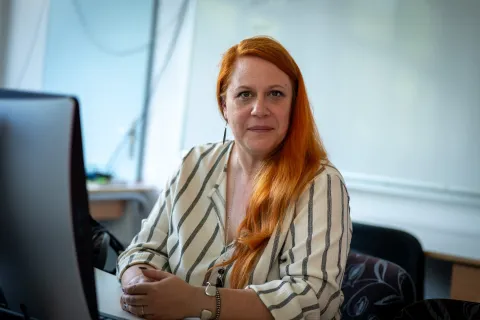
In her opening address, Prof. Zilka Spahić – Šiljak from the Gender Resource Center at the University of Sarajevo stated that while a huge civilizational leap has been made in the past period regarding human rights, the problem of culture, society, mindset, and social responsibility remains.
"The Day of the Girl” is a time when we need to remember not only what girls are marking and celebrating during this period, but that girls also have great potential, ambitions, and their own dreams that we need to enable them. And then it is important to ask ourselves what kind of society we live in, in what context. Girls are not less capable or less talented. They just need to be encouraged and given space, because I believe they can do amazing things if we support them. Today is a day when we celebrate your dreams, ambitions, and talents, but also to be aware of our responsibility to help you achieve all of that."
During the event, research findings on the status of adolescent girls were presented, including a study on the impact of IT Girls clubs and the implementation of girls' empowerment programs. Participants, along with representatives from the UNICEF Business Advisory Council, discussed in group discussions the inclusion of girls in decision-making processes, support for marginalized groups, and ways to turn successful practices into permanent programs and policies.
The panel discussion included representatives from institutions, civil society organizations, and the private sector, among them the Agency for Gender Equality of BiH, the Federal Child Council in BiH, the BIH Association for Child and Adolescent Psychiatry and Allied Professions, the humanitarian organization Genesis, the NELT Group, and UN Women BiH. Participants highlighted the importance of gender equality, education, and creating a support system for girls in Bosnia and Herzegovina.
The event also aims to encourage joint action by all partners in strengthening gender equality, creating a safe and supportive environment for girls, and scaling up successful support models like the IT Girls and UPSHIFT programs. It was emphasized that it is essential to continue working on four key priorities: quality education, mental health support, an effective system for protection from violence and discrimination, and data-driven policies that make all girls visible – especially those from Roma and rural communities and girls with disabilities.
Media contacts
O UNICEF-u
UNICEF djeluje u nekim od najugroženijih područja na svijetu, kako bi obuhvatili djecu iz najranjivijih kategorija. Širom 190 država i teritorija, mi radimo za svako dijete, bilo gdje, kako bi sagradili bolji svijet za sve. Mi nikad ne odustajemo.
Za više informacija o UNICEF-u i našem radu za djecu, posjetite www.unicef.org.
Pratite UNICEF u BiH na Twitter-u, Facebook-u, Instagram-u i Youtube-u