“The Girl I Am – The Change I Lead”
“Girls are not less capable or talented; they just need more encouragement and space,” was the message at the event held in Sarajevo to celebrate the International Day of the Girl Child.

- Bosanski/Hrvatski/Srpski
- English
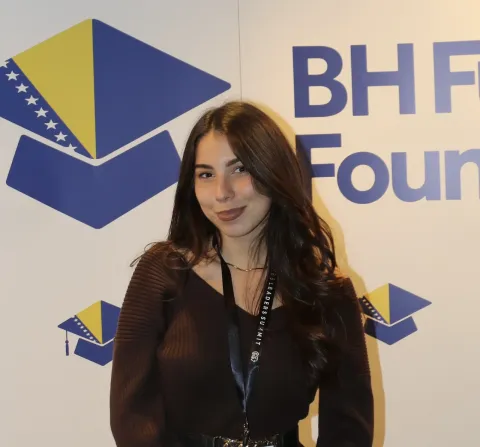
Asja Bulbulušić from the “Muhsin Rizvić” Gymnasium in Breza says that the arrival of the ITGirls club at her school changed her perception of girls and women in science, technology, engineering, and mathematics (STEM):
“Through my participation in the ITGirls club, I realized that I do belong there – that girls and women can equally take part in STEM fields and show their knowledge. I’m grateful to the IT Girls initiative, Laboratorium, and UNICEF for giving me and other girls across Bosnia and Herzegovina the opportunity to work and develop our skills – not only in programming and robotics but also in mathematics and physics,” said Asja Bulbulušić at the event held in Sarajevo to mark the International Day of the Girl Child.
“Now I have the chance to educate other girls. My goal is to one day be a role model to someone and inspire other girls to get involved, to learn, and to focus on their own growth and careers. Two things that no one can take away from you are your education and what you experience through travel. But above all, focus on education,” she said at the event in the Children’s House in Sarajevo, organized by UNICEF Bosnia and Herzegovina to mark the International Day of the Girl Child.
Held under the slogan “The Girl I Am – The Change I Lead,” the event brought together girls and boys, teachers, representatives of academia, civil society, institutions, and the private sector to jointly reflect on progress made and challenges that girls still face in realizing their rights.
In her opening remarks, Professor Zilka Spahić–Šiljak from the Gender Resource Center of the University of Sarajevo said that while major progress has been made in human rights, gender stereotypes remain deeply rooted in culture, society, and ways of thinking:
“Girls are not less capable or less talented. They just need a bit more encouragement and space, because I believe they can achieve great things if we support them. Today we celebrate your dreams, ambitions, and talents, but also remind ourselves of our responsibility to help you realize them.”
Speaking about the stereotypes and pre-imposed roles that girls and women face, Professor Spahić–Šiljak emphasized the importance of understanding the difference between gender and sex:
“It’s not surprising that many girls and boys today don’t know the difference – because our education system doesn’t include this kind of education. It’s only at university that we see courses dealing with these issues. But we should be addressing them from kindergarten and primary school onward.”


Deputy Representative of UNICEF in Bosnia and Herzegovina, Alexandra Illmer, reminded that investing in adolescent girls means shaping a generation of women who will lead tomorrow’s societies:
“Girls want to learn, lead, and be heard – but they need opportunities, support, and safe spaces to do so. Deeply rooted gender stereotypes continue to shape expectations – telling girls which professions are ‘appropriate,’ whose voices matter, and how they should behave. These patterns begin in adolescence – not because girls lack talent, but because they lack support, visibility, and opportunities. So let’s work together to ensure that every girl in Bosnia and Herzegovina has the chance not only to dream about her future – but to shape it herself.”
The UN Resident Coordinator in Bosnia and Herzegovina, Arnhild Spence, highlighted that girls in Bosnia and Herzegovina and around the world demonstrate remarkable resilience, courage, and leadership every day:
“We want the participation of girls and young women in decision-making to become the norm. We want to create inclusive societies and education that leads to equal opportunities for all. Inclusion is not a privilege – it is a right. As we listen today to the findings, discussions, and voices of girls, let us commit to integrating what we hear into national strategies, budgets, and daily practice. Because when we invest in girls – we invest in stronger communities, sustainable economies, and fairer, more peaceful societies.”
The panel discussion featured representatives from institutions, civil society organizations, and the private sector, including the Agency for Gender Equality of Bosnia and Herzegovina, the Council for Children of the Federation of BiH, the Bosnian-Herzegovinian Integrative Child and Adolescent Psychotherapy Association (BHIDAPA), the humanitarian organization Genesis, the NELT Group, and UN Women BiH. Participants emphasized the importance of coordination and collaboration across sectors to ensure access to quality services, inclusive education, and the labor market.
Indira Semanić, HR Manager at the NELT Group, said that the private sector can and should play a greater role in addressing and overcoming inequality – not only through internal processes but also through education, influence, and mentorship:
“Companies can address this challenge by ensuring equal treatment for all employees, giving everyone the same opportunities and conditions for advancement based on merit and performance – finding the best people for the best positions, regardless of gender.”
Joško Mandić from the Agency for Gender Equality of BiH pointed out that while there are many challenges that girls face, there are also mechanisms to overcome them:
“Research shows a range of problems girls encounter in society, and the question is how to address them and remove the barriers in their way. There is no need for those barriers to exist – the state has mechanisms to ensure a better life, better conditions, and equal opportunities that are your guaranteed human right. But you must know your rights in order to demand them,” he said.
Mersiha Zulčić from UN Women emphasized the need to empower women and girls – economically, and through strengthening their awareness and self-confidence.


Dr. Azra Arnautović from BHIDAPA reflected on the lack of adequate support services:
“A major issue is the lack of enough services and qualified, available professionals for adolescent girls facing problems. We also need to educate young people conceptually – many don’t even know what terms like ‘marginalized group’ mean. We need to support adolescent girls to be courageous and speak up with confidence.”
Mirsada Bajramović from the Council for Children stressed the importance of participation:
“At the Council for Children, we are here to listen to you, because your participation is crucial. You cannot work withand for children if children are not part of the process. That’s why listening to children and giving them a voice is key to all our activities and advocacy for your rights.”
Dijana Pejić from the humanitarian organization Genesis underlined the role of non-formal education as a partner to formal education:
“Alongside formal education, I believe in the power of non-formal education, which transforms us as individuals, especially during adolescence. Unfortunately, education systems in BiH still don’t recognize non-formal education as a partner. Until we all show its importance as a key tool for developing skills essential for the labor market, we won’t be fully ready for it.”
During the event, findings from research on the situation of adolescent girls were presented, including a study on the impact of IT Girls clubs and the implementation of empowerment programs. Participants, together with members of UNICEF’s Business Advisory Council, discussed the inclusion of girls in decision-making processes, support for marginalized groups, and ways to turn successful practices into lasting programs and policies.
The event also aimed to encourage joint action among all partners in strengthening gender equality, creating safe and supportive environments for girls, and expanding successful support models such as the IT Girls and UPSHIFT programs. It highlighted four key priorities: quality education, support for mental health, an effective protection system against violence and discrimination, and data-driven policies that make both girls and boys visible – especially those from Roma and rural communities and girls with disabilities.