How to Use E-Waste in the Classroom
Teachers from 12 cities gain skills for extracting and reusing e-waste components using Arduino

- Bosanski/Hrvatski/Srpski
- English
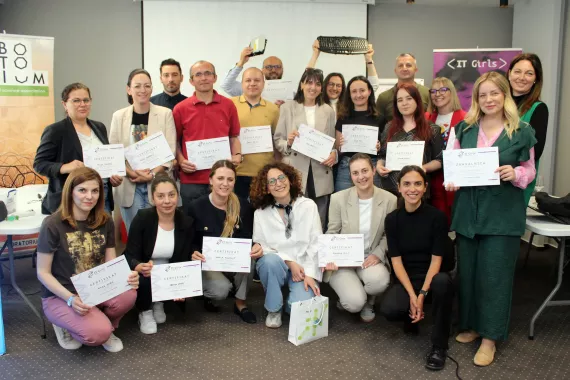
Teachers from 12 cities across Bosnia and Herzegovina attended a two-day workshop titled “Using E-Waste for STEM Arduino Projects,” organized within the “IT Girls” program. They acquired the knowledge and skills necessary to extract and reuse components from e-waste using Arduino and are now equipped to utilize existing e-waste in their schools for STEAM experiments in IT Girls clubs.
Valentina Vidović, an IT teacher at “Kiseljak” Primary School and a master educator at the workshop, said the participants demonstrated that parts from equipment stored in schools can be used for valuable projects:
“We often think of e-waste as garbage like any other, but that’s not really the case. This workshop proved that teachers can actually use many of these components. We showed how parts of old computers—like fans or keyboards—can be repurposed for different projects. Sometimes we lack certain parts and they’re hard to obtain, but today we learned that a simple fan, which can be pulled from nearly any device, can be very useful in teaching.”
“The goal of the workshop is to learn something new and, more importantly, to apply it in our classrooms using the equipment already available in schools. To recognize the potential of what we usually throw away,” added another master educator and a professor at the Electrical Engineering School in Tuzla.
The workshop for teachers, “Using E-Waste for STEM Arduino Projects,” was supported by UNICEF BiH, the UN, and NeltGroup, and was delivered by the “Laboratorium” Association in Tuzla.
“The idea to use e-waste through the IT Girls initiative emerged several years ago, and in 2022 we started mapping electronic devices in schools, recognizing the need to address the issue of e-waste. We found that there is no proper regulation on how it should be stored, disposed of, recycled, or reused. That’s how this learning process began, which I hope will open new perspectives, as e-waste holds great potential for educational use,” said Amila Madžak, UNICEF BiH’s Youth and Adolescent Program Lead, at the workshop’s opening. She added that this is part of a new, innovative component of the IT Girls program integrating new content.
Katarina Vokić, a teacher of technical culture and physics at “Fra Stipan Vrljić” Primary School in Sovići near Grude, said that IT Girls has been active at her school for two years and that the workshop gave her valuable insights:
“What we learned at the workshop will definitely be applied. Practical work is always needed, and the children will love this. We already use existing equipment at school, but now we’ll be able to supplement it with e-waste components we already have.”




Fuad Harčin, an IT teacher at “Meša Selimović” Gymnasium in Tuzla, believes the concept of using e-waste introduced at the workshop can significantly improve teaching:
“A new way to connect what we’ve been doing with things we usually throw away. When I return, I’ll check what kind of e-waste we have—some old computers and equipment—and see what can be reused.”
Ivana Kovačević, a primary school teacher at the Tenth Primary School in Bijela, Brčko District, said she always learns something new at IT Girls workshops, particularly how to involve younger students in such projects:
“In our school, I co-lead the IT Girls club with the IT teacher, where both younger and older students work together. I’m taking home many new ideas on how to repurpose e-waste that’s been gathering dust in school storage but actually holds great potential.”
Indira Selimagić, HR Manager at NeltGroup, said the company is proud to support such initiatives through its partnership with UNICEF:
“We’re glad to have recognized the value of this project and to be collaborating with UNICEF. We know the resources are going to the right place and will produce real results. In this digital age—and in our digitized workplace—we see how important and necessary these skills are. We believe projects like this should start early, even in primary school.”
The workshop, held at Hotel Terme Ozren, is part of ongoing efforts to innovate the IT Girls methodology for elementary and high schools by incorporating e-waste. The goal is to empower and equip at least 40 teachers from 10 elementary and 10 secondary schools across the Federation of BiH and Brčko District participating in the “IT Girls Are Coming to Your School” project.
As part of the e-waste mapping process, Laboratorium will work with educators to develop a methodology for mapping e-waste in participating schools and create ten new or revised IT Girls curriculum units on using e-waste with Arduino. These will be added as annexes to the Arduino manuals for elementary and secondary schools. Ten video tutorials based on these lessons will also be created and integrated into the IT Girls learning platform, with the exercises shared across all existing IT Girls clubs.
The IT Girls initiative is a joint effort by UN agencies (UNICEF, UNDP, and UN Women) aimed at overcoming the barriers and limitations girls and women face in the ICT sector in Bosnia and Herzegovina.