Children at the Centre of Disaster Risk Reduction
Through a simulation exercise, children and grown-ups in Mostar demonstrated how a jointly developed rescue plan works in practice

- Bosanski/Hrvatski/Srpski
- English
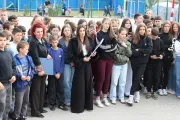
At the signal given by school principal Anđelko Rogić with a hand-held school bell, 180 pupils of the “Bartola Kašića” Primary School in Mostar quickly and calmly made their way to the safe assembly point in the schoolyard.
A simulation exercise is underway, demonstrating evacuation and rescue procedures in the event of an earthquake that causes a fire in the boiler room. It is being conducted as part of a joint programme “Disaster Risk Reduction for Sustainable Development in Bosnia and Herzegovina” supported and funded by the Government of Switzerland, the United Nations (UN) and the authorities in Bosnia and Herzegovina. The programme is implemented by UN agencies in BiH: the UN Development Programme (UNDP), the UN Children’s Fund (UNICEF), the UN Educational, Scientific and Cultural Organization (UNESCO), and the Food and Agriculture Organization of the UN (FAO), in partnership with domestic government institutions.
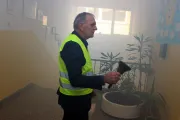
Following the principal’s signal, school staff members blow whistles in the corridors to sound the alarm, while the children, after spending a few seconds sheltering under their desks, follow their teachers’ clear instructions and make their way in an orderly manner through the smoke-filled corridors towards the exits, in accordance with the clearly established evacuation plan. A roll call is conducted at the assembly point, while firefighters, emergency medical services and police, who have secured access to the school, have already arrived in the schoolyard.
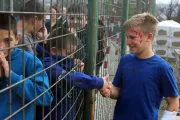
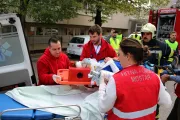
The roll call establishes that Mitar, a seventh-grade pupil, has been left injured in classroom number 19. The principal informs the firefighters, who set off to reach him, while a team from the emergency medical service waits outside the school to provide assistance. From a safe distance at the assembly point, the children watch the entire operation with great interest, including the carrying out of the “injured” pupil, who receives emergency medical assistance in front of the school, with the support of the Mostar Red Cross Protection and Rescue Service.
“It was interesting, but also educational, because it is important for children to know how to behave in situations like these. We talked about what everything would look like, they put make-up on me and applied bandages to make it all realistic, and I’m glad everything went as it should. There was no fear, the firefighters reacted excellently and carried me out, the emergency medical team received me really well, asked me about my ‘injuries’ and put me in the vehicle,” Mitar told us, sharing his impressions.
The exercise was also observed by Marija, a sixth-grade pupil and member of the children’s DRR team (Disaster Risk Reduction), who was pleased with how everyone responded in an exercise for which they had prepared seriously through training sessions, meetings and their joint contribution:
“It is very important that children take part in everything and that we can give our opinions. I think we should have more exercises like this in schools, because earthquakes, fires or floods can always happen. We identified fire as one of the greatest dangers to our school.”
Following the roll call at the assembly point, Marijana Hrkač, a teacher of IT and technical education, said that exercises like this were important so that everyone could be better prepared together in the event of an accident:
“It is important that we have some basic arrangements in place and know exactly how to behave when something happens. It would be good and useful if exercises like this were held regularly.”


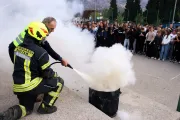
After the exercise ended, the firefighters demonstrated the use of a fire extinguisher to the children gathered at the assembly point and, together with the principal, extinguished a controlled fire. The children received basic information about what the extinguisher is used for, how to use it to put out fires in their initial stages, and when and how to move away from a fire safely.
“We arrive when things are at their worst. We are ready and have our own plan and procedures that we follow, but rescue operations are certainly made easier when we arrive at an institution that also has its own plan and where everyone knows how they should behave. It is useful for children to know how they should act, as well as for staff members, and for them to have seen today how a fire extinguisher is used, so that they can learn how to prevent a fire from developing,” says Mario Ćosić from the Mostar Professional Fire Brigade (PVP). Antonio Udundžić from the Mostar Emergency Medical Service shares a similar opinion:
“For children, this is an excellent way to practise and learn how to remain calm while evacuating, and the procedures for doing it correctly. It is also useful when staff members are trained in providing first aid.”
Principal Anđelko Rogić made no secret of his satisfaction after the exercise was completed:
“There was no panic or ‘commotion’, nobody tripped, everyone knew what they had to do and acted accordingly, which means that everyone took on board the advice we gave them before the exercise. There are always details that need to be improved, and we will work on that in the coming period. Every job carries responsibility, including that of a school principal, which is why it is important to me that we have a plan and do everything we can to ensure that, when the moment comes, the children are evacuated as quickly as possible, that they know how to get out, where the assembly point is, that they recognise warning signs and know everything else that is necessary. And it is easier to be a principal in a school like that.”
Teacher Nikolina Galić, who, together with the principal and the other members of the working group, had spent more than six months preparing the exercise, was also satisfied with the results:
“You can see that they are prepared, and if something happens, the children will at least retain a useful skill. Regardless of where a potential accident might occur, they will have the basics and know how to behave. It is useful for the school to have a rulebook and training sessions, which will now be held regularly following this exercise, because this needs to be passed on to future generations as well. It would also be good to involve the lower grades,” she says, adding that it is particularly important that the training was interesting for both children and adults:
“The children were working and contributing throughout the entire process, and we adults made our contribution too, because one cannot do without the other. I think that, ultimately, the exercise demonstrated cooperation among everyone involved.”
The “grown-ups’ representative” in the children’s DRR team was history teacher Ivan Marjanović, who also emphasises the importance of children’s participation:
“The children were active, and it was clear that they enjoyed everything. This is a good opportunity for them to learn. When the programme itself was being developed, the children’s opinions were particularly important, because, just as in the classroom, they notice certain things that we adults do not.”
Lamija Landžo from the Education Section at UNICEF BiH says that this kind of approach, which involves children, is particularly important in the whole process:
“Together with the school, UNICEF developed the ‘Child-Centred DRR’ methodology – Child-Centred Disaster Risk Reduction – which involves the active participation of children throughout the entire process. Through training sessions and activities within the programme, children were given the opportunity to identify potential hazards inside and around the school, as well as along the route between school and home. The idea is to develop a plan to improve school safety, with the child’s perspective at its very centre,” she says, adding that the idea is to use the evacuation simulation exercise to identify what went well and which details need to be improved:
“The result of the programme is that the school has its own plan and that everyone working at the school has stronger capacities to improve school safety. UNICEF is also in the process of procuring a set of equipment for the school that will provide additional support for implementing that plan.”
Child-Centred Disaster Risk Reduction (CCDRR) is an important part of UNICEF’s broader approach to child protection in Bosnia and Herzegovina, defined through “Key Action Area 3 – Protection”, which focuses on strengthening the resilience of children, families and communities, and ensuring continuous protection and support for children, including in situations involving crises, disasters and climate risks.