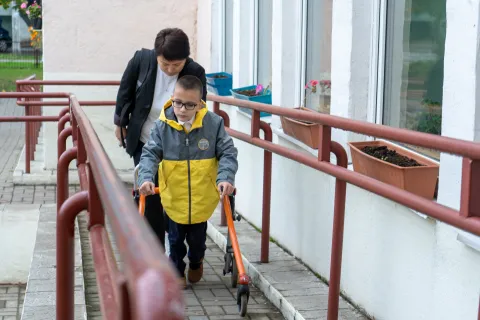
“Bullying? Not at My School”
Schoolchildren have shared their suggestions for adults on how to support a friendly environment free from violence and bullying.

- русский
- English
On 28 March, a youth forum dedicated to the issue of bullying was held. Around 50 schoolchildren from the project “Friendly and Supportive School Environment” gathered, alongside representatives of Youth Parliaments and UNICEF volunteers in Belarus. The project has been ongoing for five years, and now is the right time to hear adolescents’ recommendations on how to move forward.
The forum was organized by UNICEF in Belarus, together with the Institute of Psychology of the M. Tank Belarusian State Pedagogical University (BSPU).
Violence against children is a pressing issue worldwide, including in Belarus. According to the 2019 PISA study, 19% of schoolchildren in Belarus experienced bullying several times within a month. UNICEF’s 2018 study in Belarus found that around 11% of students in grades 5–7 and 11% of students in grades 8–11 perceive their school environment as unfriendly. Bullying—harassment by peers, senior students, or other members of the school community—is most often cited as the cause.
To help children cope with bullying situations or prevent them altogether, the project “Friendly and Supportive School Environment” was established. It is implemented by the Ministry of Education and the Institute of Psychology of the M. Tank Belarusian State Pedagogical University (BSPU), with support of UNICEF in Belarus.

The project was launched in 2020 as part of an educational experiment and is planned for five years. Its model has already proven effective in Europe. For example, in Croatia, it helped reduce school violence by half. By 2025, the project includes 43 schools from across all regions of Belarus. Over the five years, more than 17,000 adolescents and over 700 educators have participated.
Students, teachers, and parents work together to develop and implement projects and activities aimed at rethinking the issue of violence in schools, building skills for positive interaction, and creating a safe and supportive environment. When bullying exists in a school, everyone suffers — and it must be addressed collectively.
As the five-year project comes to an end, it is important to summarize its outcomes and hear children’s feedback, as well as their vision for the continuation of this work.
“This project has several unique features. One of them is that the driving force behind it is the children themselves,” Dmitry Shilin, Senior Child Protection Coordinator at UNICEF Belarus, told the youth forum. “It is therefore crucial to listen to how adolescents themselves perceive a friendly and supportive school environment. We adults tend to believe that we understand other people’s lives better over time and know what children need. That’s why this feedback is especially valuable — we can learn from you what adults need to do to make school comfortable and safe for you.”

At the forum, children and adolescents worked interactively to develop recommendations and proposals. These are “appeals” to adults responsible for ensuring a safe and healthy childhood, urging them to continue their work with consideration for the wishes of the younger generation.
“Our group developed recommendations for teachers,” shared Milana, a high school student. “For example, we emphasized that teachers should remain neutral in crisis situations and act as mediators who fairly resolve conflicts. Another recommendation is to take students’ complaints seriously, especially in cases of violence, so that these issues do not remain just talk but are addressed and resolved. One very important request is to make preventive sessions interactive. Often, we are gathered and given lectures, but information is not remembered well that way. It is better to use a playful approach so that children truly retain what they learn.”
Other recommendations from the children included avoiding public announcement of grades in class, introducing conflict resolution training at school (how to respond properly to difficult situations), and a comprehensive approach to bullying that addresses victims, witnesses, and perpetrators alike.
Additionally, the youth proposed creating a student council composed of about 10 elected senior students. This council could participate in discussing class issues and organize fair debates.

Another interesting idea was the mentorship of “newcomers” in the class. A child can often become a victim at school if they are new or if their friends have transferred to another school, leaving them isolated without support from classmates or the class teacher. In such cases, a peer mentor could be assigned to the newcomer to support them and explain the formal and informal norms and traditions of the new community.
The recommendations were developed not only by project participants but also by students from other schools.
“When we joined the Youth Parliament, we presented socially oriented projects. My project specifically addressed emotional and physical violence against children—in schools, families, sports clubs, and hobby groups,” shared Yaroslav. “I feel personally responsible for what happens around me. I have never experienced bullying myself, but my friends have been in such situations. I am currently studying at a school that, unfortunately, is not among the 43 pilot schools. Having now delved deeply into the project’s topic, I want to say that I fully support it. In the Grodno region where I live, we have all the conditions to implement this project in every school.”
All children’s recommendations will be documented and passed on to the decision-makers responsible for continuing the project. These are not just words on paper — they represent children’s vision of what a safe childhood should be and the steps and actions they expect from adults—parents, teachers, and school administration—in the context of preventing and addressing violence, bullying, and cyberbullying.