Building Hope and Resilience in Cox’s Bazar
UNICEF and the European Union are working together to support Rohingya refugee and host community children in Cox’s Bazar, Bangladesh.

- বাংলা
- English
In August 2017, violent attacks on Rohingya communities in Myanmar forced hundreds of thousands of them to flee across the border into Cox’s Bazar, southern Bangladesh. They joined the 300,000 refugees already living there, creating the largest refugee settlement in the world.


More than seven years later, one million Rohingya refugees in Bangladesh are still living in exile from their home country. Half of these refugees are children, and many have been born into this limbo. They rely entirely on humanitarian assistance and live in temporary shelters in highly congested camps, leaving them vulnerable to disease outbreaks, malnutrition, extreme weather, and gender-based violence, child marriage and child labour.

Since the beginning of the crisis, UNICEF has been on the ground responding to the needs of children and families from both the Rohingya refugee and Bangladesh host communities in Cox’s Bazar, thanks to support from the European Union. Below are some glimpses of this support.
Bringing adolescent girls to learning in the refugee camps
As Rohingya girls reach adolescence, barriers to education increase. Reluctance from parents to send their daughters to class once they reach puberty, harassment on the streets, and the distance between homes and learning centres are often cited as reasons for girls not attending classes.
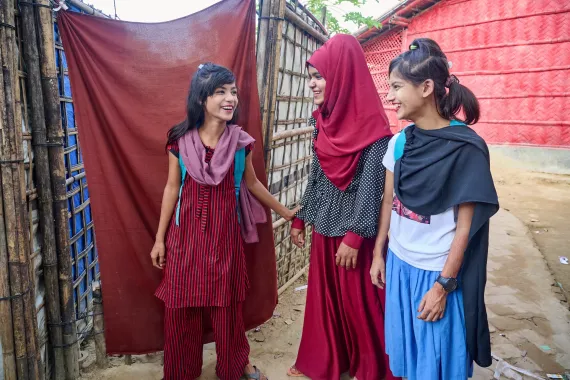


To make education more inclusive, UNICEF and its partners recruited female Rohingya volunteers to accompany girls to and from learning facilities to ensure their safety. Rahima, 20, is one of the 408 volunteers supporting girls’ education in the refugee camps. Her presence serves as a protective shield against harassment in a challenging environment, allowing the girls and their parents to feel secure.

Rahima remains with the girls while they attend class and follows up with families who do not send their daughters to school. As an advocate for girls’ education, she also helps promote education in the Rohingya community and serves as a role model for female students.
"The girls are like my little sisters,” says Rahima. “I want them to get an education so that they can become responsible adults and make something out of themselves.”

Thanks to female Rohingya volunteers, as well as the introduction of girls-only classes, parents have been more willing to send their daughters to learning centres. In the 2023-24 academic year, there was a seven per cent increase in the number of girls attending secondary education classes.
Empowering adolescent peer leaders to advocate for child protection
In the refugee camps, the number of children affected by violence, abuse and exploitation remains a significant concern. After arriving in Bangladesh, 15-year-old Anayet was forced to haul gas cylinders, rice sacks and bamboo stalks for other refugees to their shelters.

“I used to tell my parents that it was too heavy for me to lift and that carrying such heavy loads hurt my body,” Anayet recalls. “But my parents told me that we did not have any money and needed the help.”

Through community outreach by case workers, Anayet learned about the multi-purpose centres, which are supported by UNICEF with funding from the European Union. The multi-purpose centres provide case management services, psychosocial support, vocational training and adolescent clubs to teach life skills.


Anayet became a peer leader after joining an adolescent club at the multi-purpose centre and now works with case worker Salauddin to identify and stop cases of child labour, child marriage, child neglect and child abuse. He has successfully intervened in 20 cases of child labour and helped prevent one child marriage.
"I want to do good in life,” Anayet says. “I want to become a teacher. And I want to improve the lives of my entire family."
Improving nutrition through economic opportunities in the host community
In the Cox’s Bazar host community, malnutrition levels exceed the national average. According to a 2023 nutrition survey in Teknaf Upazila1 (subdistrict), over 22 per cent of children under five years old are stunted, or too short for their age. Around 13 per cent suffer from wasting, meaning they are too thin for their age, their immune systems are weak, and they are at higher risk of death.
Taiyba is one of 2,000 low-income women in Cox’s Bazar who participated in UNICEF’s Nutrition Sensitive Cash Plus Project funded by the European Union. Through the project, she received training in tailoring and poultry rearing to generate an income so that she could afford nutritious food to improve the diets of her family.


“I can give my children access to education and buy the materials they need to study,” says Taiyba. “My children are eating nutritious meals with meat, eggs, fish and homegrown vegetables every day, and I can provide proper clothing for them. We struggled a lot. But now, our situation is improving.”
________________________
1 UNICEF, Follow-up Smart Nutrition Survey in Ukhiya and Teknaf Upazila.
UNICEF expresses its sincere gratitude to the European Union for its continued support in providing safe water, nutrition, education, and child protection services for Rohingya refugee and host community children in Cox’s Bazar.