Nearly half a million Children in Bangladesh miss full immunization, despite 81.6 % coverage: Gavi, UNICEF, & WHO urge immediate action for equity
Immunization gaps persist in urban slums and hard-to-reach areas, calling for immediate, targeted action
- বাংলা
- English
Dhaka, April 28, 2025 - Marking the launch of the World Immunization Week 2025, UNICEF, WHO and Gavi, the Vaccine Alliance, warned that Bangladesh has made strong strides to increase immunization coverage, stark disparities persist, raising serious concerns on the situation of almost half a million children.
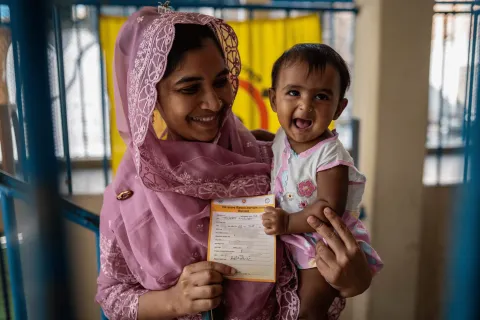
Despite the remarkable progress of the country's Expanded Programme on Immunization (EPI), around 400,000 children are under-immunized, and 70,000 (1.5%) have received no vaccines at all. The gap is wider in urban areas—only 79% fully vaccinated, with 2.4% zero-dose and 9.8% under-immunized— compared to rural areas with 85% coverage[1].
"Since the launch of the EPI in 1979, Bangladesh has made remarkable progress—raising the coverage of fully immunized children from just 2% to 81.6%. This success reflects Bangladesh´s strong commitment and the tireless efforts of partners, NGOs, and frontline health workers. But the final mile remains the hardest. Reaching every child and woman, especially in hard-to-reach and urban poor areas, demands renewed urgency, strengthened efforts, and increased investment,” said Stanley Gwavuya, UNICEF Representative OiC in Bangladesh. “UNICEF will continue its support to Bangladesh immunization programme to reach the last mile through the provision of technical support to planning, supply chain, cold chain, digital innovations and demand generation,” he added.
Bangladesh’s EPI is now saving an estimated 94,000 lives and preventing 5 million child illnesses each year— delivering an impressive $25 return for every USD 1 invested.[2]
However, challenges remain in reaching every child. Reaching the 70,000 zero-dose and 400,000 under-immunized children is critical, as they account for a large share of preventable child deaths in low- and middle-income countries. These children often face compound vulnerabilities such as poverty, lack of education, and poor access to healthcare. Challenges to reach full immunization such as human resource constraints, immunization gaps in urban slums, access barriers in hard-to-reach areas, and the upcoming transition from Gavi support meaning the Government will have to fully finance its national immunization program with domestic resources including, vaccine procurement, policy support, cold chain equipment and vaccine implementation, all require urgent attention.
“As we mark World Immunization Week, we reaffirm our commitment to promote, provide, and protect health through the power of vaccines—one of the most effective and life-saving public health tools. Bangladesh’s remarkable progress in immunization, even amid crises, reflects the strong leadership of the Ministry of Health and Family Welfare, the Directorate General of Health Services, and as well as the dedication of health workers, and support from the partners. This year’s theme, ‘Humanly Possible: Immunization for All’, reminds us of what we can achieve together. To reach every child, we must continue investing in innovation, outreach, and stronger health systems”, said Dr Ahmed Jamshed Mohamed, WHO Representative to Bangladesh. “WHO proudly stands with the Government of Bangladesh and partners to ensure equitable access to vaccines and a healthier, more resilient future for every child.” He added.
UNICEF has been a key partner in Bangladesh's immunization journey since its inception, supporting planning, supply chain management, vaccine procurement, data systems, and community engagement. Innovative tools for efficient real-time monitoring and self-registration are driving wider and more efficient coverage.
Gavi supports comprehensive routine immunization in Bangladesh, working with partners like UNICEF and WHO to combat diseases such as polio, measles, rubella, and rotavirus. Notably, since 2023, with Gavi support, Bangladesh has introduced a single-dose human papillomavirus (HPV) vaccine, targeting over 7 million girls aged 10–14 to prevent cervical cancer. Through Gavi’s unique co-financing model, as a country’s income grows, its co-financing payments increase to eventually cover the full cost of their own vaccine programmes.
“The need to maintain investments in immunization to improve health security and protect populations from vaccine-preventable diseases has never been more urgent if we are to sustain the progress and tangible impact seen across Bangladesh and South-East Asian countries,” said Sam Muller, the Regional Head, Core Countries at Gavi, the Vaccine Alliance. “It is important that Gavi is fully funded for its next strategic period from 2026 to 2030, and governments continue their remarkable commitment to the lifesaving power of vaccines. We cannot afford to lose ground in the fight against preventable diseases or addressing conditions that facilitate outbreaks to emerge and spread.”
UNICEF, WHO, and Gavi urge the Government of Bangladesh to strengthen and sustain the national immunization programme by reaffirming its high-level commitment to ensure adequate human resources and budget, prioritize urban immunization gaps, secure the vaccine supply chains, and scale up HPV vaccination, while expanding digital innovations for better monitoring and outreach. All these measures will create the environment to achieve over 95% valid vaccination coverage nationwide, leaving no child behind.
This World Immunization Week, Gavi, UNICEF, and WHO reaffirm their commitment to supporting the Government of Bangladesh in protecting every child from vaccine-preventable diseases – paving the way for a healthier, more prosperous future.
Footnotes:
[1] Coverage Evaluation Survey 2023
[1] EPI, MOH&FW & UNICEF Immunization investment case 2023
###
About UNICEF
UNICEF works in some of the world’s toughest places, to reach the world’s most disadvantaged children. Across 190 countries and territories, we work for every child, everywhere, to build a better world for everyone. For more information about UNICEF and its work for children, visit www.unicef.org/bangladesh/
Follow UNICEF on Twitter, Facebook, Instagram and YouTube
About Gavi, the Vaccine Alliance
Gavi, the Vaccine Alliance is a public-private partnership that helps vaccinate more than half the world’s children against some of the world’s deadliest diseases. The Vaccine Alliance brings together developing country and donor governments, the World Health Organization, UNICEF, the World Bank, the vaccine industry, technical agencies, civil society, the Bill & Melinda Gates Foundation and other private sector partners. View the full list of donor governments and other leading organisations that fund Gavi’s work here.
Since its inception in 2000, Gavi has helped to immunise a whole generation – over 1.1 billion children – and prevented more than 18.8 million future deaths, helping to halve child mortality in 78 lowerincome countries. Gavi also plays a key role in improving global health security by supporting health systems as well as funding global stockpiles for Ebola, cholera, meningococcal and yellow fever vaccines. After two decades of progress, Gavi is now focused on protecting the next generation, above all the zero-dose children who have not received even a single vaccine shot. The Vaccine Alliance employs innovative finance and the latest technology – from drones to biometrics – to save lives, prevent outbreaks before they can spread and help countries on the road to self-sufficiency. Learn more at www.gavi.org and connect with us on Facebook and X (Twitter).
About WHO
Dedicated to the well-being of all people and guided by science, the World Health Organization leads and champions global efforts to give everyone, everywhere an equal chance at a safe and healthy life. From emerging epidemics such as COVID-19 and Zika to the persistent threat of communicable diseases including HIV, malaria, Ebola, Marburg and tuberculosis and chronic diseases such as diabetes, heart disease and cancer, we bring together 194 countries and work on the frontlines in 150+ locations to confront the biggest health challenges of our time and measurably advance the well-being of the world’s people. Our mission is to promote, Provide and protect health and keep the world safe and serve the vulnerable.
For more information about WHO and its work, visit www.who.int
Follow WHO on Twitter, Facebook, Instagram, LinkedIn, TikTok, Pinterest, YouTube, Twitch