Youth Empowerment in Communities: New Law, New Tools, New Opportunities
UNICEF and Youth Initiative Center train community workers to foster youth engagement at the local level with support of the European Union.

- Հայերեն
- English
Nearly one in four young people in Armenia - 24 per cent - are not enrolled in formal education or employed, missing out on key opportunities to learn, contribute and thrive. This rate is more than double the European Union average 11 per cent, less than half the rate in Armenia, underscoring the need for stronger, more inclusive youth policies and services across the country.
To address this issue, the National Assembly of the Republic of Armenia took an important step forward with the adoption of country's first-ever Youth Policy Law on 5 March 2025. The law establishes a legal foundation and a more systematic approach to shaping state youth policy.
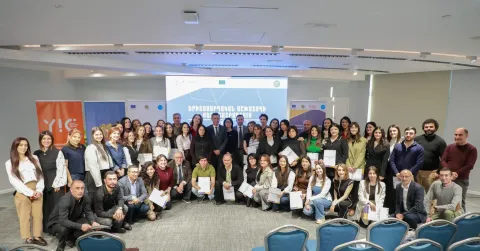
In line with the new law, to support more effective youth engagement both nationally and at the local level, UNICEF - together with the Youth Initiative Centre NGO and with support from the European Union - conducted a series of training sessions for representatives of local self-government bodies and civil society organizations. The training helped communities strengthen the mechanisms for implementing the new law and foster better collaboration with young people.

"This course opened our eyes," says Mher Mkrtchyan from the Ararat settlement administrative office of the Ararat Municipality. "For years, we tried to do something for young people, but we lacked a clear strategy. We were heading down the wrong path. We now see a unified system where local governments, NGOs, and young people collaborate in the policymaking process. Over these few days, we have learned how to carry out a needs assessment and how to implement youth policy in the community from the very beginning."
"This course opened our eyes...For years, we tried to do something for young people, but we lacked a clear strategy"
“Every community worker can be a youth worker - someone who contributes to stronger and more connected communities,” says Satenik Balabekyan, Head of the Public Relations Department at Charentsavan Municipality. "Until now, we acted out of habit. We lacked a shared vision, the right tools, and a clear methodology. This training allowed us to reassess our work and align it with modern approaches."


Youth centres as community hubs
Over the past four years, UNICEF and its partners have established a network of eight youth houses and youth friendly spaces in five marzes. And that network continues to expand with three more on the way by the end of 2025. "We are working to reach communities that don't yet have youth centres or active youth organizations," says Hasmik Aleksanyan, UNICEF Adolescent Development Officer. "The idea is to support youth engagement from the ground up. This is an important step toward ensuring that all young people have equal opportunities, no matter which region they live in." She outlined that the goal of the training series is to provide community workers and representatives of NGOs with practical tools and resources.
"The law stipulates that at least one youth centre should be created in each community. The communities themselves are interested in this process. Our young people, our community, and as a result, our state will benefit from this," noted Hasmik Aleksanyan.
"Right now, very few communities have youth policies that reflect their specific needs. Exception is one or two communities,” noted Armenuhi Petrosyan, Deputy Head of the Youth Affairs Department of the Ministry of Education, Science, Culture and Sports (MoESC). “This year, the Ministry plans to open new youth centres in six communities, three of which have already been approved - Hrazdan, Noyemberyan, and Verishen. This year, we will also announce a grant competition for 2026, enabling an additional 11 communities to establish centres."

One of the transformative elements of the new law is the introduction of the youth worker - a trained professional responsible for supporting young people and coordinating youth activities at the community level. The Youth Policy Law is aimed to ensure that youth policy addresses local needs rather than one-size-fits-all solutions.
The Ministry and UNICEF are also forming a working group to develop updated professional standards and competencies for youth workers, as well as jointly creating an updated set of operational materials for youth houses and centres. The aim is to develop a unified model that will support professionals in working more effectively with young people across the country.
"Ultimately, this is not just a training; it is system-building," says Hasmik Aleksanyan. "Our goal is to ensure that no young person is left out - that every young person has the chance to participate and realize their potential."
"Our goal is to ensure that no young person is left out - that every young person has the chance to participate and realize their potential."