Setting a new standard for dignified access to water, hygiene and sanitation at schools
UNICEF developed WASH models for schools that lack proper sanitary facilities.

- Հայերեն
- English
Children have the right to water and sanitation, and to health. This right needs to be fulfilled not only at home but also in schools, where children spend a large portion of their day. Adequate water and sanitation as part of a healthy school environment significantly improve a child’s prospects to develop and thrive. Moreover, the promotion of good hygiene behavior at school can initiate behavior change that lasts a lifetime.
Sanitation and access to clean water is not only a human right but a public good as it helps to prevent disease outbreaks and lends social and economic benefits to the society as well. Yet the reality for hundreds of school-age children is far from this. According to a UNICEF report from 2020, an estimated 367 million school-age children around the world attend schools without toilets.
In 2023, UNICEF office in Armenia initiated a comprehensive water, sanitation and hygiene assessment of 350 schools and preschools in Lori, Syunik and Gegharkunik regions and in Yerevan municipality that examined a continuum of critical elements ranging from infrastructure to minimum standards necessary for boys and girls and for children of different ages.
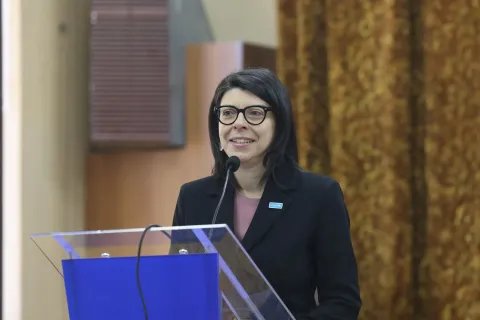
“We looked at a number of things, first, if schools have necessary facilities, whether they function and are accessible, if there is running water and a sewage system, as well as other minimum standards, such as the ratio of students to toilets, gender segregation of facilities and privacy, handwashing stations with soap, availability of sufficient cleaning and disinfecting materials and so on,”

It was no surprise that the assessment revealed significant sanitation issues in the majority of schools: 71 per cent of the assessed schools did not have access to warm water, only 21 per cent provided children with paper towels or hand-drying materials, while 86 per cent of schools lacked accessible sanitation facilities for students with disabilities and only nine per cent had sinks designed for children with disabilities.
“In some settlements, there is no sewage or waste management system. In others, there is no access to clean drinking water or running water, and maintaining the existing infrastructure remains a challenge,”
UNICEF also found out that, among the assessed schools, 25 per cent did not have access to safe drinking water, and 19 per cent experienced frequent water supply disruptions, making it difficult to maintain hygiene standards.
In addition, 60 per cent of the schools lacked separate sanitary facilities for primary school students that would be adjusted to their height. These shortcomings hinder their understanding of hygiene’s importance, posing a risk to children's health.
Based on the results of the assessment, UNICEF with the support of the Asian Development Bank further worked to categorize needs and developed WASH models that would fit these scenarios.
“We basically looked at three different types of needs: schools that have adequate infrastructure and need some form of modernization of indoor facilities; schools that do not have indoor toilets, and schools that are not seismically safe and will be demolished in the future,” informs Sarhat Petrosyan. “In the first case, we would deal with communities that had sufficient central water and sewage systems, so we focused on developing a model where each school can adapt and modernize existing indoor restrooms to meet hygiene standards and the differing needs of students, as well as address the challenge of proper maintenance of the facilities. At the end of the day, this is about creating a healthier, safer, and more dignified educational environment for Armenian children, setting a new standard for hygiene and well-being in schools across the country.”

“With the second category, we looked at buildings that do not allow for the construction of new indoor sanitary facilities, so in these cases, the models focus on building restrooms as extensions adjacent to the main building,” shares Sarhat Petrosyan. “While under the third category, we really had to get creative because we were dealing with buildings that will be taken down in the future. Hence, we came up with an accessible mobile sanitary facility that is installed near the school building, providing a long-term yet flexible solution. Once that school is rebuilt and has proper indoor restrooms, then the mobile sanitary unit can be relocated to another school or site where it is needed.”

In January 2025, with the support of Asian Development Bank, UNICEF installed the first accessible mobile sanitary facilities in Hovk village, Tavush marz, and in Hermon village of Vayots Dzor marz, benefiting 52 and 21 students, respectively, along with their school staff and faculty. In Hovk, the school’s previous restroom was a small outdoor structure with two fragile doors, no separate areas for boys and girls, and a rocky path leading to it that was not fit for students with disabilities. The only washing facility - a water pipe attached to a tree - was located far from the restroom. Before the new mobile unit, the school also lacked access to warm water and hand-drying materials, like paper towels or cloth towels.
“We hope that this assessment and the newly developed and piloted model is a promising start to a long journey ahead where we can collectively ensure that every child has access to water, sanitation and hygiene,” says Vigen Shirvanyan. “We also need to invest time and resources across a number of accelerators to safe sanitation - governance, financing, capacity development, data and information and innovation. A package of recommendations has already been shared with relevant Ministries.”
Identifying and mobilizing appropriate funding sources and financing instruments is critical, however, more research is also needed to understand the big picture beyond these 350 institutions. Consistent and disaggregated data will be essential to inform policymaking and decision-making and enable well-targeted investments and adjustments. At the same time, innovative solutions and new approaches will also be necessary to ensure that the models are ‘future-proof’, cost-effective and preserve the dignity of children and students through proper WASH facilities that are easy to maintain.
At the community level, both Shirvanyan and Petrosyan agree that robust WASH monitoring mechanisms will be no less important, linking accountability structures at the local and national level. Progress is possible and we must all raise to the challenge.