No issue is undervalued in education reforms
Discussing the 2030 education development plan with stakeholders

The Armenia-EU policy dialogue, held by the Ministry of Education, Science, Culture and Sports, the European Union in Armenia and UNICEF, brought together key stakeholders to agree around the main priorities.
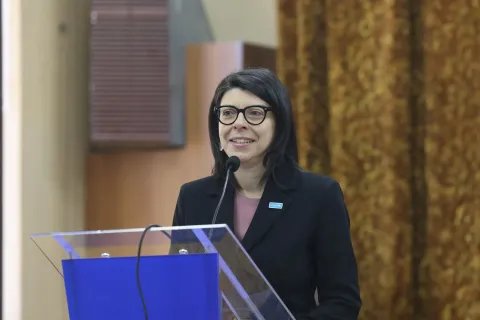
The EU-Armenia policy dialogue on brought together development partners, civil society representatives and key stakeholders in the education sector on 7 May to discuss the ongoing reforms, challenges and opportunities for collaboration. The policy dialogue was led by Zhanna Andreasyan, Minister of Education, Science, Culture and Sports; Deputy Ministers Artur Martirosyan and Araksia Svajyan; EU Ambassador Vassilis Maragos and Christine Weigand, UNICEF Representative in Armenia.
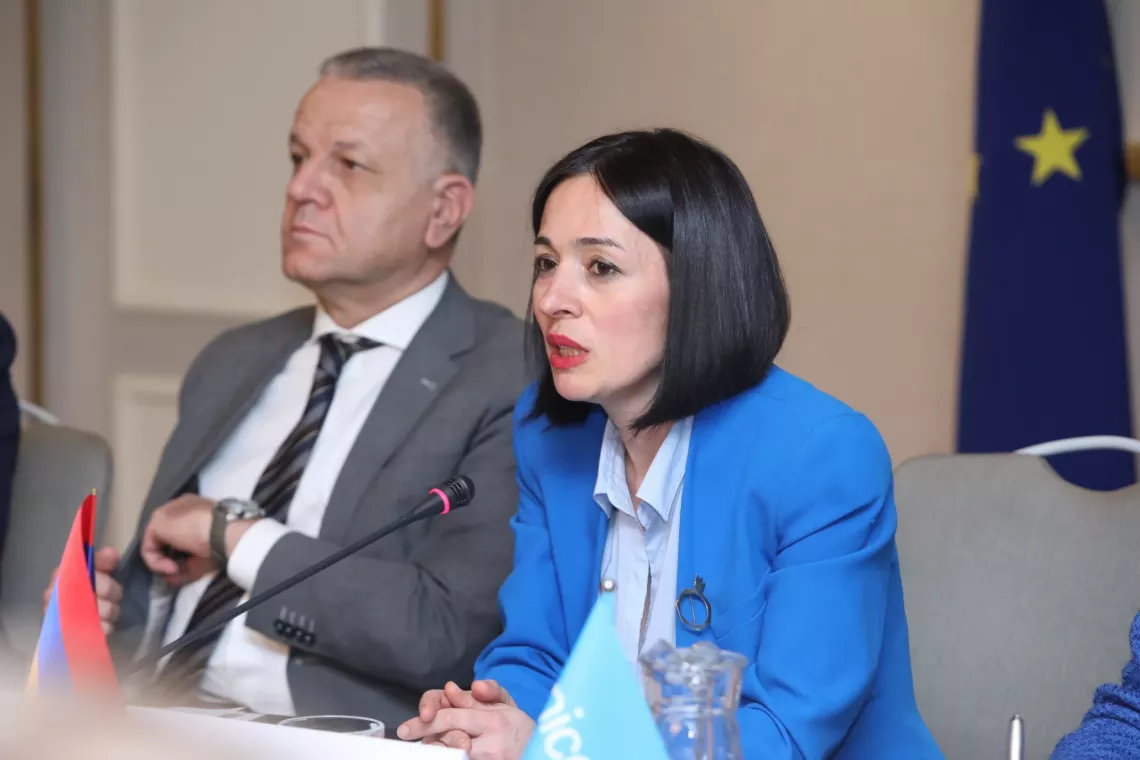
Discussion of progress on the Education Strategy 2030
Minister Andreasyan emphasized the value of the dialogue platform in enhancing collaborative work in the education sector and partnership with the EU, UNICEF, and other international partners.
“I am pleased that we have reliable partners on the long and challenging road of educational reforms. With their continued support and cooperation, we are bringing about positive changes. Without such collaboration, we would not have achieved the successes we have achieved. The goal of today’s discussion on the education strategy is clear: to evaluate programmes and progress, and listen to feedback, recognizing that education affects many groups in the larger society, involving a significant number of people,” the Minister said, pointing that navigating the reform process requires flexibility to respond effectively to changing circumstances.
The reforms encompass all levels of education
Andreasyan also noted that while the state programme on education 2030 was approved last year, it’s essential to evaluate how the implementation of the education strategy has progressed and understand progress across reform areas, such as general, vocational, and higher education.
“The strategy applies to all levels of education, from preschool and general education to secondary vocational, higher education, and non-formal education. In the education sector, no issue is secondary to others. If we aim for qualitative change, we must ensure systemic improvement at every level of education, like a chain where each link builds on the previous one. It isn’t possible to reform general education without changing the vocational education system and so forth,” the Minister stated.
Increase in public funds allocated to education
Despite challenges, the Armenian Government has not reduced the education budget in recent years. Instead, state funds allocated to education have consistently increased. “This year, the education budget is more than 38 per cent higher than last year’s, demonstrating the value we place on education as a cornerstone of state development. It’s crucial that we achieve qualitative improvement in this area to also enhance resilience of Armenia,” Zhanna Andreasyan noted.
Support programmes for refugees
Andreasyan highlighted support programmes for Armenian refugees, mentioning that the Government has made several decisions. Through one of these programmes over 500 refugee teachers will be able to work in Armenian academic institutions.
“Measures have been taken to ensure refugee students are able to exercise their right to education. The Government has decided to compensate students’ tuition fees, and we need to discuss how to facilitate this in the future too. While access to education is ensured for forcibly displaced children, there is also a need to bolster psychosocial support and other services. Collaborative efforts with certain international partners are planned in these areas,” the Minister stated.

EU support for the Education Strategy
Ambassador Vassilis Maragos also welcomed the forum participants and emphasized the importance of Armenia-EU cooperation.
“EU and Armenia strategic cooperation in education was launched back in 2019 with a comprehensive policy dialogue. Our portfolio in this sector is more than EUR 70 million. The EU supports the implementation of the recently adopted Education strategy, which includes important reforms, including the roll out of STEM laboratories and curricula in several marzes, construction of schools and building the school management system, appointment of principals, professional orientation, enhancing research in green economy and promoting the assessment of school learning outcome,” noted the EU Ambassador Vassilis Maragos. “EU also supports informal education. We are already doing a lot in this area through TUMO and COAF. In Syunik, we are going to set up two COAF centers with a total investment of around EUR 20 million, which is going to strengthen the resilience of this region. More broadly, investing in the human capital is essential for the competitiveness and resilience of the Armenian society to diversify the economy but also foster institutions and innovations. This is all the more important as EU and Armenia embark in further deepening cooperation. Today’s policy dialogue is expanded to include key stakeholders and partners, to maximize the outcome of our joint efforts.”

Quality education for children and adolescents is important
“Access to quality education which prepares children and adolescents for their future is a shared commitment by many working in the education sector in Armenia, and the Government of Armenia has consistently prioritized this goal in the last few years,” shared Christine Weigand, UNICEF Representative in Armenia. “We hope that this and the follow-on meetings will be effective in bringing together insights from a wide variety of stakeholders to help inform the policy dialogue on education and support the reform efforts under way - so that every child in Armenia, including the most vulnerable, have access to quality education.”


Reviewing progress across the Education system reforms
The conference featured a report on the implementation of the Armenian education development programme through 2030, based on results from 2023.
It was highlighted that the primary focus of changes in the education system lies in quality content, particularly in general education. A new general education standard was developed with support from the EU and the World Bank. This standard was trialed in the Tavush province starting in 2021, and this year will see the first graduates who have completed their studies under the new standard. Since 2022, it’s been gradually implemented across all schools, with the process set to conclude by 2026.
Another reform direction aims to enhance the appeal of teaching careers and professional development. Policy efforts are geared toward expanding development opportunities and linking them with fair compensation.
The first initiative was the introduction of a voluntary certification system. More than 3,800 educators have voluntarily undergone certification and now earn higher salaries. Another approach involved revising the category-awarding mechanism, allowing teachers with strong professional skills to earn higher pay. Approximately 1,600 teachers benefit from this.
New funding mechanisms have also been introduced for teachers and science instructors in schools with fewer than 100 pupils, with bonuses provided starting in September 2023. More than 16,000 teachers currently receive increased salaries. This year, a needs-based training system is also being introduced, enabling teachers to choose topics and competencies that best support their professional skill development.
Management and funding reforms are another key direction. One major change is the separation of the academic and administrative-economic departments in school management. A three-stage appointment system has been established for school principals, and a certification system for principals will be introduced this year. Some administrative and economic functions, such as accounting and procurement, will be outsourced.

Another reform direction focuses on creating a child-centred, safe environment around the “300 Schools, 500 Kindergartens” programme. In 2023, 29 schools and 167 kindergartens were fully renovated or built. This year, the plan is to expand to 264 schools, including 75 educational complexes that will provide both school and preschool educational services. This will help address the issue of communities lacking preschool services. Building these environments also includes equipping schools with laboratories and IT resources. Last year, 283 schools were outfitted with labs, and six more training sessions are planned for 2024. All newly constructed schools and kindergartens are fully furnished with new equipment.
Improving accessibility is a primary challenge in the preschool education system, as over 200 communities currently lack access. To address this, 27 alternative services have been introduced, and 29 preschools have been established in various communities.
The main goals for preschool institutions include certifying principals, regular training for educators, and piloting the revised preschool education standard, which will be fully implemented by 2026. Universal inclusion in preschool education started in 2023, and a category system has been introduced for educators.
While the school meals programme runs for elementary grades across the country, except for Yerevan, the Government plans to extend this programme to the capital city by 2025.
The primary challenge in primary and secondary vocational education is establishing an effective connection between education and the labour market. Several policy directions are emphasized here. One is adapting educational programmes and institutions to regional needs. The mapping of vocational education and training (VET) institutions and their programmes has been completed, and strategies for professional listings and their distribution have been revised. Plans include developing networks of sectoral institutions and creating resource centres in 12 educational complexes by 2030. Regarding content, the work-based learning system is a priority and is currently implemented in about 10 per cent of professions. The draft law on professional education and training circulating in the National Assembly will be pivotal for these directions.