Helping family doctors give every child the right care
From Syunik to Gegharkunik, family doctors across Armenia are strengthening their skills to recognize childhood illnesses early and provide timely, appropriate care.

- Հայերեն
- English
After 47 years of working as a family physician, Karine Zohrabyan fairly believes that learning is part of the job. "A doctor has to keep learning every day," she says.
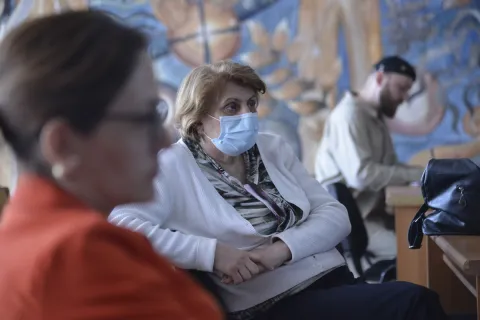
This week, Zohrabyan is among family doctors and nurses taking part in a five-day training on the Integrated Management of Childhood Illness (IMCI), supported by UNICEF with funding from the Republic of Korea.
The training focuses on helping primary healthcare providers accurately assess, treat and refer children aged two months to five years. Participants strengthen their skills in identifying common childhood illnesses and danger signs, including cough and difficulty breathing, diarrhoea, fever, ear and throat infections, nutrition and growth concerns, and anaemia.
"I never miss an opportunity to attend professional training," says Zohrabyan, who works at the Nairi Medical Centre polyclinic in Yeghvard. "Every time, my work becomes easier because I learn clearer guidance and better approaches."
For trainer Marine Babayan, one of the programme's greatest strengths is its practical approach.


"The training includes a guide that serves as a family doctor's handbook," she explains. "It helps doctors know which questions to ask parents, what examinations to perform for specific symptoms, how to assess a child's condition and what steps to take afterwards."
The guide follows a simple colour-coded system. Children assessed in the red zone require urgent referral to hospital. The yellow zone indicates treatment at the primary healthcare level, while the green zone focuses on counselling parents and providing advice for care at home.
Since November 2024, the training has been delivered in nearly every community across the regions of Ararat, Armavir, Kotayk, Gegharkunik, Syunik and Vayots Dzor. Nurses participate alongside doctors, an important part of the programme, particularly for remote communities where access to specialists may be limited.
"In remote communities, nurses need to be able to examine children, recognize danger signs, contact a physician or immediately refer families when necessary,"
Looking back over her career, Zohrabyan says the way childhood illnesses are managed has changed significantly.
"When we first trained using this approach, many of us were still working according to practices from the Soviet medical school," she says. "They weren't bad, but they were different. Sometimes it was difficult to communicate with parents and apply approaches that had become outdated."
She says the clinical guidance introduced through the training has made everyday decision-making much more straightforward.

"It leaves much less room for uncertainty. The doctor follows the steps in the guide, assesses the child and then either refers the patient or prescribes treatment,"
Participants in the training also noted that self-medication, relying on advice from pharmacy staff instead of healthcare professionals, and insisting on unnecessary treatments remain common challenges in Armenia.
For Liana Hovakimyan, Health and Nutrition Specialist at UNICEF Armenia, strengthening communication between healthcare professionals and parents is just as important as strengthening clinical skills.
"It is one thing to know the science and another to apply it while communicating effectively with parents," she says. "That is why the training also includes practical tools that help healthcare professionals explain treatment approaches more clearly and build trust with families."
She says that carefully explaining a child's condition, answering parents' questions and communicating clearly often plays an important role in choosing the most appropriate treatment for a child.
For Varduhi Karapetyan, the mother of one- and six-year-old children, the difference in the care her children have received over the years is noticeable. "Things have really changed," she says. "When my first child was young, we were referred to Yerevan much more often. Now it feels like many of the main health issues can be managed locally."
She has also noticed changes in the way doctors assess children before prescribing treatment.
"Five or six years ago, much less was needed before antibiotics were prescribed," she says. "Today, doctors ask many more questions, examine children much more carefully and order tests that help them assess a child's condition and decide on the most appropriate treatment."

"As a parent, you feel calmer and more confident that your child is in capable hands."
For Zohrabyan, strengthening the skills of local healthcare professionals ultimately benefits both children and their families.
"When local specialists have stronger knowledge and skills, we only need to refer children to hospitals in Yerevan in special cases, when specialised equipment or expertise is not available locally," she says.
For families, that means more children can receive quality care closer to home.
This story was produced with the financial support of the Republic of Korea. The views expressed are those of the authors and do not necessarily reflect the views of the Government of the Republic of Korea.