The ABC’s of parenting: Online classes for caregivers
Over 700 caregivers from across Armenia take the new course on positive parenting by UNICEF and Parenting School NGO, funded by the U.S. Government.

- Հայերեն
- English
Well-known parenting coach Sue Atkins once said, “There is no such thing as a perfect parent so just be a real one.” We would add: “... however do it in an as informed manner as you can.”
‘How come?’ you would ask. “Because as we know more about the human brain and development, there are many things that parents can do differently, preventing a lifetime of challenges for their children. For instance, we already know for a long time now that yelling at or hitting children do not help them alter their behavior how parents sometimes would like. Instead, constant yelling and accusations cause toxic stress to children. Yet many parents may not really grasp the profoundly negative effect this can have on their children not just in that moment but in their lifetime or simply do not know better,” explains UNICEF Acting Child Protection Specialist, Victoria Ohanyan. “This is why we want caregivers to be as informed as they can, as well as resourced to deal with everyday challenges, because parenting is not an easy job. Parents often yell or hit their children, not because they want to, but because they are tense, stressed or burned out, and feel like they have no other option in that moment.”
The good news is that you have a multitude of other options at your hands, and it’s worth knowing them and consistently putting them to practice so that you can raise a healthy child as well as enjoy your own parenthood, because they do grow up quickly! To this purpose, UNICEF teamed up with Parenting School NGO in Armenia to offer a special course on positive parenting to over 700 caregivers from across Armenia, with funding from the U.S. Government.
“Parents need the skills to regulate and manage not only their own emotions but also the emotions of their children, especially in difficult situations, including crises. Taking a parenting course is the best you can do for yourself and your children, and in an emergency situation, it becomes even more important. The workshops are free and delivered online, making it possible for all parents to participate and gain valuable parenting skills, regardless of geographic location or financial means,”
“Each parent comes to the coursework sessions with questions like how to respond to children’s emotions, discipline without punishment, manage their won emotions, and so forth. During the workshops, parents receive universal tools for relating and communicating with their children that are applicable to many situations. Together, we try to learn how to understand the problem and resolve the matter competently,” Velitsyan explained.

A philologist by profession, Hayarpi Hayrapetyan lives in Yerevan and has two children: Aren is a year and a half, and Khachatur is two months old. Hayarpi says she pays close attention to parenting manuals and follows social media pages on parenting and children’s psychology.

“I take parenting topics extremely seriously because I realize that I am responsible for the wellbeing and development of an individual and a citizen of our country. It is important that my child grows up as an independent person who is brave and without emotional baggage. I have struggled for too long, trying to overcome my own issues. I don’t want my children to go through what I went through,”
Hayarpi says she gained a lot of knowledge during the coursework. “The ‘behavior should be in the third position’ formula really stuck with me. I learned that we should not criticize children’s behavior but rather should try to understand their emotions. Your child’s emotions should come first,” she said.

Mane Saroyan, an accountant from Lori, also took the course. She is currently on maternity leave and takes care of her one-year-old daughter, Luse. “Luse is my first child, and though she is still an infant, I’ve realized that our relationship has become complicated. I need new skills to avoid further communication issues and to raise a mentally healthy child,” Mane explained.

“Here’s the most basic example: In the past, when my daughter misbehaved, I would get angry, maybe pick her up and try to speak to her. I learned from the experts that I should instead get to her level, try to make eye contact, and start talking on more equal terms. This made my life a lot easier and helped both of us tremendously,”
Mane came across the positive parenting course ad online and signed up. During the coursework, she realized that her problems aren’t unique only to her situation. She found that there were many other mothers like her; that other mothers also do not manage to take care of themselves or have difficulty understanding their children.

Satine Musayelyan, from Syunik, has two daughters, a 16-year-old and a 13-year-old. She feels that she is in a difficult stage as a parent, trying to get along with her two teenagers. “At this stage, communicating with my daughters, Tina and Nelly, is not so easy. Sometimes, I don’t understand them; sometimes, they don’t understand me. For this reason, I decided to participate in the course offered by UNICEF and Parenting School to acquire the necessary skills. I am currently in my senior year to get a degree in psychology, so this programme was also important for me professionally,” Satine explained. Satine especially liked the homework that was assigned after each session.

“Sometimes, when I found it difficult to do [the assignments], I would turn to my daughters for help. For example, no one can answer the question, “Who is your dream parent?” better than them. This is how I learned to identify their desires and understand what I need to do and how I should improve myself. After participating in these workshops, I believe, my daughters and I will begin to understand each other again one day,”
Satine also shared her experience on her social media pages. She says that many people asked questions and were interested. Satine gave the same advice to everyone: “It is worth participating if you want to signal the beginning of important changes in your life. Time passes quickly, and we often miss out on the best years of raising a child.”
The course sessions also focused on self-care since taking care of children without first taking care of yourself is impossible. As one of the participants put it, “I shouldn’t feel guilty about leaving my baby [with a loved one] for half an hour to go to a hair salon.”
To complement the coursework, UNICEF also collaborated with expert psychologists to develop the Happy Mom challenge this summer – a digital activation to engage mothers and young people and encourage them to regularly practice self-care with short, daily challenges.
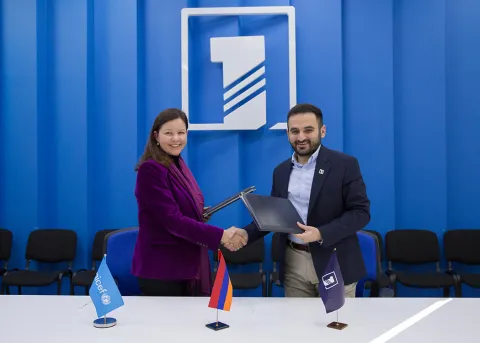
As part of the initiative, UNICEF, with funding from the U.S. government and in partnership with the Public Television of Armenia, also issued a special regular episode of the Healthy Lifestyle show, 16 episodes in total, focusing on essential parenting topics through practical tips and steps.
This article was developed with the financial support of the U.S. Government. Its contents are the sole responsibility of the authors and do not necessarily reflect the views of the U.S. Government.