Driving Inclusion: Kamza Launches the Social Transport Service
Read about the contribution of EU4SocialCare to accessible services

- English
- Shqip
Kamza Municipality, in partnership with Together Foundation under the EU4SocialCare programme, has launched an innovative social transport service aimed at improving accessibility for persons with disabilities and others facing mobility challenges.
For Suela Lala, director of Together Foundation, the initiative represents a concrete step toward inclusion. She has long advocated for accessible services in Albania and notes that collaboration with Kamza Municipality has been remarkable. “What impressed me most,” Suela explains, “was that instead of reacting defensively when we raised accessibility issues in the past, the municipality listened, collaborated, and actively sought solutions. That kind of openness is rare, and it laid the foundation for this project.”
The idea of social transport emerged from a clear gap in mobility options. Albania lacks wheelchair-accessible taxis, and public spaces remain largely inaccessible. Kamza, one of the country’s largest municipalities by population and territory, is home to many residents for whom mobility presents daily challenges. Drawing inspiration from services she has seen across Europe, Suela and Together Foundation envisioned a service that allows residents to reach government offices, medical appointments, and even leisure activities that were previously out of reach.

“This service is about much more than transportation,” Suela emphasizes. “It is about independence, inclusion, and participation. For many people, being able to move freely in their city means being able to live fully and take part in society.”
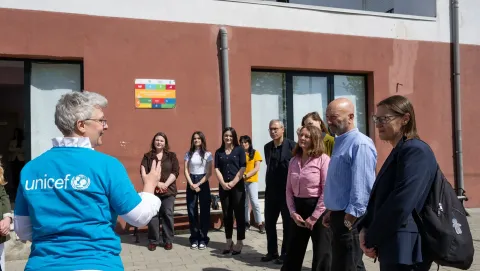
The service was officially inaugurated on 12 September, in a ceremony attended by the UNICEF Representative, the Mayor of Kamza, and representatives from the European Union Delegation.
“Mobility is dignity. And the launch of the social transport service here in the municipality of Kamza addresses one of the greatest barriers for vulnerable families – access to health, education, and essential services.” - Murat Sahin, UNICEF Albania Representative
Early feedback indicates that the social transport service is already making a tangible difference in residents’ lives. Suela is optimistic about the future: “We hope this model can be expanded to other municipalities. It is a practical example of how collaboration between civil society and local government can remove barriers and create a more inclusive Albania.”
The initiative has been made possible with funding and support from the European Union under the EU4SocialCare programme, which aims to strengthen social services and inclusion for vulnerable groups across Albania. “EU4SocialCare has provided the resources and framework that make projects like this feasible,” Suela notes.
For her, seeing the service in action is deeply meaningful. “This is what advocacy looks like in practice,” she says. “It’s one thing to talk about rights on paper. It’s another to see those rights being realized every day for real people in your community.”