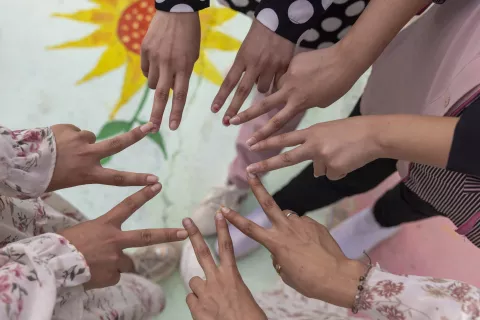
Activity: Collaborative decision making
Taking action: Adolescents discuss ideas from previous sessions and choose one to explore further or to develop as a group project

Activity overview
Energy level: 3/5
Literacy level: 2/5
Complexity level: 4/5
Time: 10 to 30 minutes
Purpose: Decide collectively on ideas and topics to learn more about or create a group project.
Objectives
Adolescents will be able to:
- Rank ideas as a group.
- Make decisions about interests.
Competency domains
- Critical thinking and decision making
Works well for
Adolescents who are ready to talk about and listen to each other’s ideas, to make decisions together and to explore an issue in more depth.
Phase
Taking action
Before
Adolescents should have identified an idea that they are interested in developing as a group project or learning more about. The Our environment, Our days, Our challenges, Our solutions, and Brainstorming solutions, possibilities and project ideas could all be first steps.
After
Once the adolescents have agreed on an idea to explore or develop as a project, they can follow-up with activities such as Plan a project, Forming problem and opportunity statements, Prototyping, Organizing an exhibition, and Community dialogue.
Preparation
None needed.



Activity steps
Step 1
Warm up: Ask the adolescents to sit comfortably in a circle on the floor and put the marker board or a flip chart where they can all see it.
Step 2
Write the idea that adolescents have chosen to discuss on the marker board.
Examples could include:
- Our cultural and artistic traditions.
- Contributions adolescents make to peace in the community.
- Challenges adolescents face in their daily lives.
- How adults in the community view adolescents.
Step 3
Write a simple question about the topic to stimulate an open discussion about adolescents’ ideas, opinions, priorities or hopes. Examples could include:
- What cultural and artistic traditions would we like to learn more about?
- What contributions do adolescents make to peace in this community?
- What are the most significant challenges adolescents face in their daily lives?
Step 4
Distribute one, two or three index cards and a marker to each adolescent. Each adolescent should write an answer to the discussion question on each of the index cards. Give the adolescents three to five minutes to think and write.
Step 5
Facilitator says: ”Place your index cards on the floor in the middle of the circle and then explain your answer.
Step 6
Explain: When all of the adolescents have shared their ideas, ask a volunteer to group the index cards into similar themes. If the same idea card appears several times, just keep one of them and draw stars on it to show that the idea has come up often. If two or more ideas seem very closely related, discuss whether to consolidate them as one idea.
Step 7
Facilitator says: “Now let’s put the cards in order of importance (or “in the order of your interest”). There is an imaginary line across the middle of the circle. At this end of the line is Very important. At the other end of the line is Not important at all.”
Step 8
Ask a volunteer to place the index cards along the imaginary line according to how important he or she considers them, and to explain why they think so.
Step 9
Ask another volunteer to give their feedback on the ranking and to make changes if they want to.
Step 10
Continue the discussion with further volunteers until patterns of agreement emerge within the group. If necessary, continue the discussion in a follow-up session before agreeing on the group’s most important or interesting ideas.
Step 11
Share and Take away
Discuss:
- Which ideas do we find the most interesting or important?
- Can we agree on one idea to explore further or to develop as a group project in our next sessions?
Do and don't
Do
- Allow adolescents to share their own ideas in response to the discussion question.
- Encourage adolescents to share their written ideas with each other individually, rather than reading them aloud, if that makes them more comfortable.
Don't
- Encourage adolescents to explore very difficult ideas or challenges that they may find overwhelming.
Adaptation
Different opinions and ideas: If adolescents are interested in more than one idea, they can divide into smaller groups to look at each of the ideas separately. They can also divide the ideas and discuss them at different sessions.
Low literacy: Instead of writing on the index cards, adolescents can draw a symbol that represents their ideas.
Environment
Indoor or outdoor space. Quiet.
Read and use
Our challenges, Our solutions, Our environment, Forming problem and opportunity statements, and Brainstorming solutions, possibilities and project ideas activities, for steps to take before and after this activity.
Supplies
- One marker board
- One, two or three index cards per adolescent
- One marker per adolescent
Improvise
Adolescents can take more time to explore different ideas before choosing one to focus on. For example, they could create drawings or stories about each idea as part of an exhibition in the community.
Continue
If adolescents find this process helpful, they can use it whenever they need to reach a group decision collaboratively.



Highlights
Decide collectively on ideas and topics to learn more about or create a group project. Works well for adolescents who are ready to talk about and listen to each other’s ideas, to make decisions together and to explore an issue in more depth.