Activity: Organizing an exhibition
Taking action: Adolescents plan for an exhibition of their creative work and projects

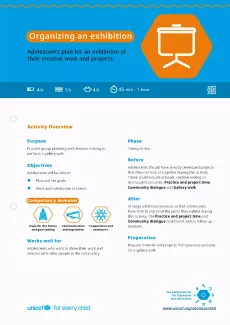
Activity overview
Energy level: 4/5
Literacy level: 1/5
Complexity level: 4/5
Time: 45 minutes to 1 hour
Purpose: Learn how to think through a project creatively; Use a journey map to work on group and individual projects.
Objectives
Adolescents will be able to:
- Plan and set goals.
- Work and collaborate in a team.
Competency domains
- Hope for the future and goal setting
- Communication and expression
- Cooperation and teamwork
Works well for
Adolescents who want to share their work and interact with other people in the community.
Phase
Taking action
Before
Adolescents should have already developed projects that they can look at together during this activity. These could include artwork, creative writing or drama performances. Practice and project time, Community dialogue and Gallery walk.
After
Arrange additional sessions so that adolescents have time to carry out the plans they outline during this activity. The Practice and project time and Community dialogue could work well as follow-up sessions.
Preparation: Prepare material and projects from previous sessions for a gallery walk.



Activity steps
Step 1
Explain: Participants will first organize a gallery walk to look together at the projects or work they have created in previous sessions. Give them five to ten minutes to complete the gallery walk.
Step 2
Discuss:
- Do all of our projects have something in common?
- What do we hope that other people in the community will learn, feel and understand when they look at our work?
Step 3
When they have finished the gallery walk, ask the adolescents to sit together in a circle, where they can see the marker board or flip chart. Encourage them to share their answers to the two questions above, as a warm up to further planning discussions.
Step 4
Facilitator says: “Now we will agree to a common theme and title for the exhibition.”
Step 5
Write the following questions on the marker board or write each question on a different piece of flip chart paper:
Invitations:
- Who do we want to invite to the exhibition?
- How will we invite people?
- How will we publicize our exhibition?
Time and location:
- Where could we hold the exhibition?
- When will we hold it? Think of a date and time when community members will be able to attend, and that allows enough time for adolescents to plan the exhibition.
Organization and presentation:
- How will we arrange the exhibition?
- How will we introduce and present the exhibition? (Discuss whether adolescents should give introductory or closing speeches to welcome participants, or if it would be more appropriate for other community members, such as local leaders, to do this.)
- Will we post written explanations for each project or artwork, or explain them ourselves? (For example, adolescents could stand next to individual projects and provide explanations to those viewing them.)
Step 6
Divide the adolescents into three committees to discuss each of these topics and to develop work plans using the following chart.
What will we do?
Who will do this?
When will we do it?
What resources or support do we need to do it?
Step 7
Sharing and Take away:
Explain: Each committee should present their ideas. Encourage all of the adolescents in the circle to agree on a realistic plan that includes the necessary steps for a successful event.
Step 8
Agree on the next steps and discuss whether the next session will include time for carrying out the plan.
Do and don't
Do
- Support adolescents to develop an exhibition that allows everyone to share what they have done or achieved.
- Encourage adolescents to be proud of their work and open to sharing it.
- Review adolescents’ plans for organizing their exhibition - Help them to develop a realistic plan that is in line with their time and resources, and identify areas where they may need support from others.
- Encourage community members to engage positively with adolescents at their exhibition - In some cases, it may be helpful to meet community members in advance (including parents, local leaders, or civil society organizations) to gain their support and to address any questions or expectations they may have.
Don't
- Force any adolescents to show their work if they don’t want to.
- Leave adolescents to prepare for the exhibition without reviewing their plans and providing support.
Adaptation
Work with adolescents to adapt the exhibition to the people they want to share their work with (For example, they may wish to hold an exhibition specifically for their parents or peers.)
Environment
Indoor or outdoor space; Large area for gallery walk.
Supplies
- A marker board or at least three pieces of flip chart paper
- Markers
- Adolescents’ projects or artwork
Improvise
Adolescents could adapt this activity to prepare for other types of public presentations, depending on their projects. For example, they could organize a performance, innovation fair, debate or dialogue.
Continue
If they are going to continue working together as a circle for some time, the adolescents can hold exhibitions on regular basis (monthly, quarterly or annually) to raise awareness about their work and to engage with the community.
Highlights
Learn how to think through a project creatively; Use a journey map to work on group and individual projects. Works well for adolescents who want to share their work and interact with other people in the community.