Zimbabwe expands Civil Registration services to hard-to-reach areas
Without birth certificates, many children are unable to enroll in school, receive vaccinations, access social services, or claim legal protection.

For families in Zimbabwe’s remote and underserved communities, accessing basic services such as birth registration can be a formidable challenge. In places like Sinamusanga, a remote village in Binga District—over 160 km from Binga Town and bordering Zambia—the distance, cost, and lack of road infrastructure often leave children without a legal identity or access to essential services.
Without birth certificates, many children are unable to enroll in school, receive vaccinations, access social services, or claim legal protection. For rural communities, the barriers to obtaining these documents are not merely administrative—they are structural and deeply rooted in geography and inequality.
But that’s beginning to change.
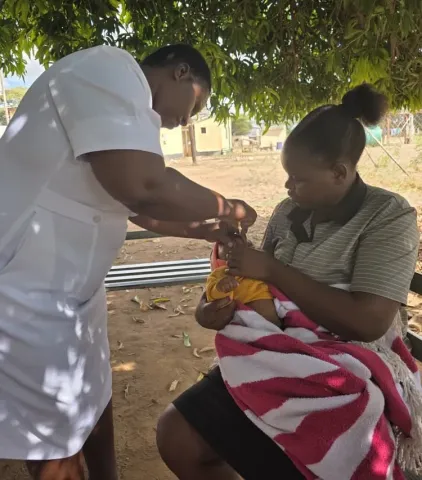
With support from UNICEF and funding from the Governments of Sweden and Switzerland, the Government of Zimbabwe recently launched a week-long mobile registration blitz in Binga District. The initiative brought birth registration, death certification, and national identity services directly to rural communities—places where formal registration was previously inaccessible.
One resident, Honest Mudenda, shared his story. “I cycled 10 km through wildlife-infested bush with my wife and 1-year-old son to get this certificate,” he said. “Before this mobile programme, we had to travel to Siabuwa or Binga Town, which is simply unaffordable for many of us. This is the closest these services have ever come to us.”
Indeed, the only available public transport operates once or twice a week and can cost up to USD 30 per round trip—a cost that many families cannot afford.

Similarly, Norah Mwende, a mother of three, walked 4 km to reach the mobile registration site. “This birth certificate means my daughter can now start school and sit her Grade 7 exams. It’s a huge relief for our family.”
To address these long-standing challenges, the Civil Registry Department is also digitalising its registration systems, helping decentralise services and increase efficiency. More than 20 registry offices and sub-offices across Zimbabwe have already been computerised, allowing real-time data entry and faster document processing.
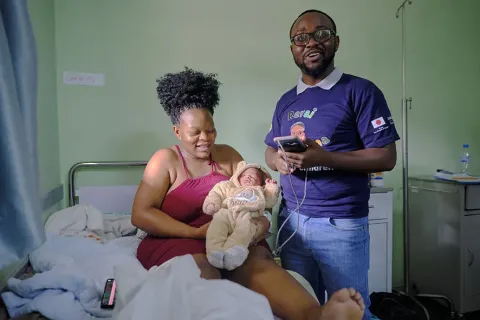
One of the most transformative examples of this digital shift is seen at Mpilo Hospital in Bulawayo, where a fully computerised civil registration sub-office is situated just 200 metres from the maternity ward. This proximity enables new mothers to register their newborns and obtain a birth certificate before being discharged.
“This integration between the health and civil registry sectors means fewer children will grow up without legal documentation,” said Mr. Phineas Sithole, Director of Operations at Mpilo Hospital.
Digital registration is now also operational in other rural and peri-urban areas, including Kariangwe in Binga, Bubi, Manama Mission Hospital in Gwanda, Mahusekwa in Mashonaland East, Murambinda in Manicaland, and Epworth in Harare. This expansion is creating more equitable access and reducing the burden on families who previously had to travel long distances to obtain registration.
Evidence Mwende, originally from Binga but working in Bubi, benefited from this new system. “My employer required a computerised ID and birth certificate,” he said. “I came to the registry office in the morning and walked out with both documents by midday. This used to take weeks—now it takes hours. It’s life-changing.”
The government has also taken steps to empower community leaders in the registration process. Chief Sinamusanga, Gasta Siyateya Mwinde, explained how traditional leaders are now authorised to issue BD1 forms for births occurring outside health facilities. “This legal empowerment ensures that children born at home are no longer left behind in registration processes. It’s a critical step for planning and inclusive development.”

Birth registration in Zimbabwe is guided by the Births and Deaths Registration Act (Chapter 5:27). To register a child, a parent—usually the mother or father—must fill out a BD1 form. This form includes details such as the child’s name, place and date of birth, the parents’ marital status, and their personal information.
These efforts are part of Zimbabwe’s broader commitment to achieving legal identity for all by 2030, in alignment with Sustainable Development Goal 16.9 and the African Union’s Civil Registration and Vital Statistics (CRVS) agenda.
Speaking during the rollout, Ambassador Raphael Faranisi, Secretary for Home Affairs and Cultural Heritage, noted: “Digitalisation not only modernises our service delivery but also strengthens policy formulation through access to timely, accurate data. This government is serious about ensuring that no one—and no place—is left behind.”
UNICEF Zimbabwe’s Chief of Child Protection, Nyasha Mayanga, echoed this sentiment. “Obtaining a birth certificate or national ID is not just a formality—it’s a child’s gateway to health, education, and protection. Through digital innovation and close collaboration with government and development partners, we are working to ensure that every child, no matter where they live, can realise their right to identity.”

According to the 2023–2024 Zimbabwe Demographic and Health Survey, birth registration coverage has increased to 57% for children under the age of five. While this marks progress from previous years, a significant number of children—especially in rural areas—remain unregistered.
With continued investment in digital infrastructure for local leadership empowerment, for many children, such as those in Sinamusanga, this could be the first step toward a future of opportunity, rights, and recognition.