UNICEF tents avert classroom shortages in Chipinge schools
“By providing the tent, UNICEF made teaching and learning easier. It is better to teach in a tent than under a tree,” he said

CHIPINGE, ZIMBABWE-Whenever the storm clouds appear, teachers at Clearwater School in Chipinge pack the over 800 pupils into the Secondary School's only two classroom blocks.
“That was the only way we can ensure the children’s safety,” explained Moffat Sigauke, the headmaster of the school. “Some of the pupils were learning under a tree exposed to the vagaries of the weather. There was no way they could be let out in such unforgiving weather.”
Clearwater is a satellite school in south-eastern Zimbabwe, a region prone to harsh weather associated with climate change.
In March 2019, the deadly Cyclone Idai the Eastern Highlands, unleashing heavy rains and strong winds that triggered flooding and landslides. More than 340 people died, and 140 schools were affected as huge boulders that cascaded down the mountains flattened homes and entire townships.
In response, UNOPS is implementing the four-year Cyclone Idai Recovery Project (ZIRP) with the United Nations Children’s Fund (UNICEF), Food and Agriculture Organization (FAO), World Health Organization (WHO), and World Food Programme (WFP), IOM, UNFPA and UNESCO, as technical agencies.
This “One Project – One Team” approach brings together expertise in each sector to fully deliver the project outcomes for Cyclone Idai recovery.
Clearwater was among the beneficiaries and it received a big tent which accommodates 30 pupils who used to learn under a tree. These pupils would shun school when it was either raining or was too cold.
“By providing the tent, UNICEF made teaching and learning easier. It is better to teach in a tent than under a tree,” remarked the headmaster who thanked the organisation for availing the facility and other learning materials.

He added before the donation “there was access to education without quality,” at his school and was heartened that pupils were now coming to school every day as a result.
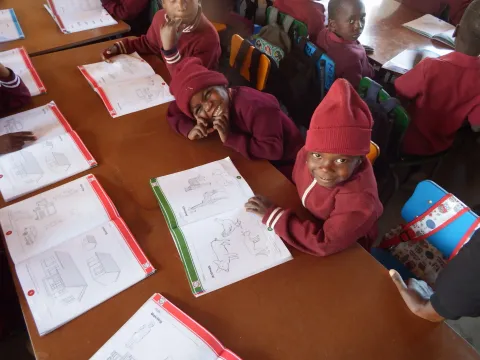
Apart from the tent, Clearwater secondary school also got satchels (school backpacks) for pupils, educational kits containing pens, exercise books, textbooks, markers for teachers, chalks, blackboard paint, dusters and other things which the headmaster said made learning easier.
This was confirmed by a teacher at the school, Maidei Zvotoona, who lives with albinism. Teaching in the searing Chipinge sun would have been difficult for her.
“When we opened last year after the prolonged lock-down, our school coffers were empty. We had to rely on the books donated by UNICEF."
"Even teachers did not have books for scheming. Some pupils came to school without pens and mathematical sets. Some travel for ten kilometres and pass in a mountainous area, making the school bags very useful.”
At Nyaututu Primary, another satellite school in Chipinge, the situation was worse after its makeshift classroom structures were damaged by Cyclone Idai, prompting lessons to be held under trees. Donors who first arrived at the school said they could not assist because the destroyed rudimentary two and half-metre buildings were not proper classrooms.
“Of course they were right but this was all we had,” said school headmaster, Liberty Maushe who was disappointed by their reaction. He said it was Unicef that came to their rescue.
“UNICEF donated four tents. These tents have eased the pressure of teaching and learning under trees. The school’s pass rate rose from 13 percent in 2020 to 39 percent in 2019. We attribute that to the donation by UNICEF,” said the headmaster.
The school has an enrolment of 824 pupils. Sadly one of the tents donated by Unicef was destroyed by termites during the Covid -19 induced lock-down.
Tafadzwa Maposa, a grade six pupil at the school revealed her parents lost everything to the deadly cyclone and could not afford to buy her a satchel to carry her books.
“My books used to get wet or torn because I did not have a school bag to carry them. My parents had no money as all our belongings were washed away by the cyclone,” she said.
Takura Mhlanga, another grade six pupil said, thanks to Unicef, there was no difference between him and other pupils from well-to-do families.
“My parents could not afford a mathematical set for me and this made me feel out of place at school. Now when we are in a maths class, I simply pull mine out,” he said, his face beaming with a smile.

Yolanda Pidzeni, a grade six girl was grateful that sanitary pads donated by UNICEF restored their dignity.
“I used to miss classes because I did not have sanitary pads. So I would pretend that I am not feeling well, yet the main reason would be that I did not have sanitary pads,” she said.
Despite the welcome intervention by UNICEF, challenges remain at the satellite schools.
Spiwe Chinheya, a senior teacher and four other teachers still teach under a tree as classroom shortages persist at Nyaututu Primary school.
“UNICEF chipped in and helped us with tents, but still there is a gap. As a teacher, I face challenges when teaching under a tree. Pupils, especially infants, do not concentrate when learning in an open space particularly if their relatives pass by. It's difficult for them to comprehend what they are taught because of the lack of chalkboards. I feel more still needs to be done," Chinheya said.
Maushe, the headmaster, concurred with her saying the school faced furniture and infrastructure problems.
“Some classes are sharing one room and there are distractions among learners. There are no chalkboards, no desks. We are trying our level best under the circumstances but the lack of resources is affecting us,” said the headmaster.
Just like Nyaututu Primary School, Clearwater Secondary School also needs additional classrooms.
“We need at least four more tents so that there is social distancing among learners. These other classes are overcrowded. We cannot turn to hot sitting because children come from very distant places. Resources permitting, we need about four classroom blocks,” said Maushe.
“However, we need more classrooms and teachers blocks. 17 teachers share three houses. Most commute from Chipinge and sometimes arrive late for work. Conflicts among teachers arise. Three families share one house with five rooms; another house has three rooms and two teachers share it. The other one is a makeshift structure and accommodates one family.”