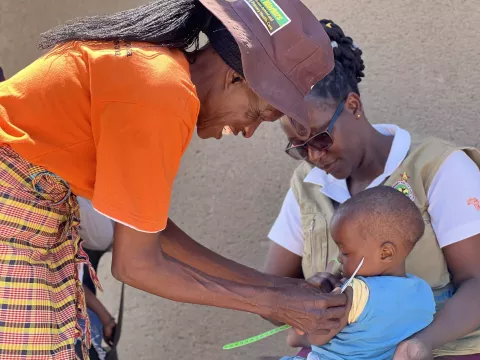
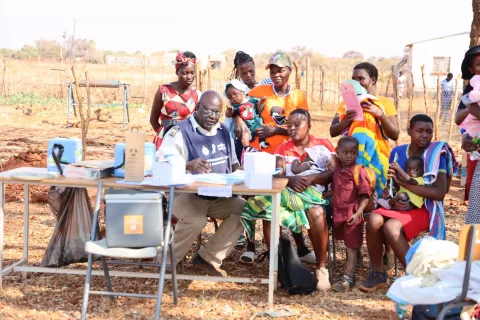
A passion for serving hard-to-reach communities drives Nomore Rwambiwa.
“I wanted to help those people by referring them to the hospital and visiting the three villagers to educate mothers to breastfeed their babies properly and ensure they are immunised.

Nomore Rwambiwa was motivated to become a village health worker after seeing several people in his remote community succumb to preventable diseases due to lack of access to primary health care services.
Rwambiwa (44), a father of three from Gonzo village in Mashonaland East’s Chikomba District, has been traversing one of the most challenging terrains in Zimbabwe to provide primary health care services in Gonzo, Chitamba and Mukumba villages since 2010.
Most homesteads in the area are nestled atop hills and valleys where access roads are in a bad state, with the situation often getting desperate during the rainy season.
The movement of people is also curtailed by dangerous wild animals that roam freely in the villages, making it difficult for villagers to access Sadza District Hospital and other health facilities for treatment and vaccination during disease outbreaks.
“I became a village health worker after seeing that access to health services in my community was difficult,” Rwambiwa said.
“Women were giving birth at homes, most were not registering their pregnancies at health facilities, children were falling sick, and some would be taken to traditional healers or apostolic sects for treatment with some dying there.
“I wanted to help those people by referring them to the hospital and visiting the three villages to educate mothers to breastfeed their babies properly and ensure they are immunised.
“I remind mothers that a baby must be breastfed at least eight times a day, and they must be given time to sleep during the day to grow healthy.”
He said the movement was complex because of the terrain to the point that, so he had to walk on foot instead of cycling because of the bad terrain.
Rwambiwa is one of the thousands of village health workers throughout Zimbabwe supported by the Health and Child Care Ministry, UNICEF and its partners, including donors of the Health Resilience Fund – the European Union, Ireland and the United Kingdom – as well as Gavi, the Vaccine Alliance.
He links the community and the formal health system, especially in hard-to-reach areas.
The villagers he services are far between, but Rwambiwa said the challenges did not deter him as he believes his work has led to a positive change in the communities.
“The villages are far in between, and the terrain is so bad to the extent that in some areas, I have to walk instead of cycling,” he said.
“The bad terrain discourages some people from going to Sadza Hospital, especially those from Chitamba village, because it is very far, and I cannot cover it in one day.

“There are also many snakes and dangerous animals, such as hyenas, in this area. I often encounter snakes during my village visits but am not deterred.
“There are no access roads, and it is difficult to get health workers to come here for awareness campaigns and immunisation programmes.”
Rwambiwa, a farmer and the point person in the village for livestock vaccinations said he sets aside two days a week to service the towns where he makes home visits to attend to people with chronic illnesses, pregnant women and mothers of newborn babies.
“I want to thank the Ministry of Health and Child Care, UNICEF and its partners for giving us bicycles that make it easy for us to access our people,” he said.
“I also want to thank UNICEF for continuously visiting us and sharing information when there are outbreaks of diseases such as COVID-19 and measles.
“It gives us the confidence to assist our community. The allowances that we get also help us to sustain our families.
“I want to say that with such kind of support, the future of children and pregnant women in the areas I cover is bright because they receive the right health education to protect themselves against diseases and have healthy lifestyles.”
Rwambiwa said he would continue to work with some religious groups in his area, who discourage their members from seeking health services.
“One of our biggest challenges during the Covid-19 and measles outbreaks was dealing with religious groups who discourage their members from seeking health services,” he added.
“Some were influencing others in the community to shun vaccination campaigns, but most people were vaccinated because of our awareness programmes.
“I am happy that most people in the villages I serve now have health-seeking behaviour.”
……………..
The Ministry of Health and Child Care, UNICEF and partners work in close partnership to empower the frontline health workers – including the village health workers and the professional nurses at the local primary health facilities – to deliver essential health services to the people of Zimbabwe entitled to. Current and past partners in the health sector include the donors of the Health Resilience Fund - the European Union, Ireland, the United Kingdom and Gavi, the Vaccine Alliance – as well as Australia, Canada, China, France, Japan, the Netherlands, Norway, Sweden, United States Bureau for Humanitarian Assistance, Eli Lilly Foundation and Rotary.