

Mukaradzi mining community rises above the cholera tide
Within a single day, 64 cholera cases were received at an Oral Rehydration Point that had been set up at Mukaradzi Mine in Mt Darwin

In the heart of Mukaradzi Mine in Mt Darwin District, Wimbikai Nyamupfukudza, an artisanal miner, paints a stark reality of their struggles during the cholera outbreak. "Our biggest challenge was the lack of clean water," he explains, gesturing towards murky pits.
At the peak of the cholera pandemic, mining communities were the worst affected due to the poor water and sanitation facilities in those areas, with Mukaradzi Mine recording the highest number of cases in Mt Darwin District. “We used this water for everything, despite its foul odour. We have asked for a borehole here." Amidst these harsh conditions, Wimbikai's resilience shines through, illustrating the strength and determination of those striving for better conditions in their community.
As the community riled under the health problem, an Oral Rehydration Point was established, and within a day, the mine recorded 64 cholera cases.
Thanks to the work of Village Health Workers and humanitarian workers like Ketty Chirangwanda, a field health officer under Welthhungerlife (WHH), whose proactive reaction to the situation saved lives.
“The situation was not looking good back then. We had set up an Oral Rehydration Point at the mine, and this was not even a clinic. Still, the community members came in their numbers because the nearest health facility, Mt Darwin Hospital, is about 10km away,” said Chirangwanda.
“The problem was that even after receiving treatment, the artisanal miners were going back to open defecation and drinking contaminated water as there were no toilets and clean water sources in the community.
“Cholera was also spreading like wildfire because part of the Mt. Darwin community believed that the disease was God’s way of punishing witches and wizards,” she said.
As part of efforts to arrest the cholera situation in Mt. Darwin, UNICEF, WHH, and the Ministry of Health and Child Care worked tirelessly to educate the community about the importance of clean water and sanitation and provide medical treatment to those affected by the disease.
Two hundred non-food item kits were also supplied and distributed in three mining communities: CUT199, Manjengwa, and Tongogara in Mukaradzi and the nearby Yemurai A village.
The distribution targeted the nomadic artisanal miners as they were at greater risk of contracting and transmitting cholera due to the lack of potable water and toilets at the mine.
Village health workers also played a pivotal role in the cholera response as UNICEF, WHH, and the Ministry of Health had capacitated them.
Health personnel, the village health workers, and the community outbreak response teams established in the mining community did contact tracing to facilitate early detection and treatment of cholera and were the first point of contact at the community level.
The multi-pronged approach seeks to strengthen hygiene practices in response to cholera, create cholera awareness in the mining community, and empower them with cholera prevention and control knowledge.
This was fundamental in creating continued cholera awareness and strengthening community-based surveillance in the mining community.
With the response teams in place, hygiene kits distributed, and awareness campaigns done, the efforts were instrumental in combating the spread of cholera in the area.
The Ministry of Health and Child Care reports indicate that no cholera cases were recorded for July.
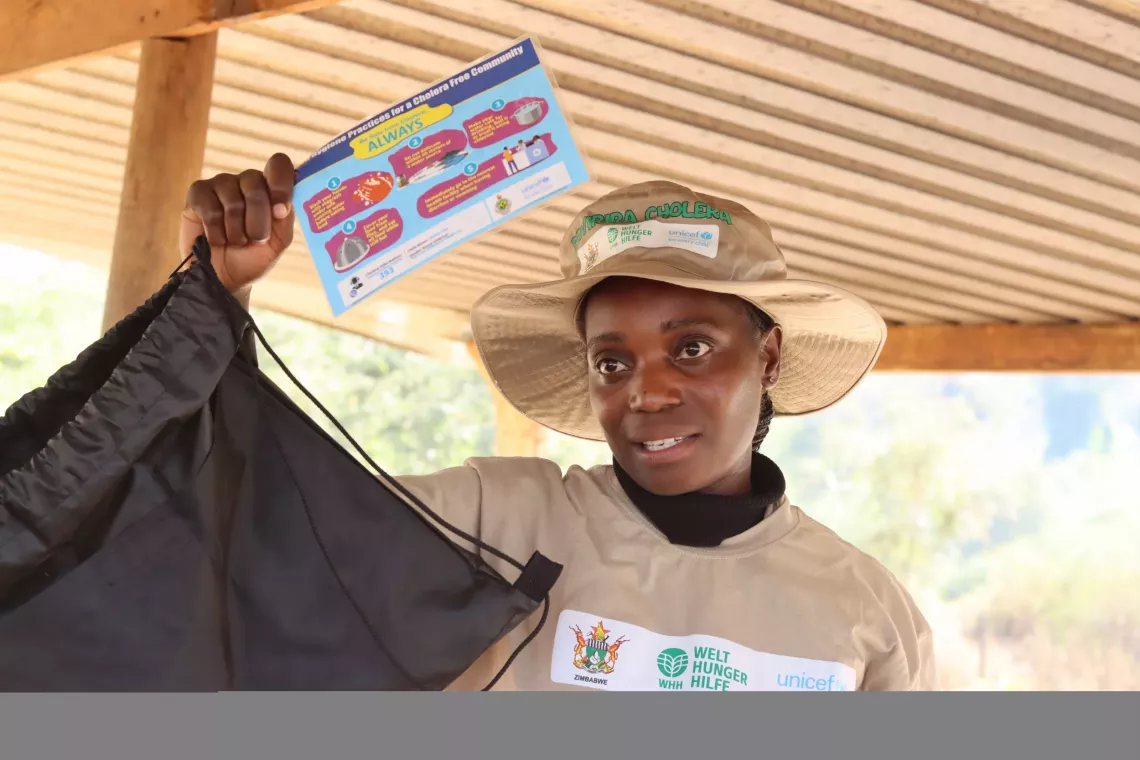
Jenny Mukombi, an NFI kit recipient at Tongogara Farm in Mt. Darwin, is now a strong advocate for good hygiene practices.
“The need for proper handwashing with clean water and soap after using the toilet or when handling food can never be over-emphasised. We lost several members of this community to cholera, and we do not want a repeat of that.
“Our naked eyes what to what to what to see the bacteria in water; what we might view as clean water can be contaminated. This is why we use water guards in all our drinking water. I am encouraging community members to do the same,” said Mukombi.
Through the collective efforts of the donor community, community members, local leaders, and healthcare professionals, the incidence of cholera has decreased in Mukaradzi, and living conditions in the area have improved. The mining community has shown resilience and determination in the face of adversity.
UNICEF’s cholera response is funded by multiple donors, including the Centre for Disease Control and Prevention (CDC); the European Civil Protection and Humanitarian Aid Operations (ECHO); the Health Resilience Fund (HRF), a Zimbabwean pooled fund supported by the Governments of Ireland, the United Kingdom, the European Union, and GAVI, the Vaccine Alliance; Japan; the UN Central Emergency Response Fund (CERF) and UNICEF Global Humanitarian Funding, and with in-kind support from private sector partners such as Alliance Media & JCDecaux for digital billboards, and Cash-In-Kind logistics support for commodities from United Parcel Service (UPS) Foundation.


