High Level Field Mission: Children’s rights are interlinked
A UNICEF organised High-Level Delegation with Government and donors visits education, health, nutrition, WASH and child protection programmes in Mutare and Rusape

Children’s rights are interlinked; therefore, an integrated approach is the most effective way to tackle the needs of children. That was the credo of a High-Level Field Mission UNICEF organised to Mutare and Rusape in the Manicaland province. The High-Level Delegation included the Ambassadors of the European Union, Indonesia and Japan and the Development Director of the Embassy of the United Kingdom to Zimbabwe. The mission started in Manicaland’s provincial capital Mutare with a courtesy call to Hon Nokuthula Matsikenyere, Minister of State for Provincial Affairs and Devolution. The participation of Ms Tumisang Thabela, Permanent Secretary of the Ministry of Primary and Secondary Education, graced the field mission. It included several provincial and district officials from the education, health, land and agriculture, and child protection sectors.
The field mission in Mutare district brought the High-Level Delegation to Gombakomba Primary School, Matanda health facility and the Mururu water scheme. The next day, the delegation travelled to Rusape and visited the solarised Chamakumbu Secondary School in the Mokani district. The mission concluded with a comprehensive visit to the child protection programme, including a meeting with Community Childcare workers, Child-Friendly, the Child-Friendly Court visit, and a presentation at the Victim Friendly Police Unit of Rusape.
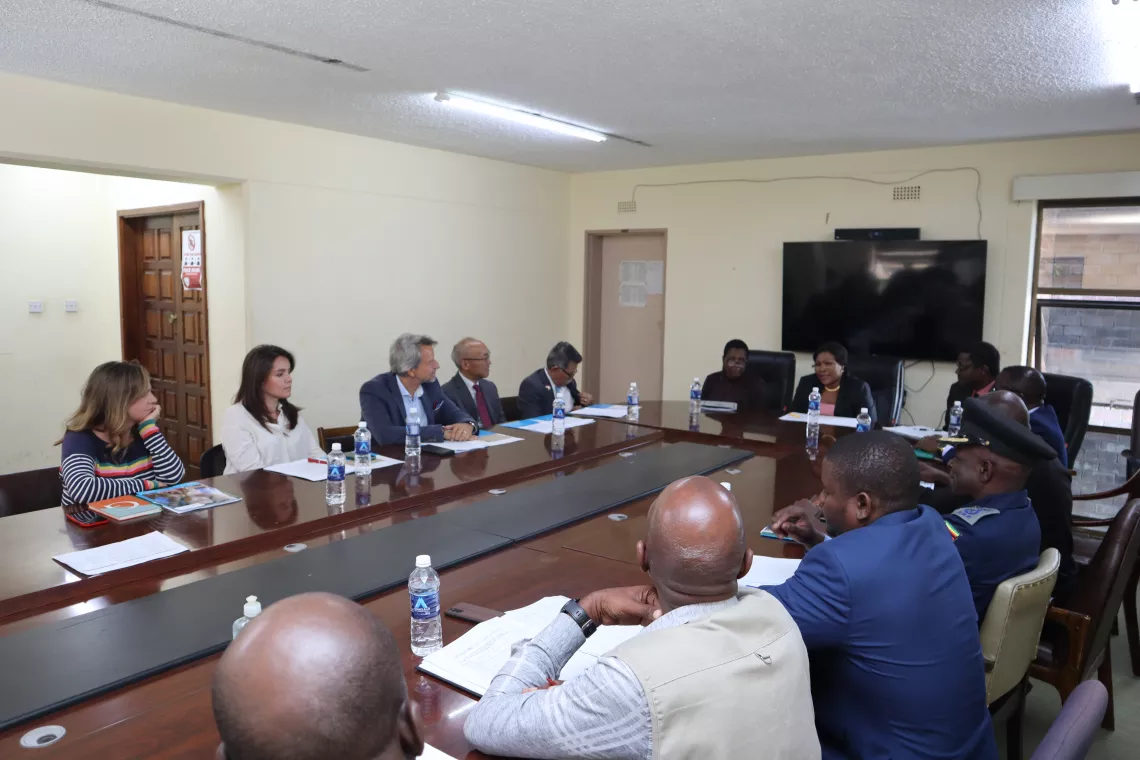
Hon Nokuthula Matsikenyere, Minister of State for Provincial Affairs and Devolution, receives in the Government Composite Building of Mutare the High-Level Delegation for a courtesy call at the beginning of a two-day field visit to Manicaland. From right to left Ms Geraldine O’Callaghan, Development Director at the Embassy of the United Kingdom to Zimbabwe; Ms Maria von Kirschmann, wife of the EU Ambassador to Zimbabwe; Dr Tajudeen Oyewale, UNICEF Representative; HE Mr Jobst von Kirschmann, EU Ambassador to Zimbabwe; HE Mr Dewa Made J Sastrawan, Ambassador of Indonesia to Zimbabwe; and HE Mr Satoshi Tanaka, Ambassador of Japan to Zimbabwe.

The High-Level Delegation visits the Gombakomba Primary School. The school was supported with new curriculum textbooks through the Global Partnership for Education (GPE), funded by the European Union and the United Kingdom. Teachers in the school were trained in syllabus interpretation and continuous assessment. The Global Partnership, through the complementary School Improvement Grant (SIG) programme, also assisted the school with a USD 5,000 grant to build a new classroom block for 50 Early Child Development learners. To complete the classroom while parents and the community contributed labour and financial resources valued at approximately US$15,000.
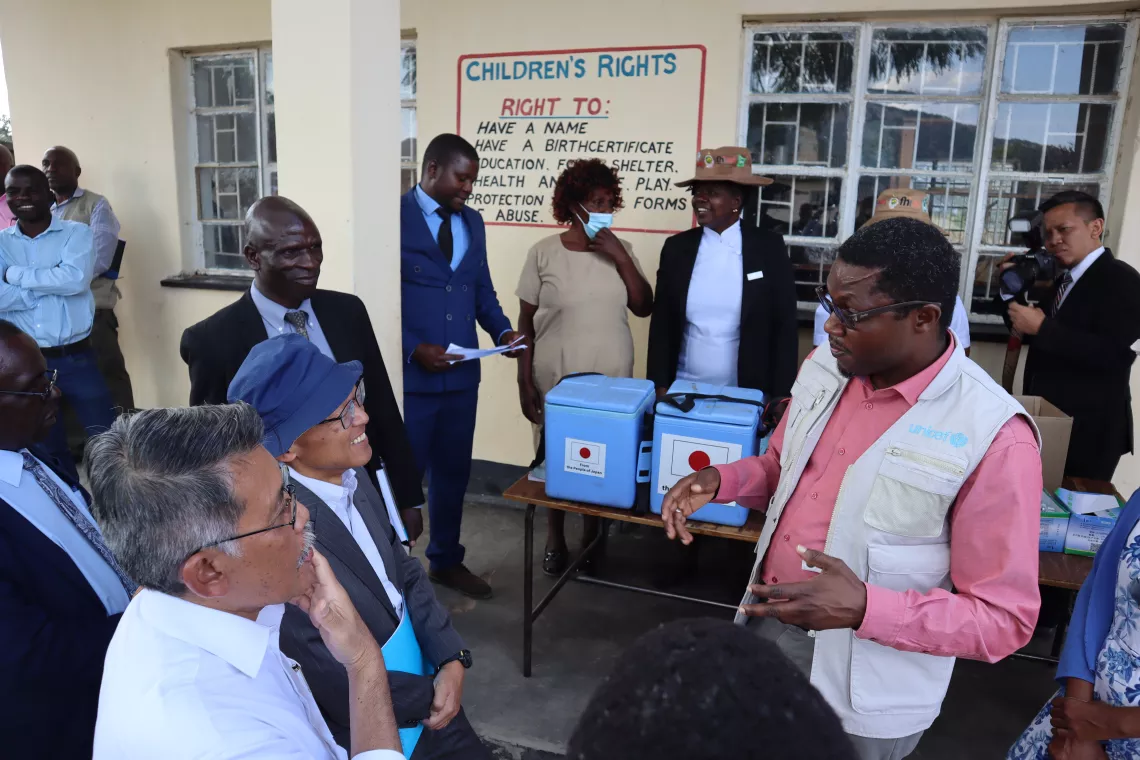
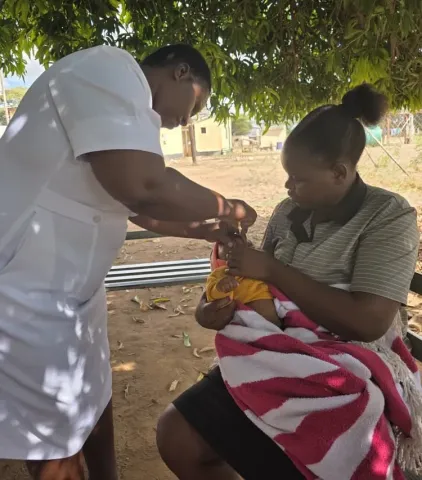
In Gombakomba Primary School, learning is linked to health and nutrition. A school feeding programme provides children with a warm meal to tackle malnutrition among the children. The feeding programme has a positive impact on the enrolment rates of learners and their learning performances. Village health workers (VHWs) visit the school regularly to provide health support to the learners, including through vaccination. Japan supports the vaccination programme in schools and health facilities by providing funds for the cold chain to ensure vaccines reach children at the right temperature.

The High-Level Delegation in one of the classrooms of the Gombakomba Primary School, with the teacher. Gombakomba Primary School is a Safe School. Every child has a right to a safe and secure environment within the school and home to make learning possible and fulfilling. Violence against children may lead to decreased self-esteem, reduced school attendance, and lower academic achievement. Once children experience violence, there is a long-lasting impact on their lives. To respond to this, the Safe School programme has trained the Gombakomba Primary School Guidance and Counselling teachers on Child Protection, including Mental Health and Psychosocial Support (MHPSS). In addition, the school established a school-based child protection committee composed of school management, parents and caregivers, community leaders and learners.

The Matanda Clinic in the Mutare district is a typical static rural primary health care facility. The clinic has three nurses and serves a population of 7,368, with approximately 21% below five years of age. Through the Health Development Fund (HDF) and its successor, the Health Resilience Fund (HRF), with financial contributions from the European Union and the United Kingdom, and funding from Japan for the cold chain, UNICEF has been supporting the Matanda health facility with essential medicines and nutrition commodities; training of health workers; procurement of necessary maternal neo-natal child health equipment and supplies; preventative and curative nutrition services; and assistance for the Expanded Programme on Immunization (EPI).

The High-Level Field visit ended its first day in Mururu. Mururu is a community-managed solar-powered piped water scheme established under the Climate Adaptation Water and Energy Project, supported by the United Kingdom. The system serves 1,543 people, including two schools. A total of 18 stand-up taps are distributed over the area. Thanks to the community-managed solar-powered piped water scheme, children and staff at the two benefiting schools can now access safe drinking and hand-washing water helping. The water scheme now also provides safe water at inaccessible distances reducing the burden for women, children, the elderly, and people with disability. Household walking distances were reduced from an average of 2 kilometres to 50 meters. The availability of safe water led to a marked reduction in diarrheal cases reported in the area.


The second leg of the mission included a stop at the Chamakumbu Secondary School in the Makoni district, 40 kilometres south of Rusape. The school has benefitted from the solarisation programme meant to improve the learning environment for the children. The programme provides clean energy to teachers’ houses, school administration and Leaners Information Technology Hub to enable digital learning. In Makoni district, four schools benefitted from this project bringing together donors, Government, and development partners to contribute towards the six pillars of the Reimagine Education agenda: connectivity, renewable energy, affordable content, devices, youth engagement and digital learning solutions. The United Kingdom is a key funder in the solarisation programme rolled out in Zimbabwe by UNICEF in support of Primary and Secondary Education.


The High-Level Field Visit ended with a comprehensive programme on child protection. In Rusape, the delegation met with ten community childcare workers. The Community Childcare Workers are the frontline community workers within the National Case Management System. They identify and refer child abuse and exploitation cases to relevant services for medical, legal and social support and further investigation by the Victim Friendly Police Unit. The delegation was given a presentation by the Victim Friendly Police Unit of Rusape and visited the Victim Friendly Court. A Victim Friendly Court is a court centred around a vulnerable witness, often testifying in a case of sexual abuse. Given the nature of the trauma, the court is geared towards accommodating the witness. The court has a separation room where the survivor can testify and be protected from re-traumatization. The Child Friendly System is funded by the European Union through the Spotlight initiative.