Unbroken
Chichi’s fight against child marriage and her mission to protect every girl

LUSAKA, Zambia, November 2025 --- “When my dad broke the news, I wasn’t broken at first. I trusted him; I knew he loved me and would never give me something harmful. I believed he was doing what was best for me,” shared Chipasha, reflecting on what went through her mind when her father first told her he was marrying her off.
At only 15, Chipasha Iliamupu’s (affectionately called Chichi) life was married off for K300 - about thirteen U.S. dollars. As a child bride to a man twenty years older, her dreams of education and freedom were traded for survival. Yet today, at 32, the same girl once silenced by circumstances stands before global leaders, speaking for millions of girls still trapped in the cycle she bravely escaped. Chichi, an Ending Child Marriage (ECM) Champion, is a qualified linguistics teacher at the Mayukwayukwa Day Secondary School, a refugee settlement in Western province of Zambia and a volunteer at the Young Women’s Christian Association (YWCA). She has turned her painful past into a platform for agency. Chichi proudly shares that she passed victimhood as a survivor and now is a positive advocate for ending child marriage. From the fields of her rural childhood to the stages of the United Nations and now the biannual Global Programme on Ending Child Marriage (GPECM)’s Global Meeting, her journey is one of defiance, hope, and unwavering resilience - a true testament to what happens when a girl is given the chance to rise.
Born in Livingstone, Zambia, Chichi is the eighth of nine children, among three sisters and five brothers. Both her parents have since passed away.
Reflecting on her childhood, Chichi describes a life marked by struggle and poverty. “Life growing up was tough; we lived in abject poverty,” she said. Neither of her parents had any formal education. Her mother earned a modest living through tailoring, while her father worked as a casual labourer at Kafue Textiles in Livingstone.
Due to the difficult living conditions, Chichi’s uncle decided to move the entire family to the Kalumwange Resettlement Scheme in Kaoma, hoping they could start afresh. But the change of location brought little relief. “It was something different, but the poverty followed us,” Chichi recalled. “Education opportunities disappeared. None of my siblings made it to the grade seven exams.”
Her three sisters left school early and became mothers before marriage. With no funds for education, the entire family - including Chichi, ended up abandoning schooling.
Determined not to give up, Chichi resorted to manual jobs to survive, often weeding people’s gardens in exchange for money, food or clothing. “Through that, I was able to sponsor my schooling,” she said. Her efforts paid off - she managed to study up to grade eight before reaching adulthood.

But in December 2008, when schools closed, Chichi’s father introduced her to a suitor - a man twenty years her senior, who already had three children from three different women. Her father’s decision, Chichi explained, was driven by a sense of dignity and social pressure. “He didn’t want to be a laughingstock in the village after my three sisters had children out of wedlock,” she said. “He also saw the marriage as an opportunity for dowry - the man paid him K300.00 +/-$13.00 and assured him he would take me back to school, because that was my only cry.”
“After a full month in seclusion, I was finally pronounced a grown woman - ready for marriage,” Chichi recalled. “At the time, I was still sponsoring myself in school. I knew primary school was manageable, but secondary and boarding fees would be far more expensive. I would have had to work ten times harder just to stay in school. So, when my husband said he was willing to pay for my education, I thought it was the right thing to accept.”
Chichi recalls that moment as the point where her understanding of girlhood disappeared. To her, she felt like a child up until the day she saw her first menstruation.
After that, she was considered a woman - and society, along with her father, decided it was time for her to marry. “That’s how I lost my childhood,” she reflected. The boundaries were suddenly clear: she could no longer play or mingle with her peers. Yet, despite being treated as a woman, the older women in her community still saw her as a child because of her age, leaving her caught between two worlds.
The marriage turned out to be nothing like what Chichi had been led to believe. What was meant to be a new beginning quickly became a life filled with pain, abuse, rape, and torture. The promise of school sponsorship - the one hope that had made her agree to the union, soon disappeared. Amid the suffering, Chichi became pregnant and gave birth to a daughter, who is now 16 years old and in the 11th grade.
When asked what gave her the strength to leave her marriage despite the risks. Chichi recalled a turning point: One day, while taking her daughter for an under-five check-up, a Young Women Christian Association (YWCA) peer educator began speaking to mothers about the dangers of early pregnancy and child marriage. “It felt like she was describing my life,” Chichi said. The message struck a chord, making her reflect on how her peers were still in school while she was trapped in an abusive marriage. She later visited the YWCA office to share her story. Although they didn’t directly advise her to leave, the options they presented helped her realise that staying might cost her life - and her daughter’s future. That realisation gave her the courage to leave, carefully and strategically, to avoid further harm.
One of her key motivations was the broken promise that her husband would support her education. Instead, he insisted she first bears him two or three children. Determined to take control of her future, Chichi secretly enrolled in grade nine and began making and selling ice blocks to pay her own examination fees of K37.50/$1.66.
At school, she studied alongside one of her stepdaughters, who was in grade eight, often helping her revise while preparing for her own exams. When Chichi passed and qualified for grade ten at Kaoma Secondary School, she discovered that the YWCA. was running a “safe space” programme for girls. She joined - and eventually became the group’s president.
From grades ten to twelve, Chichi thrived academically and personally. She completed secondary school impressively and was later admitted to the University of Zambia (UNZA) on a full bursary, where she pursued a Bachelor of Arts with Education, majoring in Linguistics in African Languages and English.

I wish the younger version of myself understood her rights - and had known about the institutions and organizations that could have protected her from losing her childhood...
Witnessing a significant gap in advocacy and protection motivated me to champion this cause. During my own marriage, no one spoke up or stood on my behalf. Despite the hardships I faced. Of course, I forgave my father - even though his situation did not improve after receiving the bride price. I cared for him in my own home until his passing in 2012, when he died in my arms.
She explained that many people believe once a girl enters marriage, she is trapped and can never escape it - as though confined to a prison cell. Even educated individuals often assume that girls who have experienced marriage cannot succeed academically or be productive members of society. She added that survivors are frequently judged and blamed, especially when they try to rebuild their lives or leave such situations.
Chichi knows all too well the vital role education has played in transforming her life. She uses her experience as a positive example for her daughter and, as a teacher of adolescents, continuously mentors young girls - encouraging them to stay focused on their education as the key to a brighter future.
She believes traditional leaders can play a crucial role by strengthening and enforcing community rules, as they are the gatekeepers of local customs and practices. On a broader scale, global initiatives such as GPECM and similar systems should recognize that rescuing girls from child marriages is only the first step. There is a need for comprehensive aftercare services that should support survivors as they heal, helping them reintegrate into their communities without fear of stigma, while also equipping them with practical skills to sustain themselves.

Chichi urges parents to let their children remain children and prioritize their education, reminding them that a dowry cannot lift a family out of poverty - its benefit is temporary, and the hardships will persist. She also encourages delaying initiation ceremonies (where girls are taught among other things, about marriage) until children are mature enough to understand their significance, ideally after completing their final grades.
To girls who feel trapped or hopeless in marriages before the right time, her message is one of courage and hope: “though the journey may be difficult, stand up and fight for your rights - there are organizations and institutions ready to protect and support you,” she concludes.
Chichi expresses deep gratitude to the Government of the Republic of Zambia for the Re-Entry Policy, which gave her a second chance at education and a new beginning. Without it, she says, she might still have been trapped in marriage - but today, she stands as a testament to the power of opportunity and hope. Chichi’s story is more than survival - it’s a rallying cry for every girl still fighting to claim her voice. Her journey from a child bride sold for a few kwachas to a global advocate standing before world leaders is proof that no dream is too small, and no voice too faint to spark change.
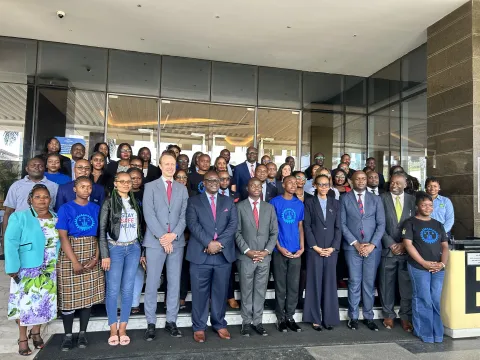
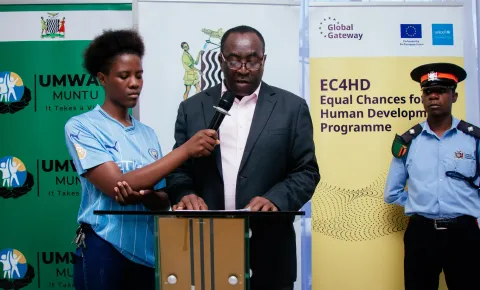
During the commemoration of the International Day of the Girl, Chichi took the stage in Nairobi, Kenya carrying not just her own story, but the hopes of countless girls who believe that one day, they too will be free to choose education over exploitation, dignity over despair, and hope over fear.
Because when one girl rises, the world rises with her.
###