Tackling Cholera Starts in the Community
Community-based approach crucial for cholera outbreak response to provide early care

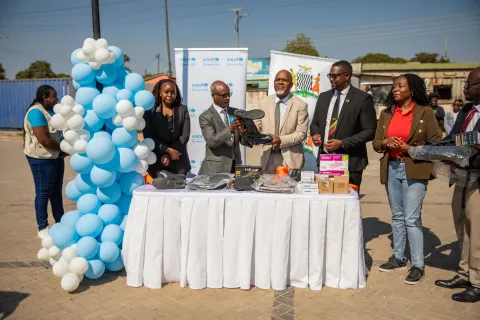
Creating a community-based treatment structure to respond to the cholera outbreak is crucial to provide early care to those showing symptoms of cholera. Early treatment prevents cases from spreading and has been key to lowering cases of cholera in Zambia. Fortunately, with the support of donors like the European Union Humanitarian Aid (ECHO) and the Central Emergency Respond Fund (CERF), these systems could be strengthened both in the hotspots of Lusaka and beyond as the cholera outbreak spread.
Partnering with the Red Cross and the World Health Organization (WHO), UNICEF contributed to the establishment of treatment structures, which included Oral Rehydration Points (ORPs), Oral Rehydration Centers (ORCs) and Cholera Treatment Centers (CTC). The first line of defense against cholera is the ORPs which are operated by trained Community Based Volunteers (CBVs) and can be found outside their homes. These locations are meant to be easily accessible for anyone showing potential signs of cholera. At the ORPs one can find Oral Rehydration Salt (ORS), which is necessary to treat diarrhea. Depending on the symptoms presented, the CBV will then help transport the patient for further treatment.

The next stop is the Oral Rehydration Centers (ORCs). ORCs are operated by an environmental health technician and in charge nurse. These are located in key points throughout hotspot communities. Here, cholera patients can receive additional treatment. Finally, Cholera Treatment Centers (CTCs) were created at health facilities and hospitals where those who were presenting symptoms could be taken for treatment. These CTCs allow for cholera patients to be treated in a confined location to stem the spread of disease. They are highly organised and allow facilities to treat more patients in a clean and expanded location. These CTCs drastically improved facilities’ ability to treat cholera patients. At the Chipata CTC this could be seen by an increased number of hygienic beds, improved data keeping systems, and modernized equipment.
During the height of the outbreak, Heroes Stadium became the treatment center for the masses. However, CTCs allowed for patients to be seen in locations closer to home, which was crucial for severe cases. Some also shared with us that it allowed for families to visit easier than they would be able to at Heroes.
These 3 systems are powered by dedicated health professionals and volunteers. Bringing the two together have allowed community members to take ownership of the disease outbreak in their community. Oftentimes, they are the ones to first learn who is sick or showing symptoms and can quickly provide the first round of ORS prior to helping them seek additional treatment.
Strengthened systems such as these are key to not only treating current cases but preventing future cholera outbreaks and quickly responding as the need arises. The combination of these structures also highlights the strength of multiple organizations working together and the impact that can be had when measures are developed in coordination with each other.