Reaching the Green Zone
How community-led actions are improving child nutrition in hard-to-reach areas of the Sinazongwe District

Sinazongwe District, Southern province, Zambia, February 2026 – More than 12 kilometres away from the Sinazongwe District Health Office, in a rural community often out of reach and out of network, children are growing up strong and healthy. Community-based Volunteers (CBVs), parents and caregivers are driving this with the introduction of a simple, easy-to-use self-monitoring tool: the Family Mid-Upper Arm Circumference (MUAC) tape.
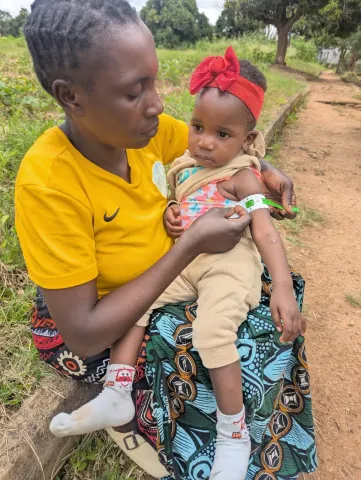
“One day a CBV came to my home and measured my son, Blessing, using the Family MUAC tape,” recalls Lance Mututa, 22. “That is when I discovered he had moderate malnutrition. We were then enrolled in the programme and received a corn and soya blend to improve his nutrition.”
Before the programme was introduced, women and caregivers in this community walked more than 12 kilometres across lush hills and under intense heat to reach the nearest health facility. A single visit could take more than six hours to complete, including commuting every time a child had diarrhoea or fell ill.

These challenges were felt even more heavily during the 2024–2025 drought, which reduced crop yields and worsened food insecurity and malnutrition among children.
“With the drought that occurred in 2024–2025, we saw a surge in malnutrition levels,” explains Dr. Christabel Musonda, District Health Director for Sinazongwe.
We are very grateful for the support received through CERF beyond the immediate drought response, because capacity to respond to malnutrition shifted from the health facility to the community.
Dr. Christabel Musonda, District Health Director for Sinazongwe.
Unfortunately, the Chamukwapulo area of Sinazongwe District has not only been affected by the drought. When heavy rains fall during the rainy season, hard-to-reach areas become even more isolated, with families forced to cross streams to access essential services.
However, the distance and barriers that once made it difficult for families to access lifesaving health and nutrition services are beginning to change. In Sinazongwe District, twenty health workers have been oriented in Family MUAC and effective community health communication. They have passed this knowledge to 103 Community-Based Volunteers, who have since oriented more than 3,000 mothers and caregivers across 44 hard-to-reach areas in the district. Families can now check their children’s nutrition status at home, helping detect malnutrition earlier, enabling quicker treatment, and ultimately saving lives.
“Previously, we relied on mothers coming to the health facility, where CBVs would screen children for moderate and severe acute malnutrition,” Dr. Musonda explains. “Now screening starts in the community. Mothers can monitor their children directly and only refer to the health facility when necessary.”
Community-Based Volunteers have also been oriented to manage acute malnutrition within the community, further reducing barriers to access, as before treatment was only accessible in the health facilities.
“Nutrition supplies are now available within our community,” says Belda Maanya, a CBV who supported Lance.
It is a game changer. Children and caregivers no longer need to walk long distances. What motivates me is that I now have knowledge I did not have before. There is more awareness in the village. We are seeing fewer children suffering from malnutrition and preventable diseases
Dr. Christabel Musonda, District Health Director for Sinazongwe.

As communities prepare for future climate shocks, like heavy rains that flood roads and cut off villages, they are now better able to keep essential nutrition services going. Treatment supplies are available within the community, and trained Community‑Based Volunteers are providing care closer to families. Parents themselves can check their children’s nutrition status using simple tools like Family MUAC, meaning they no longer rely solely on distant health facilities. As a result, even when roads are flooded or services are disrupted, children can still get timely treatment, helping communities stay strong and adapt in the face of recurring climate‑related emergencies.
Lance now checks Blessing’s arm regularly, watching the colours on the tape closely. She looks forward to the day when Blessing’s arm finally reaches the green section: a sign not only of his recovery, but also a demonstration that when parents, caregivers, and communities are equipped with the right knowledge and work together, they become first responders for their children’s health and a lifeline for their communities.

UNICEF is grateful for the support from the United Nations Central Emergency Response Fund (CERF), which has made this work possible. Together with Plan International and the Ministry of Health, climate-adapted nutrition services are now reaching families where they live. By bringing care closer to communities and empowering Community-Based Volunteers with simple tools like the Family MUAC tape, parents can spot signs of malnutrition early and get help quickly—even when floods or other climate-related emergencies disrupt access to health facilities. This investment is helping build stronger national systems and a healthier, more resilient generation of children in Zambia.