Between Loss and Care: A mother’s ongoing journey in the Neonatal Intensive Care Unit
How UNICEF supported neonatal care is helping one mother through prematurity

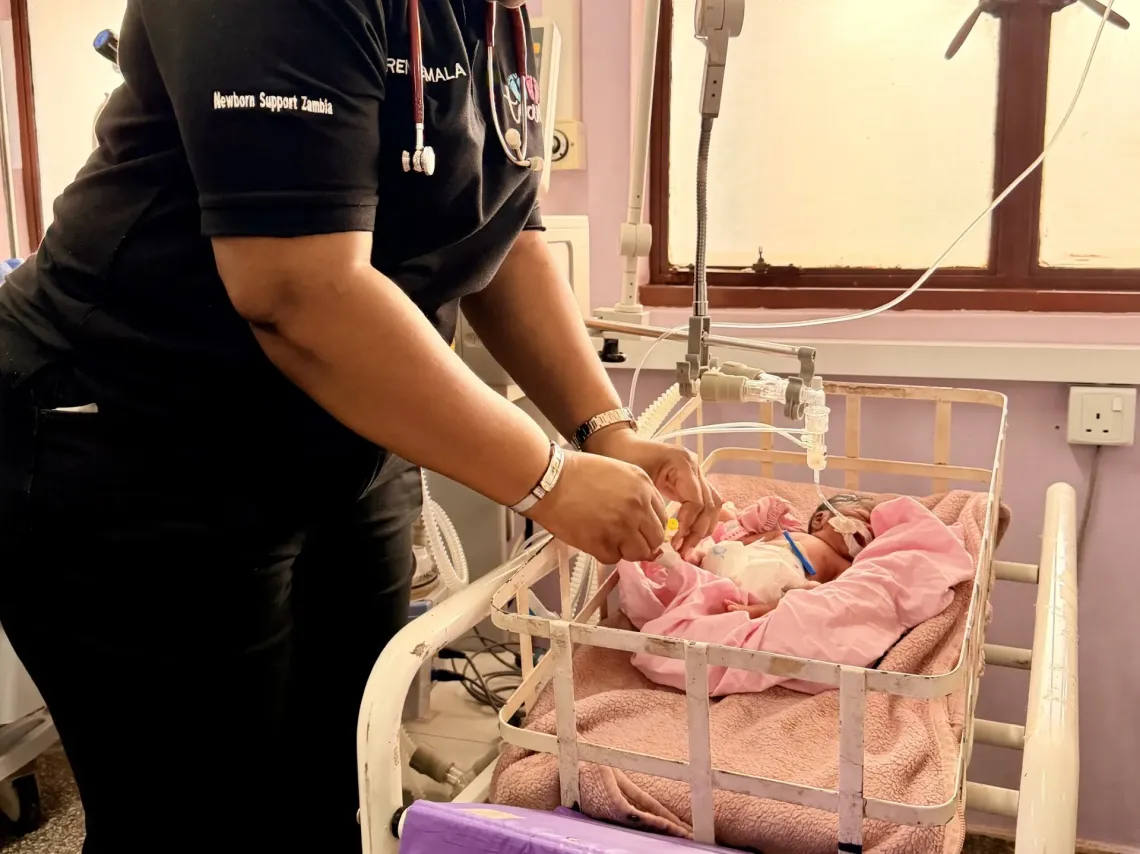
LUSAKA, Lusaka province, Zambia, December 2025 --- The Neonatal Intensive Care Unit (NICU) at the University Teaching Hospital’s – Women and Newborn Hospital has become the center of one mother’s world for nearly two weeks. Mwendalubi Solochi sits for hours beside her premature baby boy, observing carefully on a plastic chair, listening to the steady hum of machines and soft yawns of newborns fighting to survive.
Mwendalubi is a teacher and mother of four. At home, three young boys wait, unable to enter the ward due to hospital rules. Her husband visits when he can but most days, she walks outside to hug her other children when they visit, then returns to the unit. “It’s hard”, she says. “You want all your children close, but you have to keep going.”
This was her first experience with premature birth. Her pregnancy was normal. She attended antenatal care throughout her entire pregnancy and felt well. When labour started before 37 weeks, it came as a shock. Nothing had prepared her for the reality of the NICU or the loss that followed.
Mwendalubi was carrying twin boys. One survived; the other did not.
“Some days,” she says in tears, “I find myself walking towards the room where the other baby was. Then I remember he is no longer there.” The memory stops her mid step.
Inside the NICU, staff work under immense pressure. Dr. Mala, a neonatal fellow who has worked in the hospital for 15 years, explains that the hospital receives the most complicated cases. “We care for premature babies, babies with infections, breathing problems, congenital conditions; all of them come here,” she says.
She adds that support must extend beyond the hospital walls. Mothers like Mwendalubi need help not only from their families, but from the community as well. With that support, this is a baby who can grow.
UNICEF has supported this work in concrete ways. According to Dr. Mala, equipment provided through UNICEF, including warmers, phototherapy machines, infusion pumps and infection prevention supplies, has helped reduce loss of lives in the unit. “We used to see higher numbers of deaths,” she says. “Now, those numbers have gone down.”

With funding from SIDA, UNICEF also supported the national rollout of the Kangaroo mother care, helping train health workers and strengthen care closer to communities, reducing unnecessary referrals to overcrowded tertiary hospitals like the UTH.
For Mwendalubi sitting beside her baby, these systems are felt in small, daily moments; when her baby is warm, when nurses guide her hands during skin-to-skin care or when machines hum quietly and do their work.

This is not the journey Mwendalubi imagined. It is marked with many emotions from loss, exhaustion, and uncertainty. However, inside the NICU, she is surrounded by care and holds onto hope. Hope that tomorrow will be gentler than today.