UNICEF warns climate impacts on education could lead to $21 billion in lost future earnings in Zambia
As the Fund for responding to Loss and Damage (FRLD) Board meets in Livingstone, new analysis highlights urgent need to mobilize financing and strengthen education systems to address climate-related loss and damage and protect children’s learning

LIVINGSTONE, 21 April 2026 – Climate-related disasters have already cost education systems in Zambia USD 60 million in damage to infrastructure and have disrupted learning for around 5 million children, according to a new UNICEF and Dalberg report, Protecting Children’s Learning Futures: Quantifying Climate-Related Loss and Damage in Eastern and Southern Africa. The analysis estimates these disruptions have resulted in up to USD 5 billion in lost future earnings, a figure projected to reach between USD 13 and USD 21 billion by 2050 as climate impacts intensify.
Zambia’s experience already illustrates the scale and human toll of these projections. The strong 2023–2024 El Niño drought in Southern Africa, one of the worst in decades, left nearly 10 million people without food, water, or power. Schools were consequently forced to reduce hours, close temporarily, or send students home early. Rural children and girls were disproportionately affected, with many dropping out to support family livelihoods or facing increased child marriage risks.
As Zambia hosts the 8th Board Meeting of the Fund for responding to Loss and Damage (FRLD), UNICEF and Dalberg are releasing for the first time a report that quantifies the scale of economic climate-related loss and damage to education in Zambia and across the region. Despite this, children remain largely invisible in financing decisions, and education continues to be insufficiently reflected in climate responses.
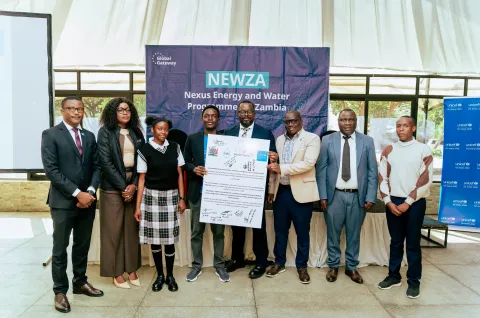
“Zambia is already experiencing the real and growing impacts of climate change on our people and our systems, including education,” said Hon. Credo Nanjuwa, the Minister for Southern Province speaking on behalf of the Minister of Green Economy and Environment. “As we host the FRLD Board Meeting, we have the critical opportunity to ensure that climate financing responds to these realities, especially realities of those most vulnerable to climate impacts – children – and prioritizes their critical services.”
Climate-related disasters such as droughts and floods have already cost education systems in Eastern and Southern Africa an estimated USD 1.3 billion in direct loss and damage and disrupted the learning for 130 million children, according to the analysis. Such disruptions have resulted in up to USD 140 billion in lost future earnings for countries and are projected to rise to USD 380 billion by 2050 as climate impacts intensify and if no action is taken.
“When schools are disrupted by floods, droughts, or extreme heat, it is children’s learning and futures that are at risk,” said Mr. Mang’ombe Tembo, the Principal Planner from the Ministry of Education. “We must invest in climate-resilient education systems that minimizes climate related loss and damage and keeps schools safe, inclusive, functional, and resilient in the face of climate-related shocks.”
The UNICEF and Dalberg report includes in-depth analysis from Ethiopia, Kenya, Mozambique, Somalia and Zambia, demonstrating how increasing and more intense extreme weather events – including floods, droughts, cyclones and heatwaves – are destroying school infrastructure, forcing children out of classrooms, and disproportionately affecting girls, children with disabilities, and marginalized communities.
“When climate shocks hit, it is our education that suffers first,” said Hildah, a youth representative. “We want solutions that protect our learning, because our future depends on it.”
Beyond infrastructure damage, climate change is also generating significant non-economic losses, including lost learning time, psychosocial stress, and increased protection risks for children. Missed school days today also translate into lower lifetime earnings tomorrow, compounding long-term impacts on human development and national development.
Despite these impacts, education receives only 0.5 per cent of global climate finance, leaving education systems exposed to repeated cycles of loss and recovery. Evidence from Mozambique underscores the value of investment: schools built to resilient standards withstood Cyclones Idai and Kenneth in 2019, while thousands of conventionally built classrooms were destroyed. The UNICEF and Dalberg analysis shows that strengthening schools to withstand climate shocks not only protects education but delivers strong economic returns, with every USD 1 invested generating up to USD 13 in benefits by reducing damage and disruption, safeguarding learning continuity, and preserving children’s long-term development and productivity.
"Education is a fundamental right of every child and one of the smartest investments countries can make to safeguard their future economies. Building climate-resilient education systems is no longer optional; without it, the socio-economic development of nations will be irreversibly harmed," said Dr. Saja Farooq Abdullah, UNICEF Zambia Representative.
As the FRLD Board meets in Livingstone later this week, it is essential to recognize children not only as those most affected by climate impacts, but as rights-holders whose learning, protection, and well-being must be safeguarded during climate-related crises, and whose needs, capacities and voices must shape recovery and resilience. Climate-related loss and damage to education is not only a financing challenge – it is a systems and continuity challenge, with long-term implications for human capital and national development.
Addressing this challenge requires concrete and coordinated actions. To protect children’s learning, strengthen resilience to future shocks, and further advance Africa’s long-term development, UNICEF urges governments, donors, and climate funds to:
- Strengthen the integration of education within national climate frameworks: Explicitly reference education – including learning continuity, system resilience, and protection of children’s rights - in National Adaptation Plans (NAPs) and Nationally Determined Contributions (NDCs), and other climate policies, to ensure education is recognized as an essential service and to help unlock access to climate and loss-and-damage financing.
- Apply a climate-risk and resilience lens to domestic education financing: Ensure budget allocations to education are climate-informed and prioritize continuity of learning, safe school operations, psychosocial support, and protection measures, particularly at the foundational stage of learning, so that education systems remain inclusive, functional and resilient in the face of climate-related shocks.
- Scale and target international climate finance for education: Ensure major climate funds, including the Green Climate Fund, Adaptation Fund and the Fund for responding to Loss and Damage (FRLD), allocate dedicated resources to education, with FRLD specifically supporting unavoidable losses as well as recovery actions that restore learning continuity and strengthen climate-resilient education systems when climate impacts exceed what education systems can adapt to.
- Recognize education-related loss and damage as both economic and non-economic: Acknowledge learning loss, psychological distress, and education system disruption as non-economic losses within loss-and-damage frameworks, alongside infrastructure damage, to ensure climate responses address the full range of impacts on children’s learning and development.
###
Note to editors:
B-roll: Climate and Education Broadcast
Country analyses in the UNICEF and Dalberg report also include:
- Kenya: 2024 floods disrupted schooling and widened gender gaps in re-enrollment, particularly for girls and children with disabilities.
- Somalia: Repeated droughts, floods and conflict have driven mass displacement, leaving millions of children out of school and newly displaced children - especially girls - least likely to attend.
- Mozambique: Cyclones Idai and Kenneth in 2019 showed that while thousands of classrooms were destroyed, those built to resilient standards withstood the impact - highlighting both the returns on investment and the scale of unmet need.
- Ethiopia: Rising temperatures and more frequent heatwaves affect 83% of children, and are already disrupting school attendance, reducing concentration in the classroom, and undermining learning outcomes.
Media contacts
About UNICEF
UNICEF promotes the rights and wellbeing of every child, in everything we do. Together with our partners, we work in 190 countries and territories to translate that commitment into practical action, focusing special effort on reaching the most vulnerable and excluded children, to the benefit of all children, everywhere.
For more information about UNICEF and its work for children in Zambia, visit www.unicef.org/zambia.
Follow UNICEF Zambia on Twitter, Facebook and Instagram