“My Day. My Rights.”: Zambian Children Call on the Government to Protect Their Rights Through Action on Child Poverty
World Children’s Day Event Highlights Release of State of the World’s Children Report, Sharing New Insights on Child Poverty and Urging Action from Regional Leaders
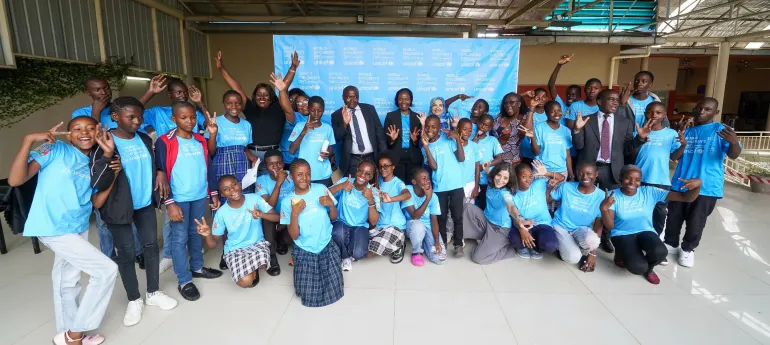
LUSAKA, 20 November 2025 – Today, Zambia joined the global community in commemorating World Children’s Day, under the international theme “My Day. My Rights: From Promises to Action” This year’s observance shines a spotlight on children’s lived experiences and calls for urgent action from leaders to move from promises to action in realizing the rights of all children.
The commemoration in Zambia brings together the Ministry of Community Development and Social Services (MCDSS), Members of Parliament, UNICEF, Joining Forces Alliance and children from across the country and featured the launch of the State of the World’s Children Report, a UNICEF report whose 2025 findings provide the latest global data on child poverty.
Acting Honourable Minister of Community Development and Social Services, Ms. Brenda Tambatamba (MP) stated, “Data and evidence are essential tools in our fight to protect and promote the rights of every Zambian child. Our ministry is deeply committed to using the latest research and analysis, such as the Multiple Overlapping Deprivation Analysis, to identify the most vulnerable children and tailor our interventions to their needs. One example of this commitment is our targeted cash transfer program, which is reaching families facing the greatest hardships, ensuring that no child is left behind as we work to end child poverty in Zambia.”
Speaking at the event, UNICEF Regional Advisor for Social Policy, Sarah Hague, highlighted the findings of the State of the World’s Children Report: “The State of the World’s Children Report underscores the urgent reality that too many Zambian children continue to face multiple, overlapping deprivations that threaten their health, education, and future well-being. We know that around 70 percent of children in Zambia are multidimensionally poor, and this demands an immediate, coordinated response. I call on the Government of the Republic of Zambia to lead a united effort, bringing together ministries, civil society, development partners, and the private sector, to harness the strengths of every stakeholder. Only through collective action can we fulfill our promise to every child and break the cycle of poverty once and for all,” she said.
In Zambia, about 6.6 million children representing about 70 per cent of those below the age of 18 are multidimensionally poor, experiencing two or more deprivations in key areas of children’s wellbeing.
“The Multiple Overlapping Deprivation Analysis (MODA) offers a powerful lens into the realities faced by Zambian children, revealing that multidimensional poverty affects nearly 70 percent of those under 18. This data is not just numbers—it is a call for urgent, united action. As Sarah Hague emphasized, we must come together across government, civil society, and the private sector to ensure no child is left behind. Let us use the evidence before us to drive coordinated solutions and fulfill our promise to break the cycle of child poverty,” explained Inez Dawoodje, Social Policy Specialist at UNICEF Zambia.
World Children’s Day offered a platform for children from all ten provinces to engage policymakers directly, interviewing them on commitments and progress towards the provisions of the Children’s Code Act and the Convention on the Rights of the Child.
“We are here to speak about what matters to us: education, health care, safety, and strong communities. We, the children of Zambia, believe that every child should be safe, learn well, stay healthy, and be able to reach their dreams. However, far too many of us are missing out on things that every child should have like good health, enough food, clean water, safety and a chance to learn. Many children are growing up without the basics they need to survive and thrive,” said Christabel Munsaka, 17 year old, from Southern Province.
This year’s World Children’s Day comes at a critical moment. Children’s rights are increasingly under threat from rising authoritarianism, the spread of disinformation, and dehumanization, all occurring within a rapidly shrinking civic space. Cuts to funding for children, growing violations of international humanitarian law, and mounting challenges to universal child rights are putting young lives and futures at risk, just when they need our help the most.
“Without urgent intervention, projections indicate that by 2030, there could be an additional 4.5 million deaths of children globally,’ said UNICEF Country Representative, Dr Saja Abdullah. “UNICEF calls on all stakeholders to reaffirm their commitment to ensuring access to education, health care, protection, and participation in decision-making, for every child.”
Parliamentary action is crucial in addressing and ultimately ending child poverty in Zambia. By leveraging data from the Multiple Overlapping Deprivation Analysis (MODA), Members of Parliament are better equipped to understand the scale and specific dimensions of child poverty across the country. MODA data reveals not only the prevalence but also the nature of deprivations children face—such as lack of access to clean water, education, and health services—enabling MPs to advocate for targeted policies and allocate resources where they are needed most. Through legislative oversight and the enactment of child-focused policies, Zambia’s Parliament plays a pivotal role in translating evidence into practical interventions that can break the cycle of poverty and secure a brighter future for every child.
Hon. Joseph Munsanje, Chairperson of the Parliamentary Caucus on Children said,
“Equal opportunities for all children are non-negotiable. Parliament stands ready to work with partners and communities to ensure that promises made to children are fulfilled. Accountability starts with us, and we invite children to hold us to that standard, as they have done today. We wish to conclude by reaffirming Zambia’s commitment to implementing and enforcing the international and regional Conventions that aim to promote and protect the rights of our children, and to ensuring that our national policies and legislation consider the provisions of these Conventions.”
The State of the World’s Children 2025 highlights that ending child poverty is achievable, and underscores the importance of centering child rights, as outlined in the UN Convention on the Rights of the Child, in all government strategies, policies and actions aimed at poverty reduction, by:
- Making ending child poverty a national priority.
- Integrating children’s needs into economic policies and budgets.
- Providing social protection programmes, including cash support to families.
- Expanding access to essential public services, such as education, healthcare, water, sanitation, nutrition, and housing.
- Promoting decent work for parents and caregivers to strengthen their economic security, which is closely linked to children’s progress.
###
About World Children’s Day
World Children’s Day, celebrated annually on 20 November, marks the adoption of the UN Convention on the Rights of the Child. It is UNICEF’s global day of action for children, by children, calling on governments, communities, and individuals to stand up for the rights of every child.
Media contacts
About UNICEF
UNICEF promotes the rights and wellbeing of every child, in everything we do. Together with our partners, we work in 190 countries and territories to translate that commitment into practical action, focusing special effort on reaching the most vulnerable and excluded children, to the benefit of all children, everywhere.
For more information about UNICEF and its work for children in Zambia, visit www.unicef.org/zambia.
Follow UNICEF Zambia on Twitter, Facebook and Instagram