Children Request Investments in Digital Literacy and Child Friendly Reporting Mechanisms
They shared their voices during the Children’s Conference organized to inform the implementation of the National Child Online Protection Strategy 2025-2027

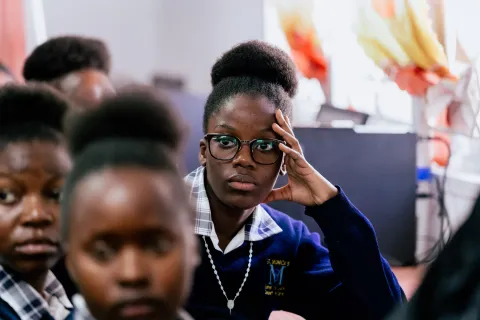
Lusaka, 23 January 2026 – Following the launch of the National Child Online Protection Strategy 2025–2029 (NCOP) on 24th November 2025, more than 35 children aged 10–17 from Lusaka Province gathered today to share their voices and experiences, discuss solutions and develop recommendations around the implementation of the strategy. This marks an important step towards creating a safer and more inclusive digital environment for children across Zambia.
At the centre of the conference were children, who shared perspectives and lived experiences on online safety, participation, and digital well-being requesting investments in digital literacy and child friendly reporting mechanisms. Children shared their concerns and recommendations on how to strengthen child online protection in Zambia, highlighting the importance of being involved in decisions that affect their digital lives.
The event was organized by the Zambia Information and Communication Technology Authority (ZICTA) with support from UNICEF and in collaboration with the Joining Forces Alliance. It brought together representatives from the Ministry of Community Development and Social Services, representatives from the Ministry of Technology and Science, the Chief Executive Officer of Lifeline–Childline, as well as representatives from other ministries, and regional and international organizations.
Children offered practical suggestions on how to make online spaces safer and more responsive to their needs, acting not only as beneficiaries, but as active partners in shaping solutions:
“I would like to see a digital future where every child feels safe on social media platforms. This can be achieved by taking serious action against cyberbullying and restricting children’s accounts from accessing content that is not safe or appropriate for them,” said Lukeke Faifa, 17 years old.
“One in twelve children worldwide has experienced some form of online sexual exploitation or abuse. New threats, including AI-generated abuse and virtual exploitation, are making online spaces more complex and dangerous. Here in Zambia, internet access is expanding rapidly, especially among young people. UNICEF is proud to support the Government of Zambia in aligning national efforts with global child online protection standards. Through partnerships with ZICTA, MCDSS, the Zambia Police Service, Childline, and others, UNICEF supports reporting mechanisms, awareness efforts, and services that help protect children and respond when harm occurs,” said Tinkhani Msonda, UNICEF Deputy Representative a.i.
The Ministry of Technology also expressed their commitment to promote digital innovation prioritising safety, inclusion, and well-being of young people and addressed young people directly: “Child online protection is a shared responsibility that requires action across sectors. Children, your voices and experiences matter: your recommendations will help strengthen online safety and ensure a bright digital future. Let us be guided by the principles of child rights, inclusion and innovation, and ensure that no child is left behind on this journey,” said Ms. Gesile Zule, Principle IT Officer at the Ministry of Technology and Science, Zambia.
Participants reaffirmed their commitment to implement the NCOP Strategy through coordinated action, invest in digital literacy and child-friendly reporting mechanisms, and ensuring children’s voices continue to inform policies and programmes. In her closing remarks, Antoinette Ngoma, Chairperson of the Joining Forces Alliance, reminded children of their critical role in the implementation of the strategy: “This is a strategy that creates an enabling environment, empowering you to navigate the digital space safely and responsibly. As duty bearers, we have a responsibility to ensure this environment remains enabling, and you must tell us when this is not happening—this is real empowerment. I am affirming the rights you have as rights-holders, and the power that this strategy is built to foster.”
Next steps will focus on ensuring that children’s recommendations are integrated into the action plan for the implementation of the Strategy, so that Zambia’s National Child Online Protection Strategy 2025–2029 translates into a tangible opportunity to build a digital environment where all children in Zambia are protected, empowered and able to thrive.
Note to Editors:
The National Child Online Protection Strategy 2025-2027 builds on the previous 2020 National Child Online Protection Strategy and was drafted to respond to an evolving digital landscape, coupled with growing access of children to information and communication technologies (ICTs). It also draws on earlier national child protection frameworks, including the National Child Policy and the National Parenting Guidelines, which together have helped shape Zambia’s broader child protection agenda.
While digital technologies offer opportunities for learning, connection and creativity, they also expose children to risks such as online abuse, exploitation, cyberbullying, and harmful content. The revised strategy seeks to address these risks while ensuring children can still safely benefit from the learning opportunities that the digital world offers.
For media queries, please contact:
Hanford Chaaba, Manager Corporate Communications, ZITCA, [email protected]
Sarah Talon Sampieri, Advocacy & Communications Officer, UNICEF Zambia, [email protected]
Media contacts
About UNICEF
UNICEF promotes the rights and wellbeing of every child, in everything we do. Together with our partners, we work in 190 countries and territories to translate that commitment into practical action, focusing special effort on reaching the most vulnerable and excluded children, to the benefit of all children, everywhere.
For more information about UNICEF and its work for children in Zambia, visit www.unicef.org/zambia.
Follow UNICEF Zambia on Twitter, Facebook and Instagram