Typhoon Yagi’s path of destruction extends beyond physical damage
On 7 September 2024, children in northern Viet Nam were confronted with the greatest cataclysm of their lifetimes. Their lives turned upside down.

- English
- Tiếng Việt
Bac Kan, Thai Nguyen, Viet Nam - When Typhoon Yagi, the most powerful storm to strike northern Viet Nam in over three decades, roared through the region, it left a path of destruction that changed millions of lives.
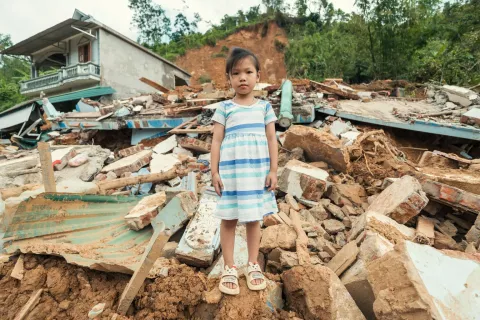
Among those affected was six-year-old Trang, who had just begun her first days of primary school. Excitement turned to despair when a landslide, triggered by the typhoon’s torrential rains, buried her family’s home and some of her new school supplies along with it.
For Trang, the beginning of her educational journey is now marred by the dramatic memory of losing what she had felt so lucky to have.
“I was so sad. My school uniform was in the collapsed house, along with my clothes. Mom managed to save my books, but I lost my pen and scissors,” says Trang, 6 years old.
“When I saw the landslide, I thought I would only reach the wall of my house,” continues her mother, Be Thi Hoa Anh, recalling the moment. “I did not expect it would collapse the whole house in less than five seconds.”
Miraculously, Be Thi Hoa Anh managed to escape, but the loss of their home was devastating, leaving Trang and her family heartbroken.
Typhoon Yagi’s impact was felt far beyond Trang’s family. In the province of Thai Nguyen, dark, polluted floodwaters turned streets into rivers, inundating homes and contaminating vital water supplies.
“There is no electricity or water, making daily life very difficult,” explains Nguyen Thuy Linh, a mother of three who found herself struggling to care for her children in the storm’s aftermath.
“We only had food and drinks thanks to rescue teams who brought them to us.” The relentless rains exacerbated the situation, preventing water from draining and leaving stagnant, foul-smelling pools that bred diseases and attracted swarms of mosquitoes.
“The biggest concern is that the children will get sick,” continues Ho Thi Duong, another mother from Thai Nguyen.

In the wake of this disaster, UNICEF quickly mobilized to support the Government’s response by providing life-saving assistance to affected communities. Recognizing the urgent need for clean water and sanitation, UNICEF has distributed water purification tablets to over 140,000 people in Thai Nguyen province.
Additionally, personal hygiene and dignity kits have been supplied to the most vulnerable families, as well as to health centres and schools in the hardest-hit communities. These efforts are crucial in preventing the outbreak of waterborne diseases, which are a constant threat in such post-disaster conditions.
The destruction caused by Typhoon Yagi did not even spare some critical infrastructure, including schools and healthcare facilities, leaving children and families without access to essential services.
Over 1,500 schools across northern Viet Nam have been impacted by the storm, with at least 13 needing to be completely rebuilt. At the Tuc Duyen Kindergarten in Thai Nguyen, teachers returned to find their classrooms in ruins, with mud covering the floors and waterlogged learning materials.
“The floodwaters rose very quickly,” says the school’s principal, Do Thi Thanh Thao. “This is why there was great damage to the equipment in the classroom.”
UNICEF's response
Yet, the damage disseminated by Typhoon Yagi extends far beyond physical structures. The disruption to education has left 2.4 million children at risk of falling behind in their studies, a prospect that weighs heavily on the minds of parents already struggling with the financial burden of replacing lost school materials.
To alleviate this, UNICEF is distributing education kits filled with essential learning supplies, allowing children to resume their education as soon as schools are able to reopen.

In addition to providing immediate relief, UNICEF will roll out multi-purpose, unconditional cash support to the most vulnerable households, particularly those with children and pregnant women, to help them recover from their losses.
UNICEF’s approach includes addressing the psychological impact of the disaster on children, ensuring that stress, uncertainty and fear do not turn into lifelong trauma.

As recovery efforts continue, UNICEF is working tirelessly with Government partners to restore access to clean water, education, healthcare and protection services for the affected children and their families.
Despite all efforts, the scale of the disaster means that much more remains to be done. The destruction caused by Typhoon Yagi has left millions of people in urgent need of assistance, and the path to recovery and resilience to additional climate shocks will be long and challenging.
UNICEF is grateful to its donors for their vital support in the initial response. However, more resources are urgently needed to keep delivering essential services and to ensure the implementation of a strong, climate-resilient recovery plan that prioritizes children and inclusivity.