Rain brings An clean water and joy
Amid water scarcity, a climate-smart solution is bringing clean water to children and communities in Dien Bien

- English
- Tiếng Việt
For An, 10, clean water had never been a given. At home, his family of five depended on a pipeline that carried water down from the mountain. What little they collected was boiled for drinking and cooking. But on some days, the tap ran dry.
“The pipeline breaks a lot. Sometimes I had to climb up the mountain with my cousin or grandma to fix it,” An said. “It’s tiring.”

Things were a bit better when An was at school. Hua Nguong primary school mostly got its water from a drilled well, which was more reliable than the mountain stream. But even that wasn’t always enough.
Here in Dien Bien — a mountainous province in Northern Viet Nam, the impact of climate change is hard to miss. With weather patterns becoming unpredictable, rain sometimes falls so rarely that streams and wells are left parched for months on end.
Now in 5th grade, An still remembers the drought that dragged on for five months last year.
“Our teachers asked us to bring our own water bottle from home,” he recalled. “By the afternoon, we were already thirsty.”
Even when water was available, quality remained a concern. Without a high-capacity filtration system, ensuring clean drinking water for over 400 students was a daily challenge. The consequences were serious: risks of water-borne diseases, fatigue, and malnutrition, all threatening children’s health and ability to learn.
That’s why, when drinking water finally began to flow from a tap, the excitement was electric.
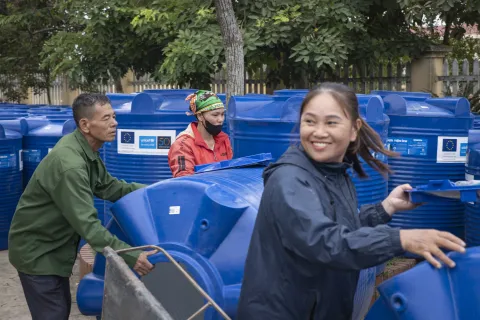
With support from the Al Ansari Family through UNICEF and our implementing partners, Gravity Water and the Dien Bien Provincial Center for Rural Water Supply and Sanitation, the school now has a rainwater harvesting and treatment system that converts rainfall into clean, potable water. The system is designed to be automatic and simple enough for school staff to maintain. Most importantly, it ensures the school has a reliable supply of safe drinking water and stays resilient in the face of climate change.
Since the system was installed, An plays harder. He runs, sweats, and returns to the tap whenever he wants.
“The water here tastes better than what I have at home,” An said after a few rounds of playing catch.
That was a relief to Hua Nguong’s vice principal Dang Thai An.
“We may not have much, but we try to give our students what they need,” he said.
As teachers make do with limited resources, the new water system has lifted a worry off their shoulders.
“This system gives us peace of mind. It’s a good feeling knowing all students will have clean water to drink, especially when the dry season comes," he added.


According to the latest report[1], just over 3% of poor households in rural Dien Bien use clean water that meets national standards.
Climate change is making access even more difficult. For the last decades, Viet Nam is among the countries most at risk from its impacts[2].
In response, local efforts — supported by organizations like UNICEF — are helping communities adapt and become more resilient to the impacts of climate shocks.
Hua Nguong primary school was one of 50 schools equipped with a rainwater harvesting and treatment system, along with 10 household clusters in Dien Bien province. Altogether, the project supported by the Al Ansari Family has already brought clean water to more than 20,500 people.
Community members were involved from the start. UNICEF and our partners worked closely with them to ensure the systems met real needs; we trained schoolteachers and local people to maintain the system, promoted handwashing with soap, and engaged with families through events and community outreach.
As climate pressures mount, lessons from Dien Bien are informing efforts to bring similar solutions to other vulnerable provinces. But at Hua Nguong primary school, the impact is already playing out.
A heavy rain passed. An and his friends raced to the water station, where the tank glistened under new sunlight.
They laughed and joked along the way. One girl said she’d be a football player when she grew up. An said he just wanted to be happy.
For a moment, everything felt light. They knew there would be enough to drink today — and tomorrow, too.
[1] Monitoring Report on the Implementation of Policies and Laws on Investment, Management, and Provision of Domestic Water Supply in Dien Bien Province, 2021–2024" – Dien Bien Provincial People's Council
[2] German Watch, Global Climate Risk Index 2025, https://unicef.link/3VQD88r