A new toilet changed Bi’s summer
In Dak Lak province, emergency cash assistance helped Bi’s mother fulfil a long-held dream: building a toilet for her children after the typhoons.

- English
- Tiếng Việt
At school, she is known as Kim Anh. At home, to her family and neighbours, she is simply called Bi.
“When I grow up, I want to be a very important person,” Bi says, grinning. “Like a school principal.”
This makes her mother, Loan, burst out laughing.
In many ways, at 10, Bi already plays an important role in her household in Dong Xuan commune, Dak Lak province. When she is not at school, Bi helps her mother cook, clean and take care of her two younger siblings - a four-year-old sister and an 11-month-old brother, while her mother farms and sells boiled peanuts on the street to make ends meet.
But for all her resourcefulness, Bi is still very much 10-year-old. “I don’t like dark places,” she says. “There might be ghosts lurking around, you know.”
Without a toilet or bathroom at home, Bi has had to think ahead about ordinary things, such as when to bathe, where to go, and whether her mother can accompany her after dark.
“If I need to use the toilet, I go to the garden behind our house, or up near the mountain with my mom in the evening,” she says.
Loan sees herself in her daughter’s experience. “I have never had a private toilet in my life,” she says. “It’s inconvenient, especially as a girl.”
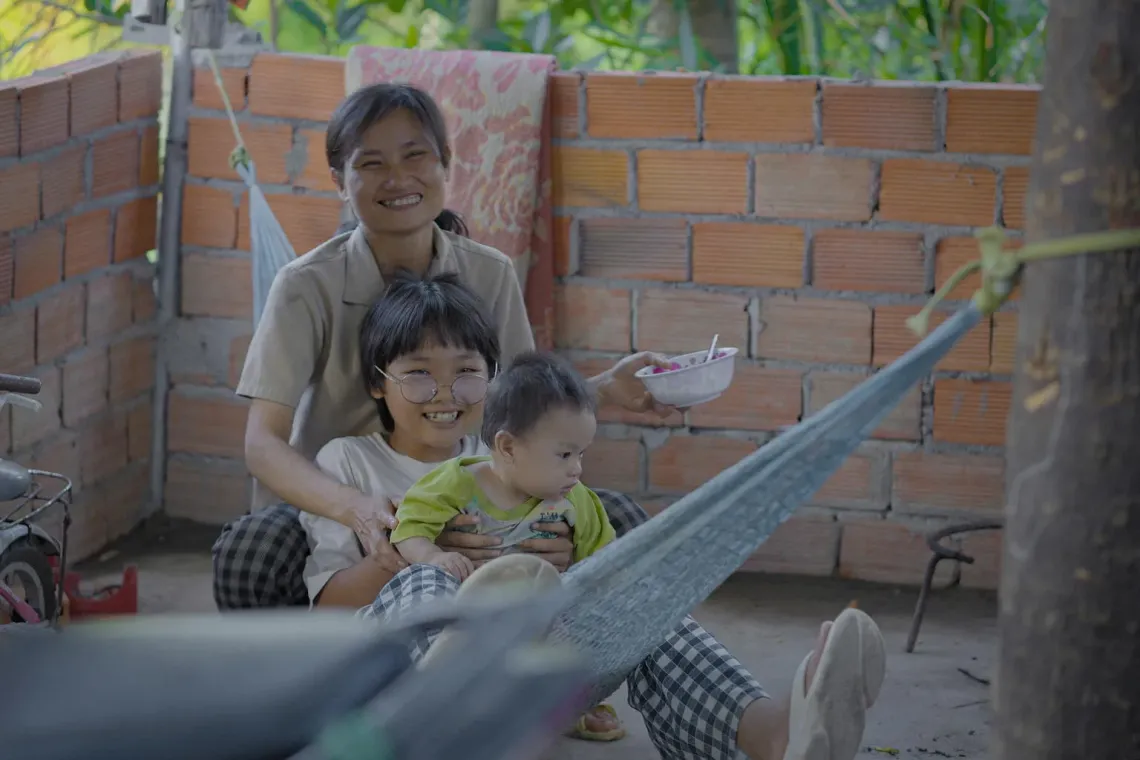
For Bi and Loan, not having a toilet meant having to go outside to relieve themselves - a practice known as open defecation. In Viet Nam, around 16 million people still lack access to a hygienic toilet1. Without one, families are more exposed to disease because germs can spread through water and soil. Children are especially vulnerable to illnesses such as diarrhoea and worms. For girls and women, the lack of a private toilet can also raise concerns about safety and dignity.
The family’s fragile living conditions got worse when several typhoons swept through Dak Lak province last year, damaging homes and disrupting access to clean water, sanitation and hygiene for many households.
Loan’s home offered little protection from heavy rain and flooding. As floodwater rose around the house and rain leaked through the roof, the family had to evacuate to her parents’ house on higher ground. Without a toilet, Bi had to go outside, even when the ground was muddy, paths were slippery and floodwater could carry waste closer to where the children lived and played.
When Loan learned that her family would receive emergency cash assistance, she knew exactly what she wanted to do. “I knew this was my chance to build a toilet for my children,” she says. “It had been a dream of mine.”
With funding from the Central Emergency Response Fund (CERF), UNICEF worked with the National Center for Rural Water Supply and Environmental Sanitation and local authorities to provide emergency cash assistance to 1,223 families with children affected by the typhoon in Dak Lak province, including Loan’s family. The cash helped them cover their most urgent needs.
Beyond that, families learned how to keep water safe, practise good hygiene and prepare for future disasters. Local builders and service providers also learned about stronger, more climate-resilient sanitation options that can better withstand storms and floods.
For Loan, it was the push she needed. With additional low-interest support from the local Women’s Union, Loan finally built the toilet next to her house. “I didn’t have everything ready, but I had to take the chance and do it,” she says.
It is a modest structure, with brick walls and a simple toilet inside. But for the family, it has already changed everyday life.
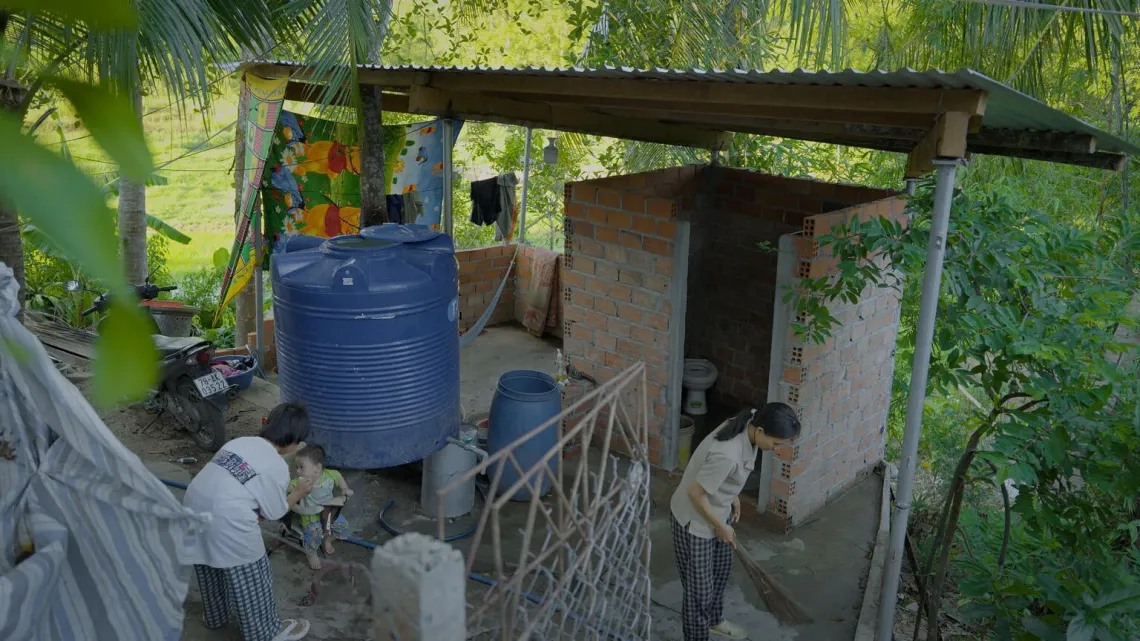
With the toilet just a few steps from home, Bi can now use it whenever she needs. “I’m so happy! It’s clean and so convenient!” she beams. “I can bring water in and bathe there too.”
Bi already has ideas for making it even better. One day, she hopes the family can add a concrete finish - maybe even beautiful tiles.
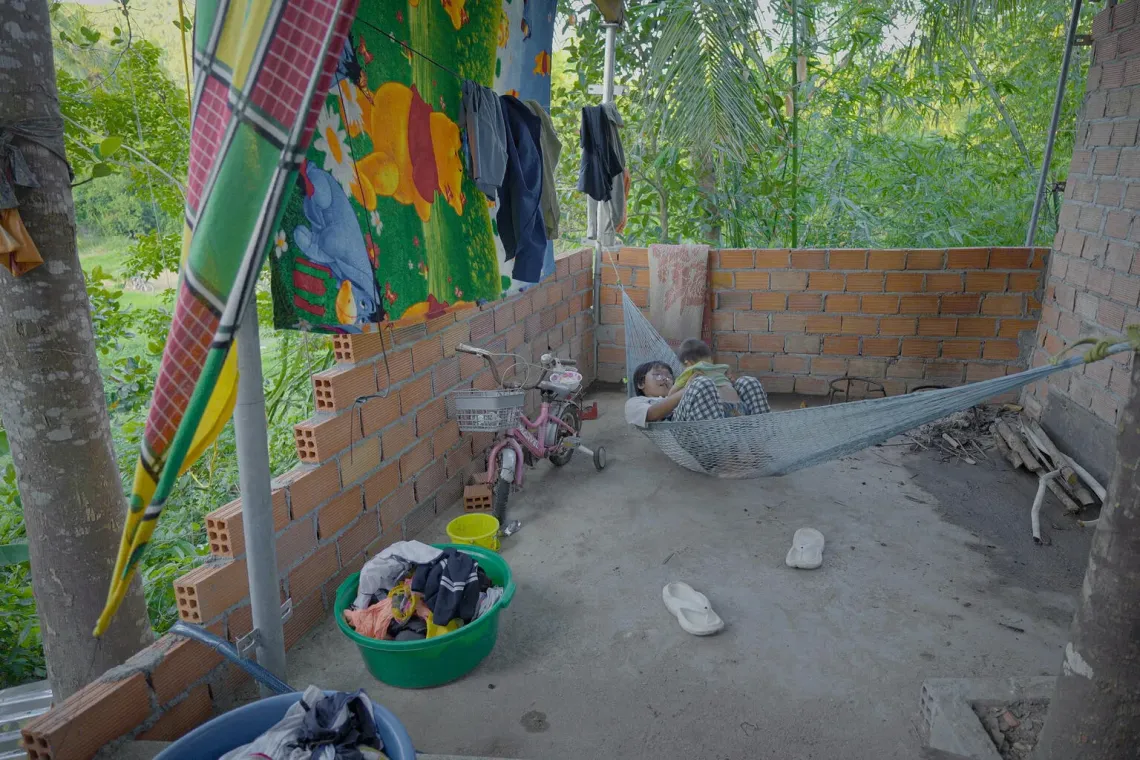
For now, though, Bi is content with the small changes in her summer days. With no classes, she enjoys spending more time with her mother and siblings. Her favourite moment comes after Loan finishes selling boiled peanuts for the evening, when the two sometimes stop by the park together.
“Bi told me I didn’t spend enough time with her,” Loan says. “I know that. I just wish I could give her more.”
Still, for Bi, those small moments are what make the summer feel full.
“The only thing is, I want to wake up early, but I can’t make myself do it,” she says with a giggle. “Other than that, everything is good!”
[1] Department of Disease Prevention, Ministry of Health. Report on the Results of Inspection and Monitoring of Domestic Water Quality for Household Use and Household Sanitation Facilities in 2024.