It takes a village to vaccinate children in remote areas
In a mountainous commune, health workers and local leaders join forces to protect every child

- English
- Tiếng Việt
As the morning mist covers the winding mountain roads, Lan Anh sets out on an important mission.
The health worker and her colleagues travel 18 kilometres to Suoi Lu hamlet, a remote village in Dien Bien province. Their scooters carry medical supplies—including a blue carrier filled with life-saving vaccines—to bring health and protection to children in need.

Two-year-old Ut is one of those children.
Born prematurely, Ut weighs less than other children his age and often falls ill. His mother, Nhi, worries about his health, but struggles to prioritize vaccination appointments at the commune health centre. The long distance and her demanding work schedule make it difficult to find time.
Now, this burden has been eased thanks to Lan Anh and other commune health workers.
“I can get my children vaccinated by walking a few steps to the Head of Hamlet’s house. It is such a relief,”
Nhi shares as her son receives his catch-up measles and rubella vaccine.
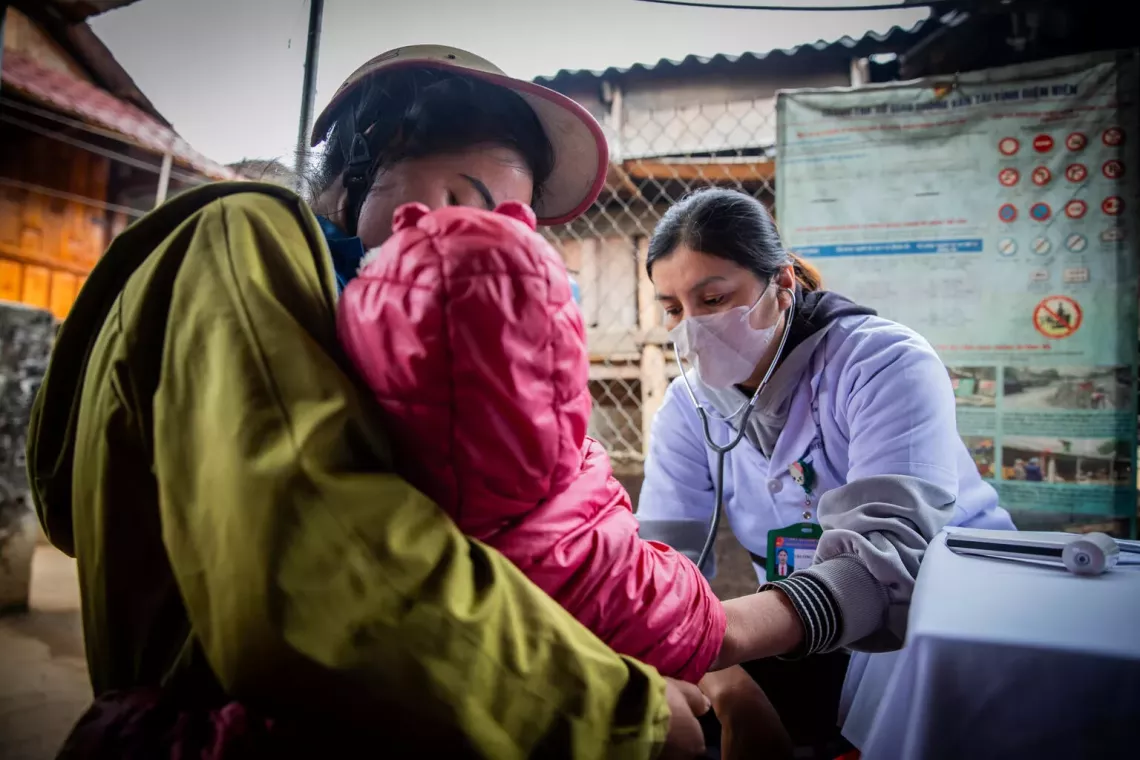
Every month in Keo Lom commune, health workers organize mobile vaccination sessions for remote villages. Equipped with specialized training, tools, and equipment such as vaccine carriers, they ensure every child receives life-saving vaccines.
“Providing care on-site is my favourite part of the job,” Lan Anh reflects, after a decade of serving her community.
But her journey hasn’t always been easy. “In the past, villagers had doubts about vaccination, so the vaccine uptake was low. I remember having to knock door by door to vaccinate the children”, she recounts.
To overcome these challenges, Lan Anh and the commune health centre reached out to community leaders like Cam, the Head of Suoi Lu hamlet.

Building on his community’s trust, Cam became a community vaccine champion through UNICEF’s immunization initiative in Viet Nam, supported by the Australian Government.
With training in effective communication, he works to ease parents’ concerns, as many fear side effects or do not realize the importance of vaccines to their children’s health.
“The key is consistency,” he says. “We must keep reminding them about the benefits of vaccines, and let them know well in advance when vaccination sessions are coming.”
To spread the word, Cam uses various methods—making announcements through loudspeakers, calling caregivers directly, or visiting households one by one.

“I heard about today’s vaccination session this morning, through the Head of Hamlet’s speaker. That’s why I brought my son here for his dose,” Nhi shares.
“With support from the Government of Australia, UNICEF is working with the Ministry of Health to make routine immunization accessible to every child,” said Maharajan Muthu, Chief of Child Survival, Development and Environment at UNICEF Viet Nam. “This includes efforts to address backsliding and to introduce new essential vaccines into the country’s routine immunization schedule.”
However, numerous challenges still lie ahead.
“Livelihood is difficult, so the community’s attention to healthcare is often compromised,” Lan Anh says.
But with the collective efforts of health workers like her and community champions like Cam, children are already one step closer to a healthier future.