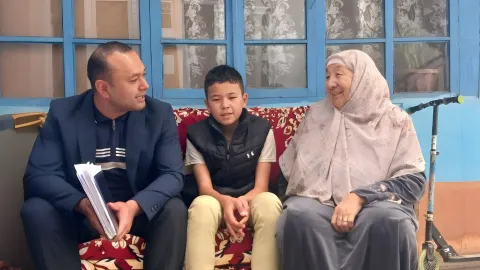
Returning of repatriated families to normal life
Providing mental health and psychosocial support to families

Returning of repatriated families to normal life – providing mental health and psychosocial support
It is easy to assume that most children and their parents, affected by conflicts get severely traumatized and will need specialized mental health treatment to recover. However, this assumption is unfounded and risks overlooking a deeper, broader understanding of healing and recovery. These families need help to bounce back and feel a part of society. This takes much more than counseling and mental health treatment. This requires a well-coordinated effort and engagement among a number of government departments at different levels, non-governmental organisations as well as communities. This comprehensive, holistic approach is endorsed in the mental health and psychosocial support (MHPSS) guidelines for humanitarian emergencies by United Nations Inter-Agency Standing Committee.
“Women and children have been affected by armed conflict for centuries in all corners of the world. With the right support and opportunities for meaningful participation in social, civic, and economic life, women and children can reintegrate into society. If they are treated equitably and if communities work together to reconcile and accept their children, these women and children can reintegrate into normal life”, says Furkatjon Lutfulloev, Child Protection Specialist, UNICEF Uzbekistan.
"Mental health and psychosocial support is about promoting well-being, not only treating mental disorders," Dr. Marcio Gagliato, mental health and psychosocial support expert.
Workshop to understand Mental Health and Psychosocial Support (MPHSS) in Tashkent
Implementing MHPSS in Uzbekistan to help families returning from difficult situations to return to normal life was one of the main purposes of a training workshop held in Tashkent from 19 to 23 August. Organized by UNICEF, it brought together 32 specialists from six regions of the country. They represented a number of organisations, including the national and regional centres for social adaption of children, the centre for providing social and legal support to minors under the Ministry of Interior, the Republican centre for psychological diagnostics and carrier guidance under the Ministry of Public Education, Ministry of Pre-school Education, the Youth Union, Women's Committee of Uzbekistan and NGOs.
The training event is part of the Government of Uzbekistan road map for supporting these vulnerable families, which was developed in partnership with UNICEF.
"The main idea behind this workshop is to make sure that representatives of governmental and non-governmental organizations apply a common approach so that families with children feel safe, protected and integrated as soon as possible. Families with children must have everything they need to return to normal life within communities," says Diana Isayeva, Child Protection Officer, UNICEF Uzbekistan.


Human rights are at the core of MHPSS as it is impossible to fully ensure people's well-being without securing their rights. "This includes access to justice, healthcare and education services, the opportunity to live where they were born and brought up without becoming isolated and feeling left behind," Diana Isayeva says.
One of the key strategic decisions taken by the government was to initiate rehabilitation of affected families within their places of residence, in villages and settlements. This was done to make services easily accessible for people without separating them from their communities.
Challenges
However, such an arrangement requires a lot of coordination and hard work from specialists in regions, and the participants in the MHPSS workshop will spearhead this concerted effort.
Dr. Marcio Gagliato, an expert on mental health and psychosocial support for humanitarian emergencies, who led the training event, believes that one of the main challenges for the specialists will be to ensure that local communities are also involved in the rehabilitation of the affected families, as reintegration is a two-way process. He says: "There is a lot of work to be done in the communities in terms of how they accept returnees from conflict zones and how they can be reintegrated. People being trained here must realize that this is more complex than a simple life choice of "yes" and "no" for them. It is much harder to have rehabilitation without reintegration. And we have learned from other places in the world that this is the biggest challenge. Rehabilitation and community reintegration must come together. How can we facilitate that process? This requires a big mind shift for some of the specialists being trained here - to understand that the work they provide is not focused only on the psychological aspects, but it also has to be focused on the community engagement".
Diana Isayeva says “from the social work perspective, which we are developing in Uzbekistan, it is very important to understand the social reasons which led to the crisis situation in a family. She adds that "we need to ensure that there are equal opportunities for an individual to access services and resources just like everyone else. This will be useful for him or her to recover from trauma in the past".


Future plans
The government's programme for rehabilitating and reintegrating families is currently planned for one year, and UNICEF is committed to ensuring long-term efforts for continuous support, especially for the affected children.
That is why there are future plans to continue improve capacity of specialists in regions. "We will focus on providing access to services for families with children, in a coordinated way so that one trained social worker or a specialist is responsible for working with one family. It will prevent a situation when too many organizations work with the family at the same time. It is important that every family is associated with one social worker or a specialist, whom we call a case manager," says Diana Isayeva.
The key to success of this plan lies in specialists working directly with families. One of them is Holidhakhon Mirzarahimova who heads the rehabilitation centre for women in Andijan Region. She was among the participants in the MHPSS training in Tashkent, and says that it gave her a new perspective on social reintegration. "International experience in this field, which we learned about here, is useful in identifying gaps in our own work and addressing them. I really like the approach which treats women and children coming from conflicts simply as people who had to experience a difficult situation, and not as victims with a trauma. It focuses on rehabilitating people instead of labeling them. I work with specialists from neighbourhoods in my everyday job, and I feel I have to pass things I have learned here on to them, maybe by having workshops of our own. I am already making some plans in my head," she says.
“UNICEF believes that all foreign children previously living in conflict zones, including children associated with armed groups or alleged to be associated with armed groups, must be treated as children and primarily as survivors of grievous violations of their rights, irrespective of their age or any other status”, Furkatjon Lutfulloev concluded.