

Ukraine’s Resilience Centres help families find strength
When war twice forced Olena and her family to flee their home, her children struggled to cope. But everything changed when they discovered the Resilience Centre in Valky.

- Українська
- English
The war in Ukraine first forced Olena and her family from their home in March 2022, when her youngest son Nikita was just 3 years old. After they fled again in 2024, there was no longer anything to return to – their house had been completely destroyed in the fighting.
"Everything we had longed to rebuild vanished in a matter of seconds," Olena recalls.
In Kharkiv, the family tried to restart their lives. But the constant shelling, fear and ever-present danger made it impossible to feel safe. Nikita, who by then was 5 years old, became withdrawn, developed a stammer, barely spoke and flinched at every loud noise.
“We knew things couldn’t go on like that,” Olena says. “So we got in the car and drove without knowing exactly where to. My husband is from Sumy, but it was noisy there too. We were simply looking for a place where Nikita could feel calm. Once, we came under cluster munition shelling".
"Nikita became afraid of everyone, even though he’s normally very sociable. My husband and I wanted nothing more than to help him feel a sense of normality again.”
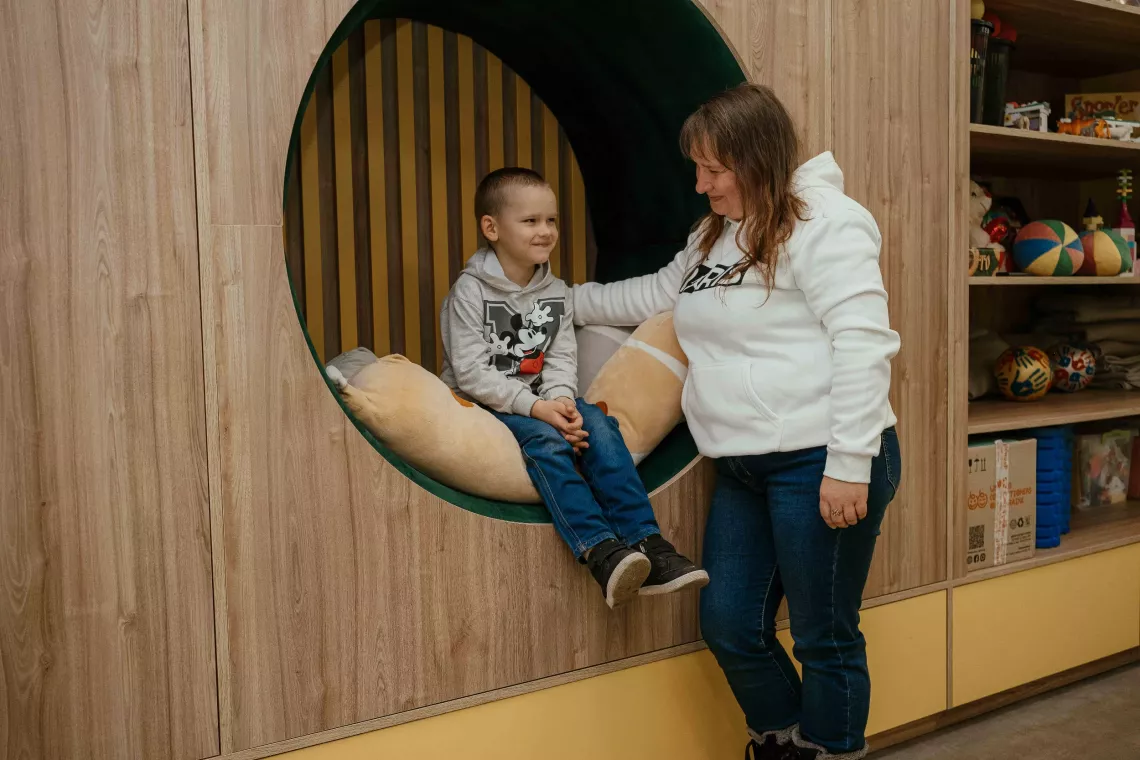
Eventually, the family moved to the Valky community in the Kharkiv region. There, Olena learned about the Resilience Centre, which quickly became a lifeline for her family, offering the support they needed to cope with their growing stress and anxiety.
At the centre, Nikita began working with a psychologist named Iryna Parovai. With every session, he opened up more and gradually learned to manage his fears. Now, he also loves taking part in the centre’s creative activities with other children.
"Nikita became himself again here. Iryna was the first psychologist my son truly trusted. After just one session, he started opening up and speaking more. He really enjoys the sessions and spending time with the other children. Even when he’s sick, he asks when we’ll go back to the centre.”

Olena has also started attending psychological counselling sessions, which help her cope with anxiety. She has found not only professional support but also a connection with others.
“These meetings really help – they bring a sense of relief,” she says. “And for children who can’t attend kindergartens or schools because of the war, the Resilience Centre offers a chance to socialise and make new friends.”

A centre for support and growth
The Resilience Centre in Valky has been operating since spring 2024, providing essential social services to the community. Parents and children can access psychosocial support, individual counselling sessions with a psychologist and a range of activities. Families can also receive crisis support here, join educational sessions or take part in group events.
“At the centre, we work to strengthen the bond between parents or caregivers and their children,” says psychologist Iryna. “Parents learn techniques to manage their emotions, while specialists develop similar skills in the children. These skills can then be reinforced at home as part of daily life.”

The Resilience Centre in Valky has become not only a lifeline for Olena’s family, but also an important part of life for the entire community. It is a place where everyone – no matter what they have been through – can find support and a sense of normality. Currently, there are five centres operating in the region, including in Balakliia, Pisochyn, Chuhuiv and Kehychivka.
The Resilience Centres were established by the Kharkiv Regional State Administration in cooperation with the Ministry of Social Policy of Ukraine and with the support of UNICEF. They form part of the national ‘How Are You?’ mental health programme – an initiative of First Lady of Ukraine Olena Zelenska.
The establishment and operation of the Resilience Centre was made possible through financial support from the German Federal Ministry for Economic Cooperation and Development (BMZ), via the German Development Bank KfW, as well as the Finnish and German Committees for UNICEF.


