UNICEF helps bring mine safety skills to Ukraine classrooms
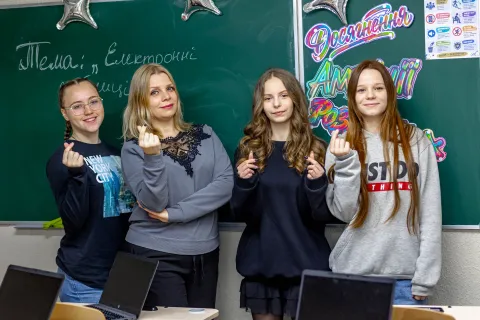
Teacher Inna Galenko has learned how to run mine safety classes for children, thanks to an online training course organized by UNICEF.

- Українська
- English
With the arrival of warmer weather in Ukraine, children are increasingly drawn to the outdoors. That is why teacher Inna Galenko has been busy organizing an online lesson about mine safety for her students during the spring break.
"People have been blown up in the fields during the sowing season, as have road maintenance workers,” she explains. “It is a very sensitive issue.”
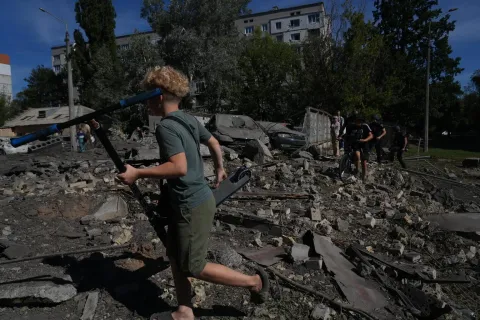
Nearly 25 per cent of Ukraine’s territory is mined as a result of the ongoing war, and it is now one of the most mine-contaminated countries in the world. The UN Human Rights Monitoring Mission in Ukraine confirmed that mines and other explosive remnants of war caused 124 child casualties between 24 February 2022 and 29 February 2024, with almost half (55) of these children killed in the Donetska and Kharkivska regions.
In Chkalovske, in the Kharkivska region, where Inna lives and works, farmland and forests have been mined and many people have been killed.

"I talk about mine safety, not only with my students, but their parents too. I have also talked with colleagues at the school and even made home visits, talking about the danger of mines and distributing visual materials.”
Initially, Inna searched for mine safety information online by herself. Eventually, she decided to learn more about the topic and took an online course run by the United Nations Children’s Fund (UNICEF). This course helped her organize and deepen her understanding. She particularly appreciated the advice from psychologists.
"It was a very good course,” she says. “I liked that there was a test after each unit. It makes it easier to remember. After the UNICEF course, I changed my approach to teaching – I now use the advice of other educators and psychologists. I also use the course materials in the classroom.”
To begin her online class, Inna uses a computer at home, watching her students sign in one by one. Many of the children struggle to attend full-time classes due to security reasons and rely on online resources to learn about mine safety.

"Probably the most useful topic for the students is abandoned ordnance of war,” says Inna “I gave examples of things that can be dangerous. As my student Mariia said in class, 'Don't touch anything that doesn't belong to you'.”
What kind of areas can be mined? What should you do if you find unexploded ordnance? Who should you contact? These are just some of the questions Inna asks her pupils. The children engage in discussions, take quizzes and watch cartoons about mine safety.

Fourteen-year-old Kamila, a ninth-grader, says that she lives near a forest.
“We are not only taught about mine safety at school – my parents also ask me to be careful, not to run around,” says the youngster. “I found out that explosives can be hidden in children's toys. I didn't know that. How is it possible?”
Kamila’s classmate, Liudmyla was also unaware of the potential hazards concealed in everyday objects.
"For example, even ordinary balls, notebooks and candy boxes can be mined,” she says.
“I like the lessons on mine safety. We even had a quiz. We watched and discussed a cartoon about different situations that young people might encounter with mines and why they shouldn't touch them. It's important for us to know this because we live in a village with mined areas.”


Thanks to the class, fourteen-year-old Ivan now knows exactly what to do if he finds an unexploded bomb.
"I would move away, not touch it and call the rescuers," he says, confidently.
Teacher Inna says it is critical that her students are safe and know how to behave in dangerous situations.

"Everyone should undergo this UNICEF's course,” she says. “It allows you to learn more about mine safety and what to do to calm down and be less nervous. After completing the course, I recommended it to my colleagues and friends. I would like to recommend the course to other teachers. Teachers especially need it, as we're teaching future generations.”
In December 2023, UNICEF introduced the ‘How to Teach Children Mine Safety’ course, with the aim of safeguarding children. The training materials are aimed at teachers, emergency services and national police officers, equipping them with the knowledge and skills necessary to educate children and adolescents on staying safe around mines.
The online course offers participants a comprehensive curriculum, adhering to international standards. Educators learn practical tools suitable for both in-person and online lessons to promote safe behavior in areas potentially affected by mines and other explosive hazards.
UNICEF has collaborated with experts in child psychology, pedagogy, inclusive education, mine awareness and behavior change to develop this course. It can be accessed at bezpeka.info and was jointly created by UNICEF, the Cultural Platform of Zakarpattia NGO, and governmental bodies including the Ministry of Education and Science, the Ministry of Internal Affairs and the State Emergency Service of Ukraine.