School of Responsible Parenting stresses the importance of early development
New and expectant parents in Zhytomyr are being trained in modern parenting practices and approaches with the support of UNICEF and the NGO In Touch.

- Українська
- English
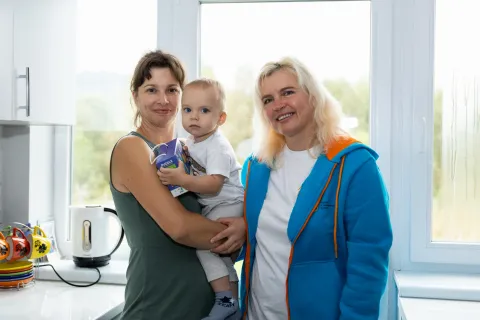
At the School of Responsible Parenting, the youngest participant, one-year-old Nastia, approaches Halyna Chekurda, a doctor, paediatrician, and facilitator of the School of Future Parenting. Halyna, who is lecturing on early childhood development, takes the girl in her arms.
The School of Responsible Parenting provides participants with the opportunity to discuss topics and acquire new skills related to child-rearing. The parenting group convenes every Thursday at the Training and Resource Centre, established at the Zhytomyr Institute of Nursing within the framework of Home visiting programme, a joint project of the Ministry of Health of Ukraine and UNICEF.
"The topic of early childhood development is important because most mothers are young and often unsure about basic caregiving tasks like holding or bathing a child. It was a blessing to have my mother's help, but not everyone has that support. Without it, where can they turn? They can only search for information."

Halyna Chekurda explains that a child in the first months of life is extremely defenseless and vulnerable, and therefore absolutely dependent on loved ones. Early childhood is a key period for the development and formation of health, which lays the foundation for a successful future.

"A baby is born with billions of nerve cells, but there are no neural connections between them. A child's health, well-being, neuropsychological development, and social adaptation are all shaped between the ages of 0 and 3."
The expert emphasizes that parents and educators act as the "architects" of children's thinking, guiding them along the path of healthy development.
"The first years of life are a unique period that determines the future"
Halyna Chekurda demonstrates how to accurately measure a newborn's body parameters. The group of parents learns how to measure body weight, temperature, head, and chest circumference. A UNICEF height gauge is used for measuring height.
The practical part of the meeting includes a quiz designed to link symptoms with descriptions of the child's condition and determine appropriate actions. This exercise helps parents understand the transitional conditions in newborns that aid in their adaptation to life outside the mother's body. These conditions include changes in breathing, circulation, body temperature, digestion, and behavior. For example, there is a physiological loss of initial body weight — up to 6-8% in the first few days of life. Parents are advised to consult a doctor if the weight loss exceeds 10% or if the baby doesn't gain weight after the first two weeks.


Transient fever is also common in newborns. During the days of maximum weight loss (3-4 days old), the baby's temperature may rise to 38-40 degrees due to the body's lack of adaptation. This condition can last for 3-4 hours and is generally safe, not requiring treatment. Some babies may become restless and refuse to eat. To relieve this, breastfeed more frequently and offer plenty of water if the child desires it. Once the fever subsides, return to a normal feeding routine. However, if the fever is prolonged or accompanied by other symptoms such as seizures or dizziness, seek professional medical help immediately.
Another temporary condition that may alarm uninformed parents is the estrous crisis. This occurs when estrogen transfers from the mother to the baby during pregnancy or through breast milk. In the first few days after birth, both boys and girls may have enlarged mammary glands that can produce a fluid similar to colostrum. Additionally, there might be bloody vaginal discharge in girls and swelling of the scrotum in boys. According to pediatricians, these symptoms are normal and will resolve on their own within 2-3 days. However, if the baby's mammary glands show signs of infection, it is crucial to consult a doctor.

Anna, the mother of 4-year-old Matvii, shares her experience from the parents' group meeting: "Today, I consolidated my knowledge about baby bathing, transition periods, and appropriate weight and height for age. The information provided here is especially useful for future mothers. In general, I would advise people to prepare for parenthood in advance: read more, attend trainings like this one, which are now available in many cities thanks to UNICEF."
"I encourage parents to find time to attend our classes," says Halyna Chekurda. "We will inform, demonstrate, and provide hands-on practice."
School of Responsible Parenting is organized by the NGO In Touch with the support of the United Nations Children's Fund (UNICEF) and the German Federal Ministry for Economic Cooperation and Development through the German development bank KfW.
>> Earlier we wrote about how Halyna held a workshop for parents on parenting without gender stereotypes.