A real desk, a real blackboard, and real joy
Some schools in Kharkiv region will return to in-person learning on 1 September, even if it means being underground but teachers and pupils are ready for the big day.

- Українська
- English
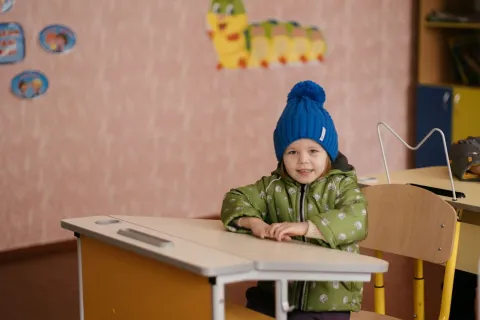
A blue-eyed girl with long blonde braids carefully sketches a big fluffy cat named Zhora and lots of hearts on the school blackboard. Like a professional artist, she signs her work: “Alessa, 7 years old, 2nd grade.”
In fact, she won’t officially start school for another week. But Alessa was so impatient for the start of term that she persuaded her mother to take her to the school early. For her, this academic year feels even more special than the first grade: for the first time since learning online, she will be in a classroom alongside her peers.

“I really want to sit at a desk. At home I don’t have one, only my chair. And I also want to talk to my teacher and classmates. At home, it’s just me, my cat, and my fish.”
Alessa is clapping her hands to shake off chalk dust. Everything in the classroom seems new and fascinating to her – the books, the teacher’s pointer, and above all, the long-awaited desk.
Although lessons haven’t yet begun, preparations are in full swing, and there is an atmosphere of anticipation. For the first time since the start of the war, Zlatopil Lyceum No. 6 in Kharkiv region will shift to a blended learning format.
“After such a long period of online learning, children can finally return, at least partially, to in-person classes at the lyceum,” says principal Ms. Viktoriia Yermolenko. Smiling, she adds: “At last!”

First graders are the priority
Zlatopil is one of the few communities that will be able to reopen its schools for in-person learning. The small town lies more than 100 kilometers from the frontline and while it still feels the destructive effects of the war, it is relatively safer.
“Starting September 1, our lyceum building will host blended learning for two community schools. About 715 students will attend our school, and another 600 at Zlatopil Lyceum No. 2,” the principal explains, standing in a hallway long deprived of children’s laughter.
Students from both schools will study in shifts in the lyceum’s shelter, which can accommodate up to 240 people at once.

“We understand that the top priority is bringing younger students back to in-person classes. Older students at least know what a classroom, a desk, or a blackboard is, but some primary school children don’t know even that”, Viktoriia adds.
Despite the school being fully online since the start of the full-scale war, the principal has hosted some lessons under UNICEF’s “Learning Recovery” programme.
Sixth graders back then didn’t even know where to go or how to sit at desks.

“At first, they were even afraid to walk up to the blackboard. I think we need to gradually restore the socialization skills that the war has taken from them”
She herself once graduated from this lyceum. Sometimes she steps into her old classroom on the second floor, sits at a desk, and remembers happy times.
A couple of letters from a sister
Now Ms. Viktoriia tries to share the joy of anticipating lessons, fun breaks with friends, and school celebrations with her students – children like Alessa.
When her mother told her she would go to school this year, the little girl jumped for joy.
“Last year my day was boring – I woke up, had breakfast, turned on my phone, and listened to lessons. Sometimes Zhora came to me, and I petted him. And that’s it”

Handwriting was especially difficult for her. In place of a teacher who could show her how to hold a pen properly and write the alphabet, Alessa relied on her 13-year-old sister Violetta.
“My sister really doesn’t like online school. She wants to have friends and go to school with them. She’s very energetic, and at home she has nowhere to put that energy,” says Violetta, who also came to the school today with her mother and sister.
Then she casts a mischievous glance at her mother Yuliia and adds: “Mom, don’t be mad, but sometimes when Alessa couldn’t write all the alphabet, I wrote a few of them (letters) for her.”
Their mother doesn’t scold her but laughs instead. She says her daughters are very different: Violetta is quiet, cautious, and calm, while Alessa is cheerful and fearless. But both share a love of creativity and a passion for learning.

“I’m even a little jealous of my sister, because she will always study in-person, while we, the older students, will alternate – a week at home, a week at school. Of course, school is better than online for me too. Some subjects really suffered online – for example, English, and now I have to study it additionally”.
Beautiful handmade bracelets sparkle on her wrists as she looks out into the sunny schoolyard, where finishing touches on renovations are underway.
Care and safety
Ms. Viktoriia gives the family a tour of the shelter, where the sisters’ classes will be held. She shows them the well-lit rooms, colorful posters on the walls, new furniture, rest areas, and even showers.
According to the principal, the school received new desks, chairs, and cabinets for the shelter from UNICEF.
“We fully understand that parents worry and feel anxious. For us, the health and safety of children are paramount, so all lessons will take place in the shelter,” the principal says, guiding Yuliia and her daughters into the rooms beneath the school building.
And while Zlatopil has fortunately not suffered major destruction or shelling, the impact on families is immense. Yuliia’s uncle is still missing and she lives with constant anxiety for what each day may bring.

“It’s very good that the school has a shelter and that they made such nice classrooms there, with proper renovations. It really feels like people care about the children”.
“There’s no gloomy impression that it’s underground – everything looks like real classrooms where you want to study. And the girls are really excited. They can’t wait to hold real pens, hug their friends, and even tease their teachers a little,” she smiles, watching her daughters play among the desks and guess where they will sit in just a week – on that long-awaited day, 1 September.
With financial support from the European Union and the governments of Korea, Norway, and Spain, UNICEF has rehabilitated shelters in 160 schools and kindergartens since 2022. All UNICEF-supported shelters are child-friendly, safe spaces designed to provide a conducive learning environment. In 2025, an additional 42 shelters are being established with EU, German, and Spanish support.
UNICEF also helps children catch up on learning, with support from the European Union, the Global Partnership for Education (GPE), and the governments of France, Luxembourg, Norway, Spain, and Japan.