Keeping the water flowing despite attacks in Kramatorsk
In Kramatorsk, one year after the local water utility was badly damaged in an attack, UNICEF and partners are working to help restore essential infrastructure.

- Українська
- English
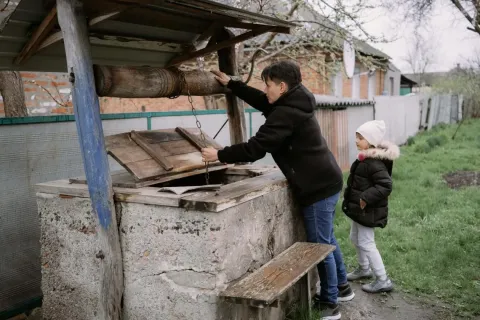
"One day I turned on the tap, and there was no water,” recalls eight-year-old Kseniya, who lives with her family in the eastern city of Kramatorsk.

“At first, I thought it was temporary, but it turned out to be for several days. My sister and I had to fetch water from the well with buckets and fill bottles to have something to drink.”
Growing up amid the ongoing war in Ukraine, Kseniya has learnt just how important running water is.
Fifteen-year-old Mykhailo, her brother, agrees.
"Water is essential for people. I heard that after two weeks without water, a person’s health reaches a critical state. At home, water is needed for cooking, and some heaters run on water.”

Oleksandr Khaliava, their father, works as the head of the emergency department at the Kramatorsk Water Utility. He is a hero to his four children.
“We work in extreme conditions”
While the children study online to the sound of air raid sirens, Oleksandr and his team repair pipes.


"We do our best to ensure a round-the-clock water supply,” says the specialist. “If there’s an accident, no one leaves work until the water supply is restored. We work in extreme conditions, eliminating the consequences of missile attacks. One of our workers was seriously injured but returned to work after six months. The most important thing for me is to keep people safe.”
Oleksandr has been leading the repair team for 20 years. He knows all the weak points of the water network and says that more than half of it – around 600 kilometres of pipes – needs replacement or partial repair.

"UNICEF and other donors provide significant assistance to our water utility – materials, generators, equipment. This is crucial during wartime. We can handle all replacements and repairs ourselves, but we do need support with purchasing materials.”
Despite the challenges, Oleksandr Khaliava loves his job. For him, all 270 of his water utility colleagues are one big family.
"The war has united us all,” he says. “I know all the relatives, children and grandchildren of my colleagues. And I also know that after work, my family is waiting for me – that's my main motivation.”

“These people are dedicated and heroic”
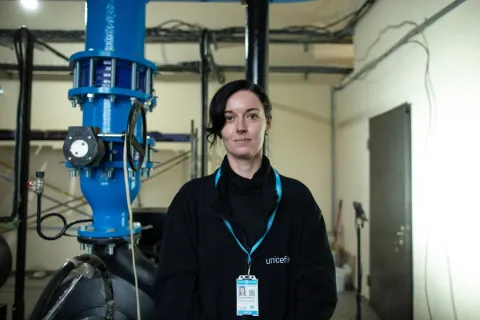
In February 2024, the Kramatorsk Water Utility was damaged during a missile attack. The building with water treatment reagents was hit, and the filtration station was out of operation for four days. Locals were warned that river water would flow from the taps and it should not be used for drinking, since untreated water can be a source of intestinal infections.
Oleksandr Sherpan, who has worked at the filtration station for over 20 years and now serves as its head, recalls the day of the attack as the most terrifying of his career.
"Next to the reagent building, some 70 metres away, there was a warehouse with liquid chlorine, which we used to purify the water,” says Oleksandr Sherpan. “If a missile fragment had struck there and chlorine had been released into the air, it would have caused a humanitarian catastrophe, resulting in thousands of deaths. But the station workers, even though they received injuries, did everything to prevent this.”


Over 600 tonnes of debris have already been removed from the destroyed building, but it still feels like the attack happened yesterday. The plumber who was on duty that night was never found under the rubble. Four workers were injured.
"They didn't quit – these people are dedicated and heroic,” says Oleksandr. “We restored the drinking water supply in four days. We received water treatment reagents thanks to UNICEF support. Now we are receiving sodium hypochlorite for disinfection and aluminium hydroxychloride for purification.”


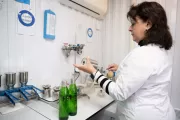
The Kramatorsk Water Utility purifies river water according to the required standards. Although the enterprise has not yet restored all its capacities, it provides quality water to almost 100,000 residents of the city and surrounding villages. In laboratories, water is tested according to a strict schedule. Specialists say that the water flowing from taps is well purified, so it can be safely drunk.
UNICEF continues to support frontline cities in the Donetsk region, as well as helping to repair and rehabilitate water infrastructure across the country, so that children and their families do not lack one of the most essential things in life – water.
The emergency assistance has been made possible thanks to the support of the governments of France, the United Kingdom, Norway, Japan and the United States Agency for International Development (USAID).