Home health care helps families in Ukraine to thrive
Family nurses are supporting early childhood development and offering essential guidance to parents.

- Українська
- English
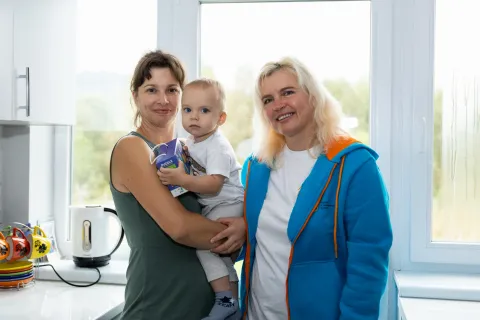
Today, 17-month-old Roman and his mother visited a healthcare centre for a scheduled appointment with Maryna, their family nurse. But instead of a typical consultation room, they were welcomed in the centre’s ‘Care Space’ – a specially designed area, created with the needs of young children and their parents in mind.
The ‘Care Space’ is a comfortable, safe and child-friendly environment intended for families with children under the age of four, created as part of the Home Visiting Programme. Every detail has been thoughtfully considered – from soft furnishings and toys to convenient changing tables and a dedicated breastfeeding area. This kind of space helps reduce anxiety during check-ups and encourages open, trusting communication between the family and the healthcare professional.
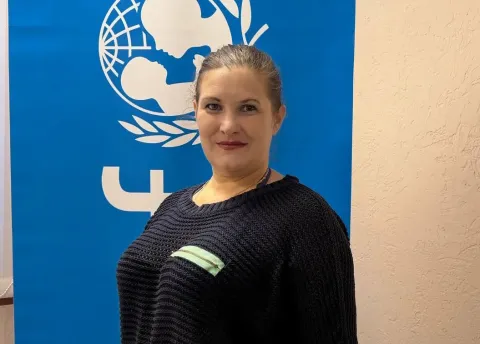
Nurse Maryna Barinova, who has been working for over a year as part of the Home Visiting Programme run by Ukraine’s Ministry of Health and UNICEF, supports families like Roman’s by offering guidance on children’s health, development and daily care.

“We met when I was still pregnant,” recalls Nataliya, Roman’s mother. “Maryna told me about the programme and, just a week after I gave birth, she visited us at home.”
Since then, Maryna has helped Nataliya navigate a range of challenges, from breastfeeding to coping with colic. On one visit, she noticed something Nataliya had not.

“She noticed that Roman was holding his head in an unusual way. I honestly wouldn’t have spotted it myself. But she suggested we see a paediatrician – and thanks to that, we were able to detect early signs of torticollis and treat it in time.”
Nataliya also has another son, three years Roman’s senior. She often turns to Maryna for advice on how to support the relationship between the two brothers.
“In line with the national programme, meetings with families take place in a mixed format – some are held at home, others at the facility,” says Maryna. “But regardless of the setting, each visit is a comprehensive consultation on child development that lasts an hour and a half to two hours. That’s enough time to calmly discuss all the important topics.”
During today’s visit, Maryna discusses Roman’s newly acquired skills, offers advice on nutrition – including which seasonal foods could be added to his diet – and helps Nataliya plan his next round of vaccinations.
“Timely vaccination is absolutely vital. We talk about both the routine immunizations on the national schedule and the recommended vaccines that offer added protection. Often, after these conversations, parents choose to catch up on any missed vaccinations themselves or arrange booster doses.”

Maryna currently supports 78 families with children under four. She provides guidance on everything from physical development to emotional wellbeing. Often, it is during these quiet, focused conversations that issues needing closer attention are first identified and addressed together with the parents.
The Home Visiting Programme is implemented by the Ministry of Health of Ukraine in partnership with UNICEF, with additional support from the Government of Japan, the German Federal Ministry for Economic Cooperation and Development (BMZ) via the German Development Bank (KfW), and Citi.
The programme is currently being implemented in 15 regions of Ukraine. Аs of May 2025, around 900 home-visiting nurses and 471 doctors from more than 250 primary healthcare facilities in 15 oblasts and Kyiv have supported around 20,000 children from 0 to 4 years old and 33,085 parents and caregivers.