Graduating amid wartime, shelters help children to finish the school year in class
Newly equipped shelters mean that children in Zaporizhzhia are able to return to school.

- Українська
- English
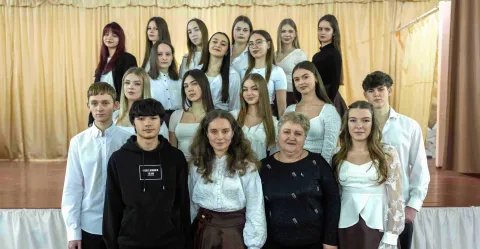
Today is a special day for 10-year-old Vova from Zaporizhzhia. He puts on his embroidered shirt, picks up a bunch of flowers for his favourite teacher and walks to school with his mother. There, his very first graduation awaits, marking the end of Year 4.
But this is no ordinary graduation – it will not take place in the school’s assembly hall but in its bomb shelter, amid wartime.

Vova remembers that in 2021, during year one, he only managed four months of in-person learning due to COVID-19. Just six weeks later, the war began.
“It was really sad. You just sit there with your tablet, doing nothing. Breaks are short, you don’t see your friends. And you don’t know how to do the tasks properly.”
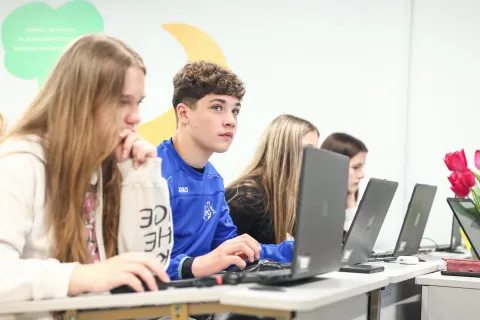
Since March 2025, the school where Vova studies resumed in-person learning, thanks to a newly built and equipped shelter, supported by UNICEF and the European Union. At last, the pupils who stayed in Zaporizhzhia could finally see each other again at school.

“I was against in-person learning before there was a shelter. Once a safe shelter was opened, I realised he needed interaction – to see his teachers and be among his peers. School offers much more than just lessons through a tablet. My son really needs this, both for his learning and for his emotional wellbeing. He’s happy to go to school.”
Kateryna Kikosh, Vova’s form teacher, recalls that when in-person classes resumed, the boy was one of the first to rejoice and return.
“He really wanted to get out of the house and be with his friends again,” says Kateryna. “And he truly blossomed.”
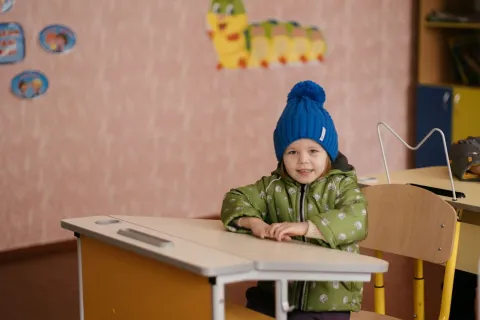
The shelter includes classrooms equipped with all the necessary furniture and learning materials, a large assembly hall and comfortable toilets. There is also now an after-school group where children do homework, play board games, build with construction sets and take part in creative activities.

“We’ve only recently moved into the shelter, but we’re already seeing improved academic performance,” says Kateryna. “The children have learned how to be together again. At first, they were withdrawn and shy. But gradually, trust and openness began to grow. The children are sincere, lively, emotional. We see how they’re opening up, communicating, developing. Online learning didn’t give them that. School is the place where they get to be themselves again.”
Vova says that his favourite subjects are IT and maths.
“I always get 11 or 12 in IT now. And in maths, I get between 9 and 12. At home I often didn’t understand the tasks, but here I can ask the teacher right away.”

Vova also sings in a choir and is learning to play the guitar. And when asked what he dreams about, he answers quietly: “For the war to end and for my dad to come back.”
“This is my first graduation. We’ll finally all be together – playing, dancing, having fun. And I’m really happy to be moving on to Year 5. There will be new subjects and, I hope, kind teachers.”


UNICEF supports Ukraine’s national ‘Back to School’ strategу. In Zaporizhzhia alone, 11 more school shelters will be completed by the start of the next academic year, made possible through financial support from the European Union and the governments of Norway and Spain. These restored and safe shelters will enable 5,599 pupils to return to in-person learning. Once all the planned shelters in Zaporizhzhia have been renovated and equipped – with support from international organizations, donors and co-funding from local authorities – more than 60,000 students will be back at their desks, representing 80 per cent of all school children in the city.