Nurses help drive home visiting programme for children in Ukraine
Thanks to a fleet of new cars donated to medical institutions across Ukraine, nurses are able to support children and newborns living in remote areas.
- Українська
- English
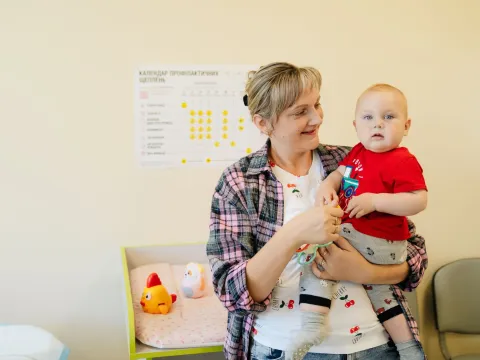
“I'm still a little nervous about driving, but I have to go because Daniil is waiting for me,” says Svitlana Kuts, a nurse from Ukraine’s Poltava region, as she fastens her seatbelt in the new car. Having recently learned to drive, this is yet another new skill she is putting to excellent use.


The car, one of 40 donated to medical institutions across Ukraine by the Spanish Government and UNICEF National Committees in Spain and the Netherlands under the Home visiting programme, helps her to visit young patients who live in hard-to-reach areas.
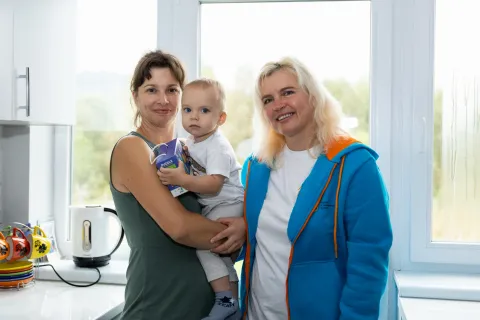
Today, Svitlana is on her way to the remote village of Vyrishalne, where 10-month-old Daniil and his family live. She has been visiting Tetiana, his mother, since her pregnancy.

“At home, children feel more comfortable and nurses can observe them – how he or she crawls, how he or she behaves. You can't do that in a clinic.”
Svitlana was among those who helped the family when they first moved to Vyrishalne, after fleeing the Donetsk region in 2023 due to the ongoing war.
“Our friends lived in Vyrishalne, so we decided to flee here,” explains Tetiana. “It was hard at first, of course, but the people here are good, they helped us with everything. Svitlana helped us with adapting to the new place, because we decided to have another child. We talk about different topics, and we can discuss psychological issues. It helps a lot.”
The first three years of life are crucial for a child's healthy development. It is during this period that neural connections in the brain and the immune system are formed. Home visiting services can help to reduce risks to babies and young children and effectively change the trajectory of a child's life.


The programme makes it easier for young children and their families to access quality health, nutrition and development services in the first three years of life and is fully comprehensive.
“Breastfeeding, proper nutrition, vaccinations according to schedule, stimulation, establishing contact and bonding between mother and child – all of this helps a baby to develop, both physically and mentally,” says Svitlana.
Svitlana examines little Daniil, measuring his height, weight and body temperature.
“Some children greet me with a smile from the doorstep and stretch their hands out to me. In general, I just love children very much, so it motivates me.”


“If I don't know something or am concerned about something, I can ask Svitlana at any time, not just during scheduled home visits. She will always respond.”
The Home visiting programme is implemented by the Ministry of Health of Ukraine together with UNICEF, with the support of the Government of Japan, the Federal Ministry for Economic Cooperation and Development (BMZ) through the German Development Bank (KFW), and Citibank.
Home visiting nurses work in the city of Kyiv and across Ukraine: in Donetsk, Zhytomyr, Kirovohrad, Dnipro, Kyiv, Lviv, Poltava, Volyn, Zakarpattia, Kharkiv, Mykolaiv, Zaporizhzhia, Rivne, Chernihiv and Odesa regions, where nurses from almost 200 primary healthcare facilities provided home-based primary care services to more than 12,000 of children from 0 to 3 yo and more than 22,000 caregivers.