Catch-up classes help conquer barriers to education in Ukraine
Eight-year-old Liana, from Ukraine’s Dnipro region, eagerly attends catch-up lessons at her local digital learning centre.

- Українська
- English
Eight-year-old Liana loves school. However, until recently, she only saw her classmates on a computer screen, due to the ongoing war in Ukraine.
Back in 2022, amid the shelling, her family had sought refuge in Czechia. However, while they felt safer, online classes proved challenging. So, after a year, the family returned to their hometown of Apostolove, near Kryvyi Rih, where one school remained intact despite the shelling. In-person classes restarted in September 2024, but Liana has some catching up to do.
“Liana is doing reasonably well in mathematics,” says Iryna, the girl’s mother. “But the Ukrainian language was harder for her – grammar, spelling – all of that seemed quite confusing to her.”
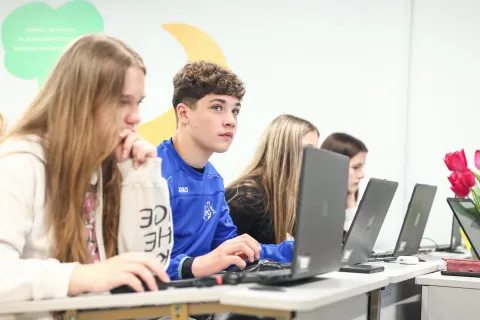
Recently, Iryna enrolled Liana at a digital learning centre in Apostolove. The centre was opened by UNICEF with support from the European Union and the Government of Luxembourg. There, specially trained tutors conduct catch-up lessons for school children.


Digital learning centres are specially-equipped spaces where students have access to modern tools for remote learning and catch-up lessons. These centres not only help children grasp new material but also provide them with psychosocial support. Mentors and teachers tailor the classes to each student’s needs. Digital learning centres operate in several regions in Ukraine, including Cherkasy, Kryvyi Rih, Kharkiv and Sumy.
“Many have forgotten the multiplication table”
Liana started attending these catch-up lessons in September 2024. In Apostolove, programmes are available for those studying mathematics, Ukrainian and English in Grades 5, 7 and 10. Primary school students also have the opportunity to attend lessons where they can learn mathematics and Ukrainian in an engaging and interactive format. Each subject includes 24 lessons, and the hour-long classes are held twice a week.
Vladyslav, a tutor and mathematics teacher at the Apostolove digital education centre, says teaching students during a full-scale war can be challenging, amid frequent air raid alarms, power outages and the forced displacement of many children. He believes lessons at the digital education centre are highly effective in helping children to absorb new material.
“Children came to us after three years of being stuck at home – first because of the quarantine, now because of the war. Many have even forgotten the multiplication table, yet they are expected to learn more advanced topics. Additionally, at home, students can often miss lessons – they might turn off their cameras and not listen to the material because there’s no adult supervision.”

Another challenge is students' mental health, with the constant stress and anxiety caused by the war significantly reducing their motivation to study. Digital education centres help children to feel a sense of normalcy through interaction with peers and engaging material.
Vladyslav also highlights the benefits of the programme for the centre's tutors.
“A huge advantage is having access to an extensive library of materials,” he says. “Teachers don’t have to stay up all night trying to design lesson formats because everything is already provided in the guidelines. Moreover, methodologists are available 24/7 if anything is unclear. At the same time, we have the freedom to add our own elements to the programme if we wish.”
“There are already positive results”
At the beginning and end of the programme, students undergo testing to assess their knowledge levels before and after the catch-up lessons. Vladyslav says that since the centre opened, based on the results from the first two programmes, students' knowledge levels have improved by an average of 20 to 30 per cent.
Vladyslav has noticed significant progress with students like Liana.
“She’s active and always raises her hand,” says Vladyslav. “She’s very interested in mathematics. Liana is a bright and cheerful girl. Like most students, her knowledge level had dipped a bit, but she worked diligently and there are already positive results."


Iryna has also noticed her daughter’s progress.
“She’s started doing her homework independently,” she says. “Previously, I had to supervise her very closely and check everything, and it was quite difficult for us. Now, she’s become much more self-reliant. I also really like our teacher, both as an educator and as someone who always finds the right approach to both students and parents. It’s immediately clear that she’s in the right place.”
UNICEF’s catch-up education programme enabled over 120,000 children to catch up with their learning in 2024, helping prevent further learning loss. Overall, nearly half a million children were able to access comfortable and well-equipped learning environments in 2024 with the support of UNICEF and partners.