4.6 million children in Ukraine face ongoing educational barriers as fourth academic year during war begins
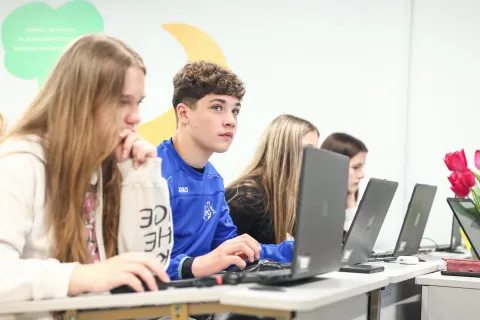
Children start another school year during wartime and ahead of the coming freezing winter months, but despite challenges they are determined to learn with support from dedicated educators across the country.

- Українська
- English
KYIV, 01 September 2025 – On the eve of the fourth consecutive academic year during the full-scale war, 4.6 million Ukrainian children are returning to learning despite numerous challenges. With classrooms damaged, lessons interrupted, and millions still displaced, the ongoing hostilities threaten to deprive a generation of their right to education and social-emotional development — putting the country’s long-term recovery at risk.
At the end of the 2024/25 academic year, over one-third of students were not fully learning in classrooms and 11 per cent relied exclusively on online education, according to data from the Ministry of Education and Science. More than 10 per cent of educational infrastructure has been damaged or destroyed between February 2022 and December 2024.
“For children exposed to the horrors of war, the start of the school year is about hope for an education free of disruption that is critical for their development and well-being,” said Munir Mammadzade, UNICEF Representative to Ukraine. “Despite the challenges, children are determined to keep learning and to realize their right to education, whether in basements, metro stations, or online,” added Mammadzade.
Educational facilities are now better prepared to provide in-person and blended learning, with 90 per cent of schools having some form of shelter but the impact of the war on the education system has been immense.
For preschoolers, where the foundation for learning and development is set, the disruption is especially severe. Many have never attended kindergarten, and in frontline regions, 83 per cent of young children show signs of emotional distress and delayed development. The structured play, interaction and learning that preschools provide are essential for early childhood development and a child’s educational journey into adulthood.
Ukraine's new law on preschool education is an important step forward to improve access to safe, inclusive and quality early learning and care. UNICEF is supporting the development of related new standards and the piloting of diverse models of early education, including through mobile preschools, workplace-based care, and community centres.
UNICEF’s support to the education sector spans both emergency response and recovery, aligned to government priorities and reforms, to improve continuity of learning and to build the long-term resilience of Ukraine’s education system.
“The recovery and development of Ukraine rely on building the human capital of tomorrow. This means engaging a broad alliance of partners to support education for every child across the country,” said Mammadzade.
In the first half of 2025 alone, UNICEF has supported more than 224,000 children through improved access to safe, inclusive and quality formal and non-formal education, including early learning.
UNICEF urges international partners to continue their support to Ukraine’s education sector as a non-negotiable investment in children and the country’s future.
Media contacts
About UNICEF
UNICEF works in some of the world’s toughest places, to reach the world’s most disadvantaged children. Across 190 countries and territories, we work for every child, everywhere, to build a better world for everyone. For more information about UNICEF and its work for children, visit www.unicef.org
Follow UNICEF Ukraine on Facebook, Instagram , Twitter та TikTok.