When a seed takes root
The story of Rwengobe’s Early Childhood Development Centre

The Rwengobe Early Childhood Development (ECD) Centre in Kamwenge District began with a simple mission: to give children a fair start in life. Just beyond the primary school, the air hums with the excited chatter of children, their tiny feet scampering as they spot visitors. You can hear the familiar excited chatter of children when they see visitors and are nudging each other to practice their welcome songs. Inside a sturdy structure built from thick logs and tree cuttings, tightly bound for stability, the children gather eagerly, ready to show off the songs they have practiced. A strong polythene sheet covers the floor, and two rooms brim with energy. One room, we’re told, holds about 150 children, standing shoulder to shoulder, raising questions about where they sit during lessons.
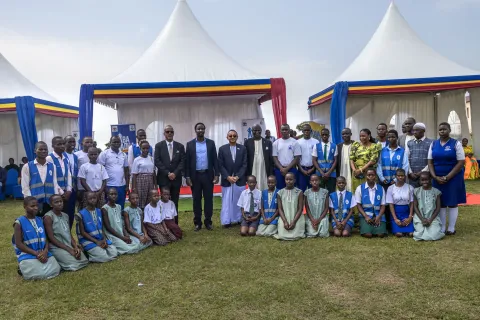
Since its establishment in January 2025, Rwengobe ECD’s enrolment has soared to 330 children, a testament to growing community trust. The centre was established following a collaboration between UNICEF and the Church of Uganda and The Church of Jesus Christ of Latter-day Saints.
“The number increases day by day!” says Erasmus Byabasheija, Head Teacher of Rwengobe Primary School, as children in baby class burst into a song about mosquitoes. In middle class, another group sings about a broom, its name first in their local language, then in English - in line with the MoES mandate of the use of local language as the medium of instruction. The thin walls do little to muffle the neighbouring class’s tune, yet the children remain unfazed. Colourful charts cover gaps between the logs, displaying the alphabet, dangerous objects, chores, and more, creating a rich “talking classroom” (a visual, print rich learning environment that supports early learning by simplifying study topics and making complex concepts easier to understand). Music, dance, and play weave seamlessly as well into learning.

Among the children is Atukunda Adrinne, who thinks she’s three or four. “I love school!” she whispers. “I eat, play, and learn new things!” She proudly sings an alphabet song.
The centre’s rapid growth has strained the school and community’s resources. UNICEF set up a tent as a backup classroom, but even that is full, with rows of tiny shoes at the entrance hinting at the numbers inside. “It’s impressive, but the packed classrooms are a challenge,” says Agnes Kembabazi, the ECD’s head teacher. “Our structures need cement and plaster for smoother learning.”
To manage, the centre increased caregivers from two to three, ensuring each class gets dedicated attention. Learning materials like counter books, jigsaw puzzles, and picture books spark curiosity. “Children see pictures and get happy,” Kembabazi says. “They tell others and more come.” Bishop Turyasingura from the Church of Uganda’s East Rwenzori Diocese adds, “Children learn from many sources, intentionally or not.”
Sustainability is at the heart of Rwengobe ECD. Parents, once sceptical of early education, now see its value. “They didn’t know before,” Byabasheija notes, “but now they say, ‘Education is good!’” Parents have donated doors and windows, while local leaders like Batalinyebwa Godfrey, the LC1 Chairman, mobilise families, sometimes using parish chiefs to enforce attendance.
“The Church of Jesus Christ of Latter-day Saints is collaborating with UNICEF, the Ministry of Education and Sports, selected District Local Governments to reach remote communities, through the three main faith-based organizations in Uganda – The Uganda Episcopal Conference, the Church of Uganda and the Uganda Muslim Supreme Council,” Daphne Mugizi, UNICEF ECD Specialist explains.
Their collaboration is bringing early learning education within reach for children who live as far as 5 kilometres from the closest primary school. Through the collaboration, over 4,552 children have been enrolled in ECD centres. UNICEF’s collaboration with the church provides teaching materials and caregiver training and works with the FBO structure and districts to mobilize communities and train centre management committees, emphasizing local empowerment. Fredrick Kamya from The Church of Jesus Christ of Latter-day Saints suggests making bricks locally for new classrooms, a step toward self-reliance. “As others support you, you must support yourself first.”
Parents like Tumuhimbisa Agnes, whose 4-year-old is enrolled in the ECD centre, beams with pride. “My child tells me what she learns daily, I have seen what ECD can do!” she says. Despite the limited income, parents pay UGX 25,000 shillings (US$7) per term. Olivia Nyinobusingye shares the struggles: “Mothers do it all. Some children can’t come because they live too far, and it’s unsafe for young ones to walk.” Charles Irumba adds, “My two children have sickle cell disease, which affects their education.” Yet, the community persists, donating materials and services and advocating for attendance.

Challenges remain, overcrowded classrooms, shared latrines, and no nearby clean water. Kembabazi pleads, “We need toilets so that these babies stop sharing with the older children, and a kitchen would really help too.” Still, hope endures. Phillip Limlim from UNICEF sees potential in quick wins, like a playground for which space exists. “We’ll keep mobilising with districts, churches, and parents so no child is left behind,” he says. UNICEF’s support, rooted in the 2016 National Integrated Early Childhood Development Policy, fosters sustainable systems through community engagement.
Aineamani Elizabeth, a Primary Four student teaching songs to the children at the ECD, captures its spirit: “Look around and see, life is new today.” Her words reflect Rwengobe’s promise - a centre sustained by community hands, faith-based roots, and UNICEF’s vision. By leveraging local resources and fostering ownership, Rwengobe ECD proves that collective effort can plant a seed and nurture its growth, ensuring children not only reach school but thrive there.
UNICEF does not endorse any company, brand, organization, product or service