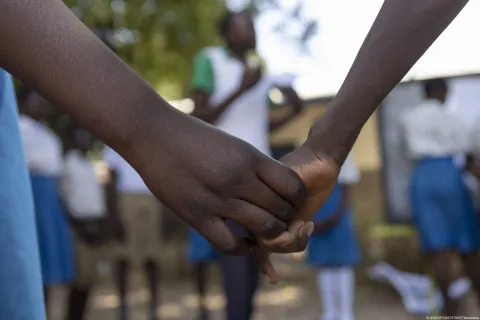
Teenagers pledge to abstain from sex to prevent pregnancies, school dropouts in Busoga sub-region
The First Lady, who doubles as the National Champion for the ‘Protect the Girl, Save the Nation’ campaign, urged participants to make good choices, defy societal pressures to engage in sexual activities and focus on gaining the right skills

"This campaign is a battle for the soul of the next generation. We must ensure that the girl child completes secondary school and is equipped with life skills as an empowerment tool. Your purpose as children is to learn; that is why you're in school. You are not there to start a marriage. Delay gratification and enjoy a future without HIV/AIDS and unplanned pregnancies,"
The ‘True Love Waits’ chant reverberated across Wanyange Girls' School in Jinja City, where 37 Secondary Schools from 11 districts converged on 29 September 2022 for a high-level dialogue to address defilement, child marriage, teenage pregnancy and promote positive parenting.
Over 2,400 students signed pledge cards to abstain from sexual intercourse to curb the skyrocketing teenage pregnancy cases in the country at the Youth Summit organized by the Organization of African First Ladies for Development Uganda - OAFLAD. The cards were presented to Mrs. Janet Museveni, the First Lady and Champion of Adolescent Girls during a high-level dialogue organized by the Government of Uganda in partnership with United Nations Children’s Fund – UNICEF and United Nations Population Fund – UNFPA with funding from SIDA.
As of March 2022, the District Health Information Software (DHIS) recorded an astonishing 378,790 teenage births in Uganda – seven per cent higher than the annual average of the last five years.
According to Mrs. Museveni, who is also the Minister of Education and Sports (MoES), the increase in the cases of teenage pregnancies, especially during the COVID-19 lockdowns, exposed the gaps in parenting and caregiving at home and is an indictment to parents and leaders at all levels to step up the charge to protect children.
The First Lady, who doubles as the National Champion for the ‘Protect the Girl, Save the Nation’ campaign, urged participants to make good choices, defy societal pressures to engage in sexual activities and focus on gaining the right skills to achieve their dreams.


Between March 2020, when Uganda entered her first COVID-19 lockdown and June 2021, there was a 17 per cent increase in teenage pregnancies, especially in rural areas, according to UNICEF Uganda's 2021 Annual Report.
The UN Resident Coordinator to Uganda, Susan Ngongi Namondo, noted that across other Africa countries, media literacy, a firm family structure and high educational attainment have been the major enablers in reducing teenage pregnancies, arguing that present and positive parenting is a vital behavioural change driver among adolescents.
"Adolescent girls have one of the highest maternal mortality rates in Uganda because their bodies are just not developed to carry a pregnancy to term," Namondo said, noting that 28 per cent of maternal deaths occur among young girls between 15-25 years.
Namondo further stressed that school dropouts due to teenage pregnancies cost girls and the country a great deal as low educational achievement leads to diminished future options, negatively affecting the overall trajectory of a country's development.
Launched in December 2021, the National Campaign championed by the First Lady, the Vice President, H.E Jessica Alupo and the Prime Minister, Rt. Hon. Robinah Nabbanja, with support from UNICEF Uganda and United Nations Population Fund (UNFPA), has returned 250 teenage mothers to school and provided more than 20,000 adolescent girls and boys with livelihood training and opportunities through their respective school clubs, said Joyce Atimango, the Trailblazers Mentoring Foundation (TMF) 's Executive Director.


Role of parents
While the campaign's focus is girl-centred, boys and men at school and home play a critical role in creating safe spaces for their counterparts to thrive.
As thus, Ambassador Jan Sadek, the Head of the European Union Delegation to Uganda, urged men, especially fathers, to be positive role models for their children for the harmful social norms and cycles of violence to be eliminated from society.
Some of the students who were interviewed for this article echoed Sadek’s remarks, admitting they felt safer at school than at home, mostly because their parents turn violent and abusive when confronted with conversations about sex.
“Due to work demands, parents no longer take care of their children’s information needs. I plead with parents to take time to know their children, understand what is on their minds and prepare them mentally for the world out there. It is the parent’s responsibility to bring up their children correctly,” said Rachel, a 14-year-old student at Wanyange Girls School.
Jolly, 16, a Senior Three student at Muljibhai Madhvani College Wairaka, feels safer at school because the Senior Woman Teacher is free with the girls and shares more about their challenges than her parents do.


“She tells us more about sex, how to avoid men and peer pressure than my parents. I used to stay inside the house at home to protect myself from men because I did not know how to deal with them. I believe that with more parental involvement, teenage pregnancies can be reduced in the communities," she said.
The Head Prefect at Wanyange Girls' School, Mable Achom, attributes the increase in teenage pregnancies in the country to the laxity of the law enforcement agencies to arrest and charge perpetrators of sexual violence against children.
According to the 2021 Annual Police Crime Report, only 6,191 cases of defilement out of 14,436 cases reported last year were taken to court.