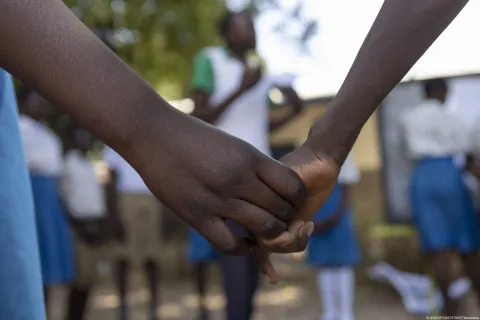
"Life was hard. There was no food, and the medical bills were too much..."
From teenage motherhood to hope

“Life was hard. There was no food, and the medical bills were too much. I wanted to leave this house and go wherever life was better.”
At just 16 years old, Dorika speaks with the weight of someone who has endured far more than her years should allow. Living in Waibuga Village, Block 3 of Kyangwali Refugee Settlement, she is the mother of a four-month-old baby boy she named Miracle. His name reflects both the trials she has overcome and the fragile hope that guides her forward.
For Dorika, teenage motherhood has meant being thrust into adult responsibilities without support, resources or preparation. Hunger gnawed at the family table, medical bills piled up and despair whispered that the only escape was to leave home and work as a housemaid just to keep her baby alive.
A new initiative is beginning to change that story. UNICEF, in partnership with Uganda’s Ministry of Gender, Labour and Social Development and the Office of the Prime Minister, and funding from the Government of Iceland, a cash transfer social protection programme is offering vulnerable adolescent mothers and their children a chance to break free from the cycle of poverty and exclusion. Dorika is among many teenage mothers in Kyegegwa and Kikuube districts who are benefiting.

During a recent joint visit to Kikuube by the Iceland Government delegation that included Palina B Matthiasdottir, Director Bilateral Development Cooperation, Ministry of Foreign Affairs, Iceland, Hildigunnur Engilbertsdóttir, Head of Mission & Sveinn H. Gudmarsson, Head of Cooperation at Iceland Embassy in Kampala, UNICEF and partners, the delegation reviewed progress of ongoing programmes, observed how interventions are benefiting communities and engaged directly with beneficiaries like Dorika. The visit also highlighted how integrated approaches – linking social protection, early childhood development and youth empowerment – are beginning to transform lives in refugee-hosting districts under immense social and economic pressure.
During the visit, Hildigunnur Engilbertsdóttir, the Iceland Head of Mission in Uganda, took a moment to hear directly from Dorika about her impressions of the programme. She asked how the initiative was shaping her life and future. Dorika responded with quiet confidence: “I want this programme to continue because this is opening our minds for the future.”
Sveinn Gudmarsson, Head of Cooperation at the Iceland Embassy in Uganda, was also keen to hear directly from the young mother. When he asked what had changed in her life, Dorika shared her journey with self-assurance:
“The first money I got helped me look after the baby who was sick then. I took him for private medical treatment. With the second payment, I have started a business to make Chikwanga [a cassava delicacy wrapped in banana leaves]. It was my idea, and my mother supported me. I put it on a basin, and I move around selling it.”

In a settlement where opportunities are scarce, this small business represents independence and dignity. For Dorika, balancing her basin of neatly wrapped Chikwanga on her head is more than just a livelihood strategy – it is a symbol of resilience and determination.
Her plans, as she revealed to the Iceland team, reach beyond survival. “I want to go back to school and attend to my business in the evening,” she says with conviction. Her dream is to one day become a doctor. “I want to get enough money for the better future of my child. If I can, I want to become a doctor.”
Her mother, Esther, only 27 years old herself, has seen the difference the programme has brought to their household. “The first change was that she had been very stressed. But after the cash, there is some food at home. The baby has gained some weight,” she explains. The family has also managed to buy mats so the children no longer sleep on sacks, and community attitudes towards Dorika have shifted from ridicule to respect.
This transformation is also supported by peer mentors like 24-year-old Nicolette Mbavazi, who works with young mothers in Kyangwali. “I can see real progress and changes in the young mothers such as Dorika,” she says. “In peering, we have analysed that even if a man persuaded us with UGX 10,000 [about US $2.90], they won’t be around to support you. I have testimony of one girl who had been married, and after the first cash payment on the programme, she left the man and rented her own place. She is now fighting to fend for her child.”
This is the essence of the UNICEF-supported cash-transfer model: financial support paired with mentorship, life skills, early childhood development services and linkages to health care and education. It is not charity; it is empowerment.
For Dorika, every wrapped piece of Chikwanga she sells, every shilling she earns, and every lesson she learns is part of a bigger journey – from despair to dignity, from exclusion to inclusion, and from survival to hope. She is not only building a future for Miracle but also standing as a quiet testimony that, with the right support, even the most vulnerable lives can be transformed.