

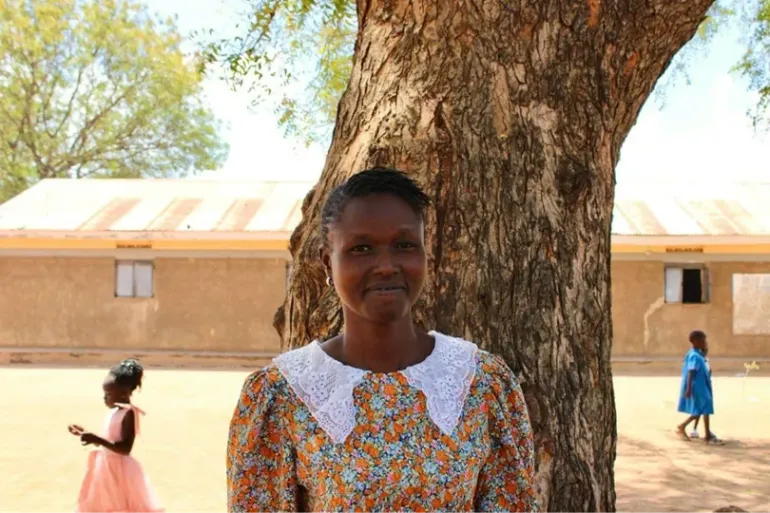
My name is Abu Janet Santa, the only ECD caregiver at Kotido Mixed Primary School, where I teach over 100 young learners. Thanks to VSO, with support from UNICEF and the Government of Ireland, I have received valuable training that has transformed my classroom. I learnt to make play materials, plan lessons, use bottle tops for counting, prepare schemes of work, conduct parenting sessions, and communicate effectively with parents. These skills have helped me create a class where children learn through play—singing, group work, rotating activities, and using real objects to learn concepts like counting and numbers.
We were also trained in child assessment. I now observe children during group activities, and this has helped me understand their abilities better. My classroom is full of instructional materials, which I make myself, and I follow a daily routine to keep learning consistent.
I have a girl in my class who cannot walk. We include her in every activity, ensuring that children see her as equal and treat her with love. Inclusion has become an important part of our classroom culture.
However, I face serious challenges. My classroom is open, and sometimes children take materials home, although they later return them. I raised this with the head teacher because the learning environment is not secure.
The biggest challenge is the lack of pay. I earn 120,000 UGX (US $34) per month, yet I often go months without receiving anything. Last term, I worked for three months and was paid for only one. This term, I have not been paid at all. As a single mother, I struggle to feed my children. I love teaching, but working four or five months without pay makes life extremely difficult. Many caregivers have already given up; that is why I am the only one remaining here.
The children are suffering too. They come to school without breakfast or lunch. Last year (2024), the World Food Programme supported the school with food, but this year (2025) nothing has come. By 10 or 11 a.m., many children fall asleep or become too weak to learn. Hunger is contributing to absenteeism and dropout.
We asked parents to contribute small items—sugar, soap, toilet paper—to help prepare tea or porridge, but many cannot afford to contribute. We hold meetings and send letters, but responses are limited.
I survive largely because of the support VSO provides during training sessions. If there were even a small, regular support—like mobile money—it would help us remain strong in our work. I am passionate about teaching, and I remain committed to my learners despite the hardships.
We continue working with hope. We want our voices to be heard so that ECD caregivers in Kotido and the region can receive the support and motivation they need to keep our youngest learners in school.