Breaking the cycle
Empowering teenage mothers and their children in western Uganda

In Kikuube and Kyegegwa districts, teenage pregnancy is more than a personal tragedy; it is a social emergency. At 28 per cent in Bunyoro and 21 per cent in Tooro, teenage pregnancy rates surpass both national and global averages. For girls, pregnancy often means school dropout, poverty and stigma. For their children, it means lost opportunities for early learning and a higher risk of repeating the same cycle.

A joint visit with purpose
Against this backdrop, a joint delegation from the Embassy of Iceland in Uganda, UNICEF and partners visited Kikuube District to see first-hand how Iceland-funded programmes are helping vulnerable adolescent mothers and their children. The visit aimed to review progress on implementation, observe how interventions are benefiting communities and demonstrate integrated approaches linking social protection, early childhood development (ECD) and youth empowerment. Importantly, it provided space for direct engagement with beneficiaries, district leaders and frontline workers – ensuring local ownership and sustainability remain at the centre.

A dual-generational solution
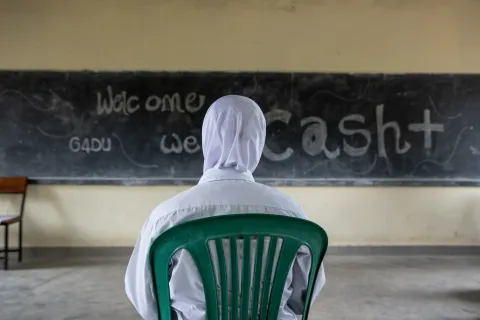
With funding from the Government of Iceland, UNICEF and the Government of Uganda have launched a bold initiative: the Cash-Plus social protection programme. It offers more than financial relief. It invests in two generations at once, giving teenage mothers the chance to rebuild their lives, while nurturing the growth, education and well-being of their young children.

Cash that builds hope
Each mother receives a cash transfer of UGX 45,000 (about US$12) per month. This amount is paid every two months, in a total of six payment cycles over a 12- month period. An additional 50 per cent top-up is provided for adolescent mothers of a child with disability. Delivered through cash transfers, the cash eases daily struggles – transport, food or childcare. But it does more: it sparks ambition.
Zainab, a 45-year-old mother living with disability, recalls: “In the beginning, life was hard. As you can see, I am disabled myself and I couldn’t help much. But now, the girl is baking cakes and supporting her child.”
Her daughter, 18-year-old Hajara, now earns a steady income: “I make and sell all my cakes twice a week. I go to the market at Kagoma on Tuesdays and then at Kasonga on Saturdays. I sell each cake for UGX 1,000,” (about US$0.29).

Learning to thrive
The programme links cash with opportunity. Through life skills training, mothers learn financial literacy, business skills and self-confidence. “I came when I could not talk to people, but now I’m confident,” a participant shares. Another adds, “I learnt personal hygiene for me and my child. I learnt teamwork. If you work together, you achieve a lot.”

Nurturing the next generation
The children of teenage mothers are not left behind. Over 3,200 children have been enrolled in early childhood development (ECD) centres. Mobile ECD units reach remote communities, while disability screenings ensure no child is excluded.
During the visit, Pálína Björk Matthíasdóttir, Director of Bilateral Development Cooperation in Iceland’s Ministry of Foreign Affairs, joined Village Health Teams in screening a baby – a hands-on moment that symbolized and illustrated Iceland’s commitment to investing in the future of children from the very start.

Eighteen-year-old Emmeline Inyeza, a volunteer caregiver with the mobile ECD centres, explains: “As we start the work, it isn’t easy because we don’t have enough teaching materials. But the work is rewarding, especially for these children.”

Peer mentors: Walking beside them
Twenty-seven trained peer mentors run safe spaces and visit homes. They provide guidance, referrals and encouragement. Allen Nakabo Ssali, UNICEF Uganda’s Social Policy Officer, notes: “Each peer mentor has 15 young mothers. They visit the homes and engage the girls one-on-one, and with their families, to check whether everything is okay with finances and budgeting. They also make referrals to the probation office on issues that the peer can’t handle, such as abuse.”

Systems that support
The programme’s strength lies in integration. Health, education, social protection and child protection services work hand in hand. Stella Ogalo, UNICEF Uganda’s Social Policy Specialist, explains: “We collaborate with different partners. For example, we are trying to link with NIRA [National Identification and Registration Authority] about the identification of these children; with health to strengthen child health and development; and with education to ensure learning pathways.”

Village Health Teams (VHTs), trained under the Iceland-funded programme, use specialized tools to detect developmental delays early. Joseph Arinaitwe, a VHT member at Kyangwali Health Centre IV, demonstrates: “We have different tools in the kit to help with the assessment of the child, such as coloured thread for sight, a bottle with pebbles for hearing, and a toy car for movement. The screening starts at birth and continues as the child grows.” Esau Atwongyeire of Finn Church Aid (FCA) further clarifies: “If you identify children early, most developmental delays can be corrected and limit developmental challenges in children. It also limits deaths.” FCA is an implementing partner of UNICEF Uganda.

Community ownership
Local leaders in Kikuube emphasize the programme’s impact. “Children must be supported to reach their potential,” said Canon Edward Musingye, the Chief Administrative Officer, Kikuube District. Uganda Youth Development Link (UYDEL) and FCA complement efforts with safe spaces and vocational training. UYDEL and FCA are both implementing partners of UNICEF Uganda on this programme. For Rogers Kasirye, Executive Director of UYDEL, the bigger picture is about restoration: “We have lots of girls who have become pregnant. This programme has come to empower them and give them skills. The matter is, how do you bounce back successfully? We can help the girls reconstruct and rebuild themselves and bounce back. But we need more research and stronger systems – from probation officers to peer mentors – to sustain the pace.”

A vision beyond the project
For the Government of Iceland, the goal is clear. “We want to break the generational cycle of teenage pregnancy,” said Hildigunnur Engilbertsdóttir, Head of Mission at the Embassy of Iceland in Uganda. “The government must see the benefits and take it up.”
Closing reflection
This programme dares to invest in two generations at once – teenage mothers and their children. The visit by Iceland, UNICEF, and partners highlighted both the progress and the promise: that when mothers are empowered, and children are nurtured, entire communities grow stronger.